


ConnectX-7 vs ConnectX-8: Comparing 400G and 800G for AI Clusters

NVIDIA ConnectX-7 and ConnectX-8 are focus on high-speed networking for AI, HPC, and data center environments, but they target different stages of network evolution. ConnectX-7 is associated with 400G NDR and 400GbE connectivity, whereas ConnectX-8 extends the platform to 800Gb/s XDR InfiniBand and flexible 400GbE configurations. Port speeds alone do not tell the whole story. However, PCIe connectivity, network protocol, transceiver form factor and the workload requirements also determine which generation an AI cluster makes more sense with.
What Are NVIDIA ConnectX-7 and ConnectX-8?
What Is NVIDIA ConnectX-7 Smart NIC?
NVIDIA ConnectX-7 is a high-speed network adapter designed for both InfiniBand and Ethernet environments. ConnectX-7 is available in different adapter configurations, including single-port 400Gb/s models with OSFP or QSFP112 interfaces, depending on the specific adapter. NVIDIA documentation lists single-port configurations supporting NDR 400Gb/s and 400GbE, as well as other lower-speed configurations.
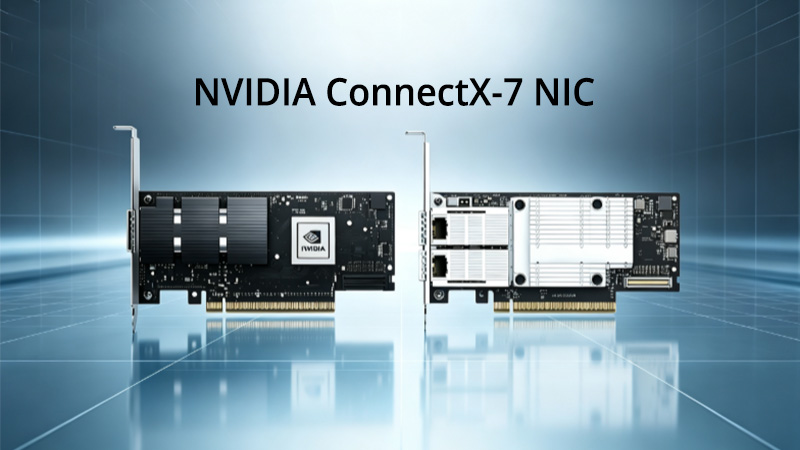
ConnectX-7 also supports PCIe Gen5 x16, providing the host interface needed for high-speed data transfers between the network adapter and server. Its capabilities make it suitable for AI training, HPC, cloud infrastructure, and other workloads where low latency and high throughput are important.
What Is NVIDIA CX8?
NVIDIA ConnectX-8 is the next generation of the ConnectX platform and is positioned for higher-bandwidth AI and data center networks. NVIDIA describes ConnectX-8 SuperNICs as supporting up to 800Gb/s of total network bandwidth.
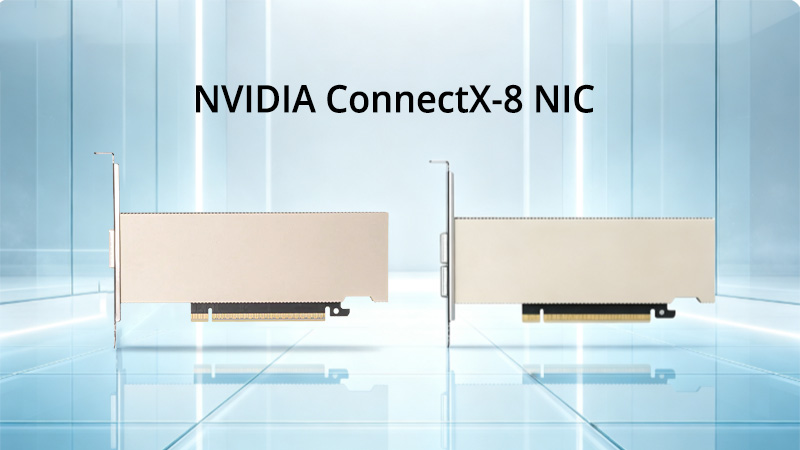
The C8180, for example, can operate with one InfiniBand XDR port at 800Gb/s or be configured as two 400GbE ports. This distinction is important: 800Gb/s XDR InfiniBand and 2×400GbE are supported configurations, rather than a single 800GbE Ethernet port. ConnectX-8 supports PCIe Gen6 connectivity and is backward compatible with PCIe Gen5.
ConnectX-7 vs. ConnectX-8: What Are the Key Differences?
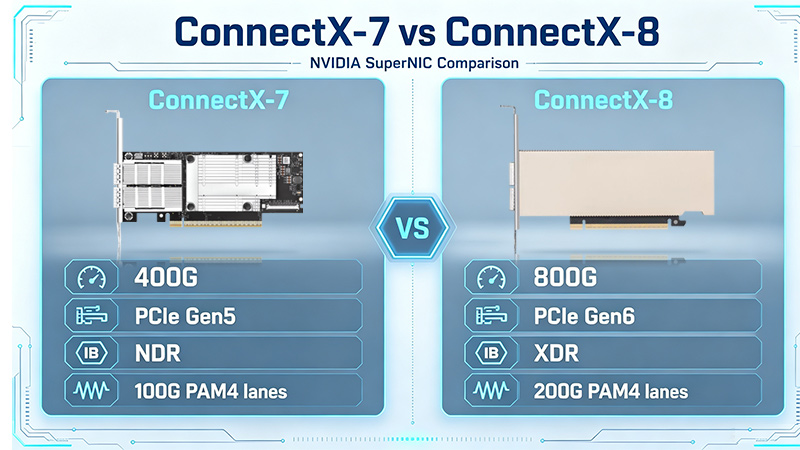
The most visible difference between the two generations is network bandwidth, but the upgrade also involves the underlying host interface and networking architecture.
400G vs. 800G Network Bandwidth
ConnectX-7 is well suited to 400G network architectures. A single-port ConnectX-7 adapter can support 400GbE or NDR 400Gb/s, depending on the model and configuration. ConnectX-8 raises the ceiling to 800Gb/s in its XDR InfiniBand configuration. NVIDIA's C8180 can also be configured as two 400GbE ports, providing flexibility for different network architectures.
When it comes to AI workloads, shifting from 400G to 800G can provide up to twice the per-port network bandwidth for GPU communications. As the number of GPUs scales and distributed training creates more eastwest traffic through compute nodes, this is an increasingly relevant usecase.
NDR vs. XDR InfiniBand
ConnectX-7 supports NDR 400Gb/s InfiniBand, using four 100Gb/s lanes. ConnectX-8 adds XDR 800Gb/s InfiniBand, using four 200Gb/s lanes. This higher per-lane rate is one of the fundamental reasons ConnectX-8 can provide 800Gb/s XDR connectivity. For large AI training clusters, higher bandwidth can help reduce network constraints during intensive distributed workloads.
PCIe Gen5 vs. Gen6
ConnectX-7 uses PCIe Gen5 x16 on supported high-speed adapter configurations. ConnectX-8 supports PCIe Gen6 x16 and is also backward compatible with PCIe Gen5. The host interface matters because a high-speed NIC needs sufficient bandwidth between the adapter and the server. Upgrading to an 800Gb/s network interface therefore needs to be considered together with the server platform, PCIe configuration, GPU architecture, and overall system design.
How Does ConnectX-8 Support 800G AI Clusters?
NVIDIA ConnectX-8 and 800G AI Networking
The main advantage of ConnectX-8 for next-generation AI infrastructure is its ability to support higher network bandwidth while providing flexible port configurations. The C8180 supports an 800Gb/s XDR InfiniBand configuration and can also be configured for two 400GbE ports. This makes ConnectX-8 particularly relevant to AI clusters where network traffic between GPUs and servers can become a limiting factor. Higher-speed networking can provide more bandwidth per high-speed port, which can help simplify network scaling in some cluster architectures.
ConnectX-8 for Large-Scale AI Training
Large-scale AI training relies heavily on communication between GPUs. Operations such as gradient synchronization and collective communication can generate substantial network traffic across a distributed cluster.
As GPU performance continue to increase, network bandwidth can become an increasingly important factor in large-scale AI clusters. ConnectX-8 is designed for this environment, offering 800Gb/s XDR connectivity, PCIe Gen6, and networking features aimed at improving AI cluster performance.
This does not mean that every AI cluster needs 800G. The actual benefit depends on GPU count, workload, network topology, and whether the existing network is already approaching its bandwidth limits.
When Is ConnectX-7 Still Enough for AI Clusters?
For many 400G AI and HPC networks, ConnectX-7 remain a viable option. For clusters that are already deploying 400G NDR or 400GbE, and where workloads do not saturate that capacity, the move to ConnectX-8 may not provide enough additional value to justify a full infrastructure refresh.
It can also make sense when the server platform, switches, optics, or cabling are designed around 400G. In these situations, ConnectX-7 can provide the required bandwidth without introducing the additional requirements associated with an 800G deployment.
What Transceivers and Cables Work with ConnectX-7 and ConnectX-8?
400G Transceivers and Cables for ConnectX-7
High-speed ConnectX-7 configurations can use QSFP112 or OSFP, depending on the adapter model. For example, NVIDIA documents ConnectX-7 adapters with single-port QSFP112 and single-port OSFP configurations supporting 400Gb/s connectivity. Depending on the network design, 400G optical transceivers, DACs, AOCs, and fiber cabling can be used to connect the NIC to compatible switches.
800G Transceivers and Cables for ConnectX-8
ConnectX-8 C8180 models use a single OSFP networking cage for their 800Gb/s configuration, while C8240 models use dual QSFP112 ports, with each port supporting up to 400GbE. Therefore, an 800G deployment needs to consider not only optical speed but also the physical interface and the specific ConnectX-8 model. Compatible 800G optical modules, DACs, AOCs, and fiber infrastructure should be selected according to the NIC, switch, distance, and network protocol.
ConnectX-7 and ConnectX-8 Compatibility Considerations
Speed is not the only consideration. When select a transceiver or cable, you should check the NIC model, port type, supported protocol, optical wavelength, data rate, transmission distance, connector type, and the interface on the switch side. For example, an 800G OSFP solution intended for a ConnectX-8 C8180 should not automatically be assumed to work with every ConnectX-8 or ConnectX-7 adapter. NVIDIA lists different interfaces and configurations across its adapter models.
ConnectX-7 vs. ConnectX-8: Which One Should You Choose?
Choose ConnectX-7 for 400G AI and HPC Networks
ConnectX-7 is a strong choice when the network architecture is centered on 400G. It is suitable for existing NDR networks, 400GbE environments, and AI or HPC clusters whose workloads can be handled effectively with 400Gb/s connectivity.
It can also be the more practical option when upgrading the network would otherwise require replacing switches, transceivers, cables, and server platforms.
Choose ConnectX-8 for 800G AI Clusters
ConnectX-8 is better suited to new, high-bandwidth AI infrastructures that can take advantage of 800Gb/s XDR connectivity. It is particularly relevant for large-scale AI training environments where network traffic between GPUs and servers is expected to grow significantly. However, the decision should be based on the entire network architecture rather than NIC bandwidth alone. Servers, switches, PCIe interfaces, transceivers, and cabling all need to support the planned configuration.
Conclusion
ConnectX-7 and ConnectX-8 represent different stages of high-speed networking for AI and HPC clusters. ConnectX-7 scales to 400Gb/s connectivity and fits well with many existing 400G deployments. ConnectX-8 extends the platform to 800Gb/s XDR InfiniBand, with PCIe Gen6 support and flexible port configurations for next-generation AI infrastructure.
For an established 400G network, ConnectX-7 can still offer the right balance of performance and infrastructure requirements. For a new large-scale AI cluster designed around 800G networking, ConnectX-8 provides a path toward higher network capacity. In either case, the NIC should be selected together with the appropriate switches, transceivers, cables, and server interfaces.


share

