


Everything You Should Know About 1.6T DR8

The 1.6T optical transceiver has emerged as a key technology in the development of AI model training, high-performance computing clusters, and cloud computing. These applications demand exponentially increasing bandwidth, necessitating the deployment of equipment supporting higher bandwidth. While 400G and 800G are still being deployed, the industry has begun evolving towards 1.6T Ethernet. This article will explore what a 1.6T DR8 module is, how it works, and its specific applications, helping you understand why it is a crucial component of next-generation data centers.
What is a 1.6T DR8
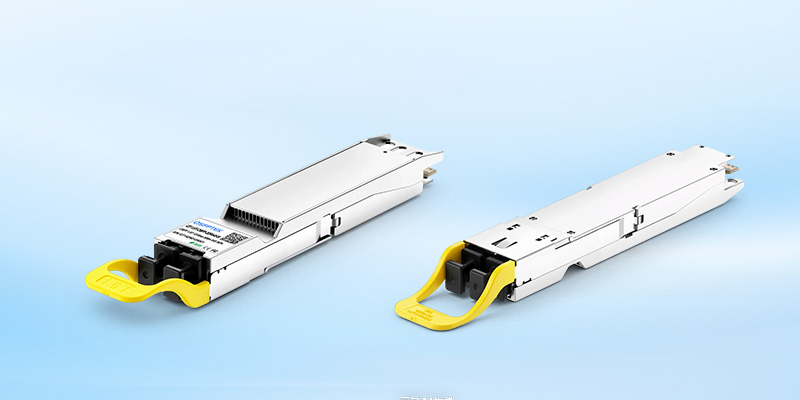
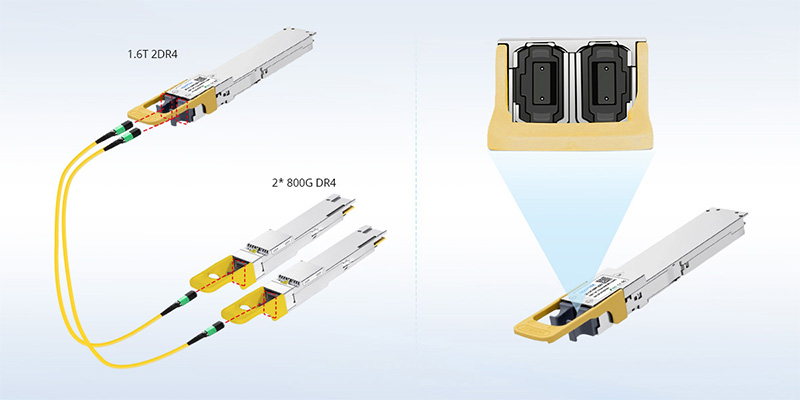
The 1.6T DR8 module is a high-speed, pluggable optical transceiver, based on an OSFP package, providing 1.6Tbps bandwidth in a dual-port module. Utilizing the DR8 design architecture, it can achieve a direct 1.6T connection from a single module or losslessly split into two 800GBASE-DR4 signals. It offers both ultra-high bandwidth and flexibility. DR8 represents dense transmission distance, featuring eight parallel optical channels, each capable of carrying 200G PAM4 signals, with the eight channels combined providing a total throughput of 1.6T.
The 1.6T DR8 has a transmission distance of 500m, designed specifically for short-distance data center interconnect scenarios, making it an ideal choice for high-density ridges, core networks, and AI cluster architectures.
How Does a 1.6T DR8 Module Work
The 1.6T DR8 optical module adopts an 8×200G PAM4 parallel transmission architecture. Unlike traditional NRZ modulation, each PAM4 symbol can carry 2 bits of data, doubling the single-channel rate without increasing the number of channels. This module has 8 transmission channels, achieving a single-channel rate of 200G. Internally, the electrical signals are first processed by an integrated DSP and driver circuit, converting the high-speed electrical signals from the switch ASIC into optical signals, which are then transmitted through the 8 parallel channels. At the receiving end, a photodetector restores the optical signal to an electrical signal, and the DSP performs signal equalization and error correction to ensure transmission quality. Because PAM4 is more sensitive to noise and distortion, the module enables FEC (Forward Error Correction) during operation to further improve transmission reliability. Simultaneously, the module supports DDM (Digital Diagnostics) and CMIS (Common Management System) protocols, enabling real-time monitoring of key states such as temperature, power consumption, and optical power, ensuring stable overall operation and easy maintenance.
Applications of the 1.6T DR8 Module
The main applications of the 1.6T DR8 module include the following:
AI Training Clusters
In AI model training, large-scale GPU clusters generate massive east-west traffic between nodes. As the number of AI model parameters increases, the demands on network bandwidth and latency also rise. The 1.6T module supports interconnection between switches and backbone interconnection, providing ultra-high network bandwidth and supporting Infiniband XDR, meeting the high bandwidth and low latency requirements of AI model training.
Hyperscale Data Centers
Due to the continuous growth in network bandwidth demands, data centers are also experiencing increasing bandwidth requirements. The emergence of 1.6T devices solves the problem of network bandwidth limitations. Deploying 1.6T modules and corresponding switches can meet various application requirements.
High-Density Spine Network Architecture
In high-density leaf-spine network architectures, switches aggregate traffic from hundreds of 400G or 800G downlinks. If the core switches still use 800G, it will not meet the demand, leading to an increasing number of core devices. Using 1.6T equipment can effectively reduce the number of ports required while maintaining the total network capacity, thus reducing maintenance difficulty.
Why Choose the 1.6T DR8
Ultra-High Bandwidth Density: Providing a single-port transmission rate of 1.6T, it significantly improves bandwidth density compared to 800G. This reduces the number of physical ports and fiber optic links required for the network core, facilitating future maintenance.
Scalable Upgrade Path: The 1.6T DR8 offers a reasonable upgrade path that aligns with the switch's upgrade direction. It avoids wasting initial infrastructure investment while preparing for AI-driven traffic growth.
InfiniBand XDR Support: QSFPTEK's 1.6T DR8 supports InfiniBand XDR, ensuring low-latency data transmission in high-bandwidth applications, contributing to business success.
Liquid Cooling Compatibility: The 1.6T DR8 RHS/Flat Top is compatible with both air cooling and liquid cooling solutions, eliminating concerns about module heat dissipation and seamlessly integrating with mainstream supercomputing and data center hardware ecosystems.
Flexible Deployment: The 1.6T DR8 features a dual-port design, supporting 2x 800G DR4 connections without the need for branch cables. This reduces cabling complexity and costs, and enhances networking flexibility.
Conclusion
The 1.6T module not only improves network speed but also represents a transformation in data center architecture. With AI workloads, hyperscale computing, and next-generation switching chips pushing network bandwidth demands to over 800G, 1.6T connectivity has become a necessity. The 1.6T DR8 module, offering flexible cabling and supporting both InfiniBand XDR and air/liquid cooling, is undoubtedly the ideal choice for your data center upgrade.


share

