


Massive AI Workloads Are Coming: What Changes Is Data Center Infrastructure Undergoing?

As AI workloads expand across servers and racks, the final performance of the entire system increasingly depends on the coordinated operation of elements such as computing power, networking, storage, power supply, and cooling. While peak parameters on paper are important, they no longer fully represent the effective throughput, scalability, or overall operating costs of a cluster.
This forces everyone to elevate their perspective to the rack and entire cluster level when planning and evaluating AI infrastructure. This shift in thinking is reshaping the design, expansion, and deployment of data center underlying architectures, making comprehensive planning, system-level verification, and deployment readiness more crucial than ever before. This article will examine these changes and the practical challenges they bring to large-scale AI infrastructure.
AI-Driven Data Center Infrastructure Transformation
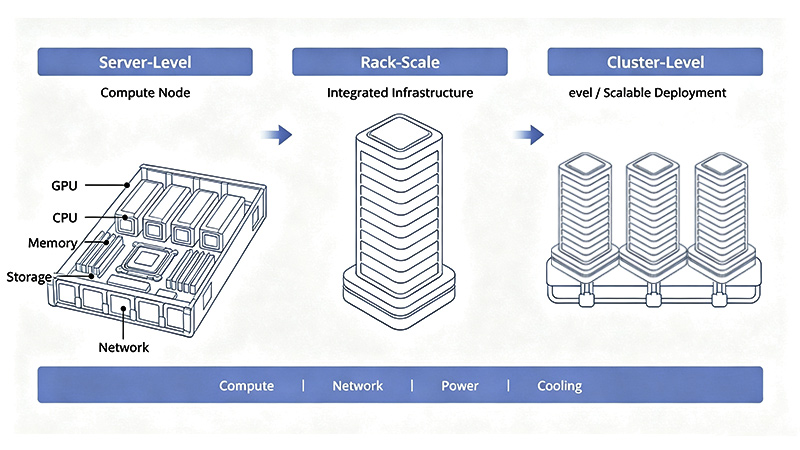
For distributed training or large-scale inference, accelerators must constantly exchange data. This makes network interconnection, storage access, power supply, and cooling capabilities extremely critical to the stability of the entire system. Therefore, current infrastructure planning has long since moved beyond single-server deployments, extending to high-density racks and even multi-rack clusters. While servers remain the most basic computing nodes, racks and clusters are becoming more core architectural design units.
NVIDIA's GB300 NVL72 is a prime example of this "rack-level" approach. In their enterprise reference architecture, a liquid-cooled GB300 NVL72 rack is treated as a standard independent expansion unit, integrating 18 compute trays and 72 GPUs. To create a larger computing pool, multiple such rack-level units can be connected and horizontally expanded through dedicated compute networks, converged networks, and management networks.
This architecture cannot be used efficiently by just putting a bunch of high-performance servers together. For fast communication between nodes and easy future growth, network cabling, interconnects, power delivery, and liquid cooling solutions need to be integrated into the overall infrastructure design from the beginning.
High-density server racks not only place enormous demands on the power supply and liquid cooling capabilities of the data center, but the massive east-west traffic between GPUs and servers also poses a greater challenge to network bandwidth, topology, and scalability.
Therefore, when planning computing clusters today, the core questions are no longer simple:
AI Computing Power Performance: Hardware Upgrades Alone Are Not Enough
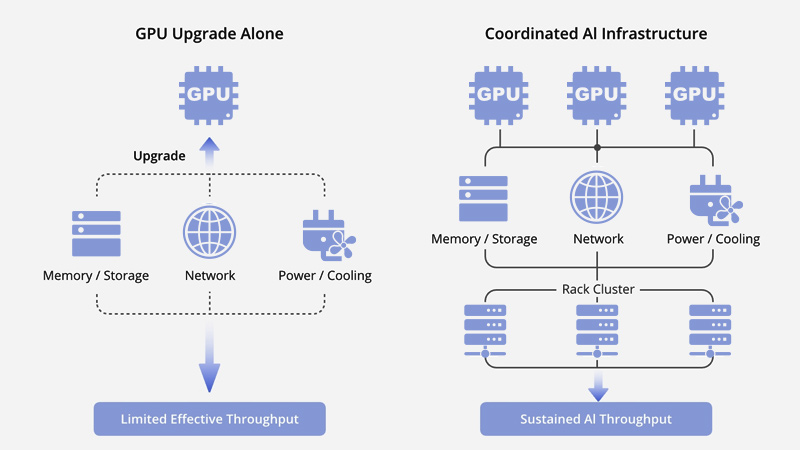
Simply adding higher-performance hardware can indeed improve AI systems, but the extent to which this value is realized depends on whether the underlying infrastructure can truly translate the theoretical capabilities of these devices into actual output during business operations.
Data Pathway Efficiency
Storage throughput, memory bandwidth, along with data preprocessing and input channels, collectively determine whether the accelerator can receive data on time. If data transmission is even slightly slow, the tempting theoretical computing power of the GPU will be wasted. Furthermore, storage performance directly impacts model checkpointing, fault recovery, feature retrieval, and intermediate data processing. Therefore, the standard for measuring this capability is not to focus on the parameters of a single hard drive or memory module, but to assess whether the entire data path can support the actual business workload.
Actual Benefits of Network Communication
The bandwidth advertised by manufacturers for network cards and switches usually only represents the available physical capacity and does not equate to the actual speed achieved when running applications. From network topology, overcapacity, and network congestion to optical links, cabling, software configuration, and even the performance of the terminal itself, everything affects the actual utilization rate of the network by the computing cluster. Often, even if faster interfaces are used to increase the communication limit, the performance improvement on the application side may not be proportional.
The Scale Effect of Cluster Expansion
Adding GPUs can indeed increase the total computing power, but business performance will not necessarily increase proportionally. The additional overhead of node synchronization, task scheduling, multi-machine collaboration, and communication will gradually eat up the benefits of the newly added hardware.
Therefore, when designing infrastructure, peak parameters are certainly a must-see indicator, but they must be comprehensively considered in conjunction with the actual utilization rate of the accelerator, effective throughput, expansion efficiency, and the final task completion time.
As AI Infrastructure Scales Up: Several Hurdles Ahead
Scaling up AI infrastructure is not only a technical challenge but also requires careful business calculation. Enterprises need to consider not only how much additional capacity they can add but also how long it will take for this computing power to be truly deployed and how efficient its conversion will be.
The Limits of Physical Infrastructure
Once you reach the rack and cluster level, network expansion is not simply about increasing network speed. Port density, switch placement, cabling, optical module transmission distance, traffic models, and oversizing ratios all need to be replanned. A network that performs well in small-scale deployments may require a complete architecture overhaul as the cluster grows larger.
Power supply and cooling also pose severe limitations. Insufficient power or inadequate cooling will not only limit rack density and reduce the number of accelerator cards installed but also slow down the expansion process. Insufficient cooling headroom can also cause machines to experience frequency throttling or operational limitations under high loads.
Therefore, cross-rack deployments often have far-reaching consequences, requiring adjustments to network topology, storage architecture, power supply and distribution, cooling, and even subsequent service access and management processes. How to increase capacity without causing unbalanced integration costs or performance degradation is a major challenge.
Capital Investment and Implementation Timeline
The scale of the investment goes well beyond GPUs and servers. Networking, storage, racks, optical communication interconnects, various cables, plus power supply and cooling infrastructure, data center renovations, and maintenance tools—each line item is a major expense.
Moreover, from procurement to the actual deployment of computing power, there are several stages: data center preparation, rack cabling, software configuration, interoperability testing, business verification, and final handover. Any bottleneck in any of these stages will delay the entire cluster's delivery and availability.
Equipment Utilization and Technology Upgrade Anxiety
The value of an AI cluster cannot be measured solely by its computing power. Equipment utilization, energy consumption, daily maintenance, management costs, and underutilized machines all contribute to increased overall operating costs.
The rapid pace of hardware iteration, with quick changes in accelerators, networks, single-point power consumption, and liquid cooling technology, is constantly shortening the lifecycle of infrastructure planning. Enterprises must strike a balance between their current computing power needs and the potential risks of future scalability and modification difficulties.
Multi-vendor Interoperability
AI infrastructure typically consists of a collection of equipment from multiple vendors. Network cards, switches, optical modules, cables, servers, and a wide variety of firmware and software all require rigorous compatibility verification before being deployed to production.
To minimize integration and troubleshooting risks, specifications should be defined early, certified combinations should be tested, and the support responsibilities of each party should be clarified.
Ultimately, this is a comprehensive business game: finding the optimal balance between capital investment, computing power availability, equipment utilization, daily operating costs, and the long-term flexibility of the architecture.
Large-Scale AI Infrastructure: Planning and Validation
The infrastructure requirements for modern AI are escalating. Much more than selecting individual components drives hardware selection; it has to be holistically considered in the context of the full system architecture and the workload.
Global Planning
Computing power, network, storage, plus power supply and cooling—these core components must be planned holistically based on your business needs, deployment scale, rack density, and future expansion plans.
Specifically, network topology, the adequacy of optical module transmission distances, cabling routes, power distribution, cooling methods, storage access, data center physical layout, and future expansion plans—all must be clearly defined in advance. This saves considerable trouble and avoids extremely costly rework due to device incompatibility during actual deployment.
System-Level Validation
Looking at hardware specifications on paper alone is insufficient to determine the usability of an AI infrastructure. To have complete confidence, a comprehensive system-level verification is necessary, primarily including:
Compatibility between various hardware components;
Smooth interoperability between network and optical communication modules;
Sustainable performance of storage and the entire data path;
Normal communication during real-world business operations;
Stable operation under full load for extended periods;
Stable power supply and cooling performance;
Efficiency degradation during cross-node and cross-rack expansion.
Only by completing this entire process can you be certain that your infrastructure is absolutely reliable under real-world loads, rather than just achieving impressive scores in individual component tests.
Deployment Readiness
Deployment readiness is not just buying all the hardware. Standardized configuration templates, validated bills of materials (BOMs), compatibility testing reports, proper documentation, installation procedures, and clear troubleshooting responsibilities—all this soft readiness is required to bring your cluster online and deployed as fast as possible.
Looking ahead, the process of building AI infrastructure will no longer depend solely on who has the most powerful machines, but rather on how effectively these devices are planned, connected, and tested so that they can work together as a fully functional whole.
Conclusion
Modern AI data centers have long since moved beyond the era of "single-point device optimization," shifting entirely to system-level collaborative operations. While impressive peak performance parameters still hold value, the actual utilization of AI computing power increasingly depends on the coordination of computing power, network, storage, power supply and distribution, cooling, and the entire deployment process. For enterprises, the real need is an underlying architecture that translates the theoretical capabilities of hardware into highly flexible, reliable, and cost-effective actual business capacity.
For network and interconnect needs, QSFPTEK provides a complete solution, including high-speed switches, network interface cards (NICs), optical modules, and structured cabling. As a crucial component of the system-level architecture, these components effectively improve overall network compatibility, total bandwidth, scalability, and deployment readiness, effortlessly handling extremely demanding AI workloads. We welcome you to further explore QSFPTEK's AI solutions and build a highly flexible, rigorously proven interconnect foundation for your computing clusters.


share

