


Eth-Trunk
Author Moore
Date 08/16/2024

What is Trunk
The data frames processed inside the switch all carry VLAN Tags. However, when two switches are interconnected, one or more interfaces often need to send and receive data frames with different VLAN Tags.
To this end, Cisco defines an interface link type called TRUNK. For a TRUNK link, this link type can carry multiple data frames with VLAN TAGS, and can classify data frames without VLAN TAGS as the default VLAN by setting PVID.
What is Eth-Trunk
ETH-TRUNK can solve the problem of low interface bandwidth. By bundling multiple physical links into one virtual link, the bandwidth can be the sum of the bandwidths of multiple interfaces. In addition to this advantage, redundancy is also increased. When a logistics link fails, traffic data can be transferred to other available links. And within a link aggregation group, load sharing can be achieved on each link.
Assume that there are currently 6 bandwidths, and one physical link can provide 10G bandwidth, and only 40G bandwidth is currently needed. You can set the upper threshold of the active interface to 4, and the remaining 2 links will automatically enter the backup state to improve reliability. The setting of Eth-Trunk is very simple and is only applied between adjacent devices. It is irrelevant to the entire network structure and is a very common configuration.
Mode of Eth-Trunk
Link aggregation mode is divided into manual mode and LACP mode.
Case of Eth-Trunk
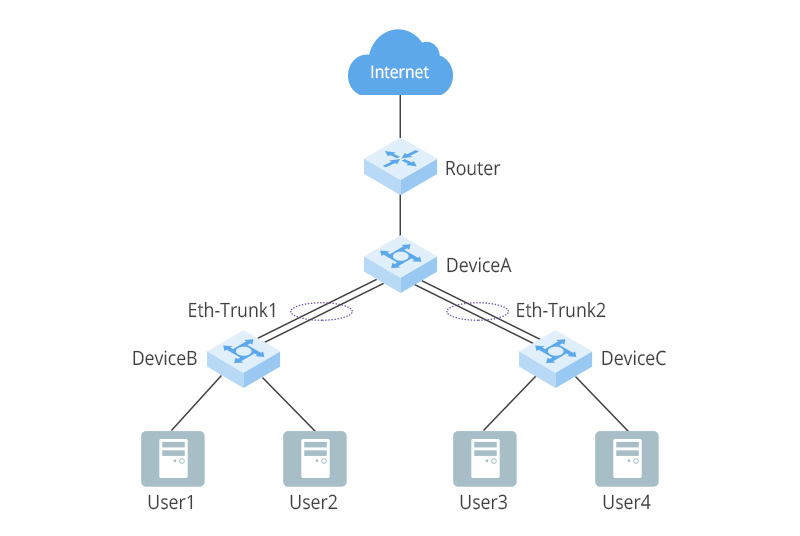
The enterprise's access layer switches B and C are connected to the aggregation layer switch A, and DeviceA communicates with the external network through the egress router. As the user scale continues to expand, users visit each other more frequently. The links between A and B or A and C must have sufficient bandwidth to carry the visits of different users, and the links must have a certain degree of reliability.
To ensure the link bandwidth and reliability between Switch A and Switch B, and SwitchA and Switch C, Eth-Trunk 1 and Eth-Trunk 2 can be established between them respectively.


share
