


AI Training vs. AI Inference: Why They Demand Different Network Architectures

As enterprises accelerate the adoption of AI, AI training and AI inference are increasingly appearing in the same infrastructure strategy. However, treating them as similar workloads can easily lead to pitfalls in network planning. In reality, the difference between training and inference goes far beyond the application level; they correspond to completely different performance goals, traffic characteristics, and operational priorities. This dictates that a network architecture cannot rely on a single traffic scheduling model to handle both ends simultaneously.
What is AI Training?
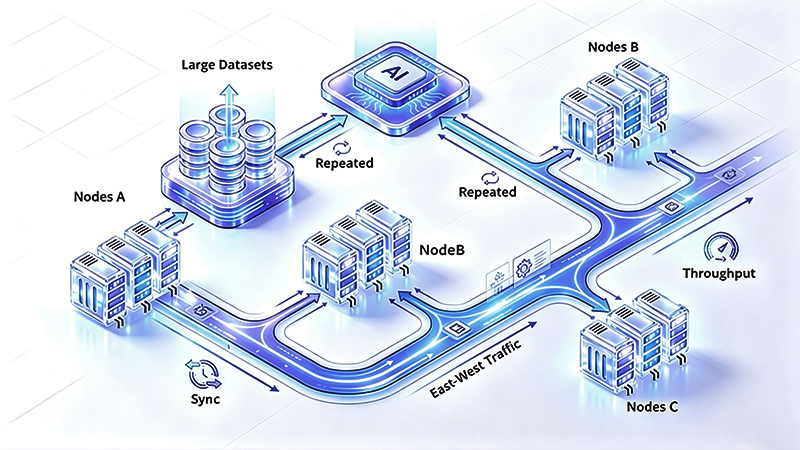
Training AI involves building and continuously improving a model from the beginning using a lot of data and repeated calculations. The goal is simple: in a large, distributed environment, the aim is to improve model accuracy while minimizing training time.
In most cases, training AI generates a lot of network traffic between GPUs, servers, and clusters. This kind of workload depends a lot on having enough bandwidth, good synchronization mechanisms, and predictable throughput. So, when they're designing networks for training environments, they usually focus on keeping data pipelines at full capacity, eliminating communication bottlenecks, and supporting large-scale parallel computing within the overall AI infrastructure.
What is AI Inference?
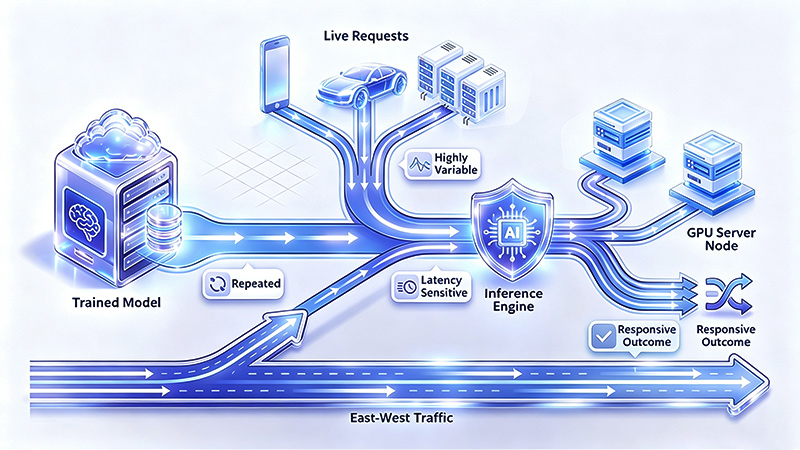
Simply put, AI inference is deploying a trained model in real-world scenarios—receiving and processing immediate requests and providing results in real time or near real time. The goal at this stage is no longer to make the model itself smarter, but to provide users or upper-layer applications with fast, stable, and readily scalable response services.
Compared to the training phase, inference deals with much more dynamic and bursty network traffic. Traffic can be stable one second and then spike dramatically the next, resulting in high concurrency pressure and extreme sensitivity to latency. In this context, the standards for measuring network performance have shifted: rather than simply pursuing consistently high throughput, the speed of system response, the stability of service quality, and the ability to handle various bursts of traffic in a distributed data center have become more critical indicators.
AI Training vs. AI Inference: What are the Differences in Network Requirements?
Before discussing specific network architecture design, let's compare AI training and AI inference from several core dimensions. Although both are under the same AI infrastructure umbrella, their performance goals, traffic characteristics, and operational priorities are completely different. Understanding these differences explains why a single network scheduling strategy is unlikely to effectively manage both aspects simultaneously.
Why do different workloads require different scheduling priorities?
Understanding the difference between AI training and inference isn't just about labeling them. The more crucial contradiction is that these two tasks pull the network in completely different optimization directions.
Let's look at AI training first. The network must be able to handle long-term, high-volume communication between computing resources. If traffic scheduling is poor, the most direct consequence is that GPU computing power is not fully utilized, training cycles are prolonged, and the hard-earned infrastructure is wasted. Therefore, the core requirements of the training network are very clear—to pursue high throughput, fairness in high-volume scheduling, and consistently stable transmission efficiency.
But with AI inference, the situation changes a lot. Here, traffic connects straight to users or applications, and latency and fluctuations become the biggest pain points. You can't just apply the same scheduling logic used for large-scale training to inference. If the network treats all traffic the same, response times will become unpredictable when there's a lot of traffic or sudden spikes.
This is why the difference between training and inference must be elevated to the network design level, rather than being treated as a business category. When performance goals change, the underlying scheduling logic naturally needs to be changed as well.
How can network scheduling accurately match AI load demands?
Different load characteristics directly determine different traffic scheduling strategies.
In AI training scenarios, scheduling strategies must emphasize predictable stream processing, efficient load balancing, and extremely high network utilization. In short, it's about continuously moving massive amounts of data between distributed computing nodes without causing congestion. This type of traffic is not sensitive to the micro-latency of a single request, but is extremely demanding on overall communication efficiency over long periods.
AI inference is a whole other ballgame. Its traffic scheduling has to be flexible and responsive. The network has to handle a lot of traffic quickly and stay stable even when there are a lot of requests. This means not only fast transmission but also minimizing latency and performance volatility.
Ultimately, the differences in scheduling logic between training and inference can be summarized in two basic directions:
AI Training: The focus is on maximizing network throughput through stable data flows and efficient transmission.
AI Inference: The focus is on minimizing transmission latency through rapid response and adaptation to sudden traffic surges.
For architects designing AI infrastructure, clarifying this boundary is an essential and fundamental task that cannot be bypassed.
What should be prioritized in the design of AI infrastructure?
After clarifying the differences between training and inference, the next step is to translate these characteristics into specific architectural design priorities. In short, the focus is no longer on reiterating the differences between the two, but on how the network architecture should be implemented in practical deployments.
Several key considerations include:
Closely aligning with business characteristics: Network design must first identify the dominant load type; avoid trying to apply a single architecture to all AI business.
Precise scheduling matching: Traffic scheduling strategies must align with load behavior patterns to ensure that network strategies truly serve actual application performance goals.
Overall resource coordination: When planning the network, computing power, traffic, and transmission behavior must be considered holistically within the overall AI infrastructure, examining how they interact.
Maintaining operational flexibility: With the increasing prevalence of mixed training and inference, the network system must be able to adjust strategies and performance in mixed load environments flexibly.
For network topologies biased toward training, RoCE lossless network design offers a highly practical reference for congestion-aware transmission.
Conclusion
Treating AI training and AI inference as two distinct network workloads is a crucial prerequisite for effective architecture planning. The differences extend far beyond the model's stage in its lifecycle; they directly impact performance priorities, traffic characteristics, and specific scheduling requirements.
At the end of the day, conversations about training and inference remind us that network design has to fit with the business world. Training depends on throughput, and inference is very sensitive to latency. So, traffic scheduling strategies need to be customized to address these specific needs. If you're a business looking to build scalable AI infrastructure, this is key for making accurate and effective network decisions.


share

