


MPO-8 vs. MPO-12 vs. MPO-24: How to Choose the Right Fiber Optic Cable?

As data center networks move toward 400G, 800G, and beyond, fiber connectivity has become increasingly important. MPO connectors are widely used in high-density environments because they allow multiple fibers to be connected through a single compact interface.
But not all MPO cables are the same. The main differences between MPO-8, MPO-12 and MPO-24 are the number of fibers and the connector configuration. This affects how the fibers are used, how much space is needed for the cables, the options for breaking the cables, and whether they are compatible with optical transceivers.
So, which one should you choose? The answer depends less on the number itself and more on your optical equipment and cabling architecture.
What Is an MPO Connector?
What Is an MPO Fiber Connector?
MPO stands for Multi-fiber Push-On. It is a high-density fiber optic connector designed to terminate multiple fibers in a single connector. Unlike an LC connector, which normally connects one fiber per connector, an MPO connector uses a multi-fiber ferrule to connect several fibers at the same time.
MPO connectors are commonly used with ribbon fiber and are available in different fiber-count configurations. Corning describes MPO as a connector for ribbon cables with four to 24 fibers, making it well suited for applications that require more than two fibers in a compact footprint.
In data centers, MPO connectivity is commonly used for trunk cables, breakout cables, patching systems, and parallel optical links.
What Do MPO-8, MPO-12, and MPO-24 Mean?
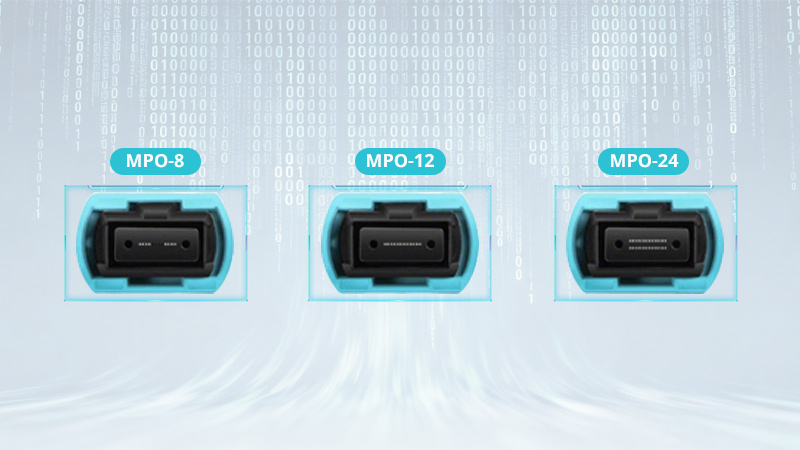
The numbers in MPO-8, MPO-12, and MPO-24 generally indicate the number of fiber positions or fibers in the connector assembly. MPO-8 features 8 fibers, usually arranged in a single row, while MPO-12 has 12 fibers in one row. MPO-24 accommodates 24 fibers, typically arranged in two rows of 12 fibers each. One important point is that connector fiber count and active fiber count are not always identical. For example, an MPO-12 connector may be used with only eight active fibers in certain optical applications.
Why Fiber Count Matters in High-Speed Networks?
Modern parallel optics divide a high-speed connection into multiple optical lanes. For example, 100G SR4 uses four transmit lanes and four receive fibers, requiring eight fibers in total. Some newer 400G and 800G parallel-optics technologies use even more fibers. This makes fiber count directly related to the physical architecture of a high-speed link. An incorrect fiber configuration can result in unused fibers, additional conversion components, polarity problems, or incompatibility with the transceiver. In other words, the optical transceiver should determine the required fiber configuration—not the other way around.
MPO-8 vs. MPO-12 vs. MPO-24: Key Differences
While MPO-8, MPO-12, and MPO-24 share the same basic connector concept, they differ in fiber count, density, and typical applications. The table below provides a quick comparison.
How Are MPO-8, MPO-12, and MPO-24 Used in Data Centers?
MPO Cables for High-Speed Optical Interconnects
MPO cables provide a compact way to connect multiple fibers used by high-speed optical transceivers. MPO-8 is particularly suitable for 8-fiber parallel-optics applications, including 40G SR4, 100G SR4, 100G PSM4, and 400G DR4.
MPO-12 can support the same 8-fiber applications, but four fiber positions may remain unused. By contrast, MPO-24 can accommodate higher-fiber-count applications, such as 400G SR8 and 800G SR8 architectures that use 16 fibers, depending on the transceiver design.
MPO Trunk Cables and Breakout Cables
MPO trunk cables bundle of fibers in a single cable that connects between patch panels, cassettes and fiber enclosures. For example, an MPO-to-LC breakout cable is a type of breakout cable that takes a single MPO connection and breaks it out into multiple smaller LC connections.
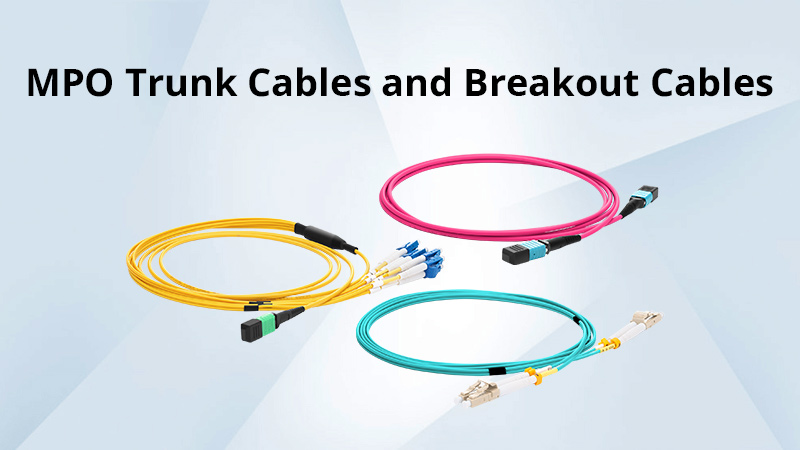
As an illustration, a MPO-12 will break out to six LC duplex connections and a MPO-8 will take four. Used for direct patching of high-density MPO interfaces to equipment which require individual LC connections, breakout cabling is typically employed.
MPO Cabling in High-Density Data Centers
In high-density data centers, the main advantage of MPO cabling is its ability to consolidate multiple fiber connections into a compact connector and cable assembly. This can help reduce cable bulk, simplify cable management, and make better use of limited rack and pathway space.
MPO-8 can be an efficient choice when the network is primarily based on 8-fiber parallel optics, because all eight fibers can be used by a single optical link. MPO-12 offers greater flexibility for mixed or structured cabling environments, including applications that need to transition between MPO and LC connectivity. It can also be useful where existing Base-12 infrastructure is already deployed.
MPO-24 provides higher fiber density for large-scale cabling systems. Its 24-fiber capacity allows multiple fiber circuits to be consolidated into fewer connector positions and can accommodate 16-fiber parallel-optics applications with additional fiber positions available for other connectivity requirements, depending on the architecture.
How to Choose Between MPO-8, MPO-12, and MPO-24
Check the Optical Transceiver
Check its connector type, fiber count, fiber mapping, polarity requirements, and whether it uses multimode or single-mode fiber. For example, an eight-fiber optical interface should not simply be connected to a 12- or 24-fiber cable without confirming that the fiber mapping and connector configuration are compatible.
Consider Your Existing Fiber Optic Cable Infrastructure
If your data center already uses Base-12 trunks, panels, cassettes, and adapters, continuing with MPO-12 may simplify installation and maintenance. On the other hand, a new deployment can be designed around the fiber architecture required by the target optical technology.
Consider Cabling Density and Management
For smaller installations, MPO-8 may provide a simple and efficient solution. MPO-12 offers a good balance between availability and flexibility. MPO-24 becomes more attractive when the number of fibers is very high and cable pathway space is limited.
Plan for Future Network Upgrades
Finally, consider where the network is going. If the next upgrade will require a different lane structure or fiber count, make sure the backbone can support the future architecture. A high-density trunk may provide useful flexibility, but it does not guarantee compatibility with future transceivers. The best approach is to design the complete link—including transceivers, trunks, breakout assemblies, panels, polarity, and fiber type—rather than choosing an MPO cable in isolation.
FAQs About MPO Connectors and Fiber Optic Cables
Q: Can MPO-12 be used for an 8-fiber application?
A: Yes. Some optical systems use an MPO-12 connector with only eight active fibers, commonly described as MPO-12/8. The connector still has 12 fiber positions, but only eight are used by the optical application.
Q: Is MPO-24 required for 800G?
A: Not always. Type of connector depends on which 800G optical technology. For example, 16 active fibers pair with some 800G parallel-optics interfaces and MPO-24 can be utilized as backbone or aggregation architectures before being broken out to the desired interface.
Q: Can MPO-8, MPO-12, and MPO-24 be used in the same data center?
A: Yes. A data center can use different MPO configurations in different parts of the network. However, the polarity, connector gender, keying, and optical loss budget must be considered.


share

