


Wiring Your InfiniBand XDR Network with 1.6T DAC

1.6T passive DAC is the core infrastructure for NVIDIA Quantum-3 rack networks. As expanding AI training clusters and InfiniBand XDR technology push interconnects to 1.6T, the electrical performance of physical links becomes critical to overall cluster stability. At this ultra-high bandwidth, rack cabling must strictly control power and heat. By delivering zero power consumption and low latency, 1.6T DAC effectively eliminates high-density thermal risks, meeting the strict speed and energy efficiency demands of next-generation networks.
What is a 1.6T DAC
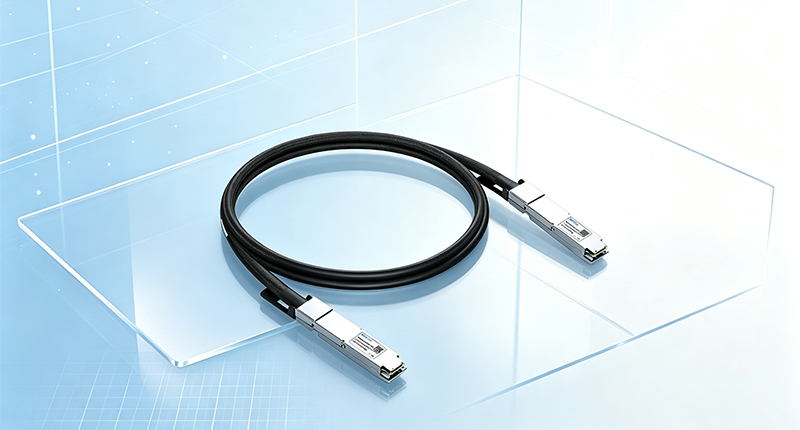
A 1.6T DAC is a passive copper interconnect solution designed specifically for next-generation ultra-high-speed computing environments. At the physical level, it typically uses OSFP or QSFP-DD packages and contains multiple sets of high-performance biaxial copper wires.
The biggest difference from the previous generation of 400G/800G DACs is that the 1.6T DAC's single-channel transmission rate jumps to 224Gbps based on PAM4 modulation. It eliminates the need for optoelectronic conversion components, such as lasers and DSPs, relying instead on pure physical copper wires to directly connect the Quantum-3 switch to the server's electrical interface.
In short, the 1.6T DAC not only doubles the speed but also represents the ultimate form of ultra-short-distance, ultra-high-density physical transmission within the XDR architecture.
Why Does AI Rack Connectivity Require 1.6T DACs
In traditional enterprise networks, optical modules are the go-to solution for bandwidth upgrades. However, modern AI training environments, such as the NVIDIA DGX SuperPOD architecture, present significant challenges.
First, there are the pain points of power consumption and heat dissipation. A single 1.6T optical module often consumes over 20W. If a ToR panel fully loaded with Quantum-3 switches is filled with optical modules, it will generate a staggering amount of additional heat, exacerbating the burden on liquid or air cooling.
Second, there's the cost of latency. In the All-Reduce operation of large-scale distributed training, even microsecond-level latency between nodes can cause GPUs to remain idle. DACs, because they eliminate the photoelectric signal conversion process, achieve true zero-latency physical pass-through. Therefore, within the optimal distance of the rack, DACs are the only solution that can perfectly balance power consumption, latency, and cost.
How 1.6T DAC Boosts XDR Cluster Efficiency
First, the 1.6T passive DAC achieves zero-power transmission within the rack. It relies entirely on the power of the switch and network interface card (NIC) itself, saving valuable power that would otherwise be consumed by the optical modules and allocating it entirely to GPU computing power.
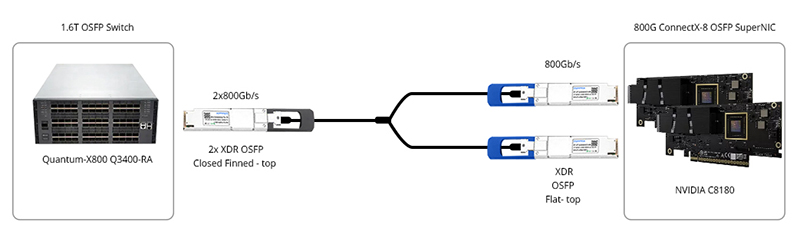
Second, it enhances the offloading capabilities of high-density networks. In practical deployments, a single Quantum-3 switch typically connects multiple 800G AI servers. Using 1.6T OSFP to 2x 800G OSFP/QSFP-DD breakout DAC cables, the speed difference between the switch and NICs can be perfectly matched, doubling port density utilization without increasing the physical layers of the switch, greatly simplifying the Spine-Leaf network architecture.
Finally, its nanosecond-level ultra-low latency significantly reduces communication latency in InfiniBand lossless networks, directly translating the advantages of the underlying hardware into higher model training efficiency.
1.6T DAC vs. Active Optical Solutions at 224G
With single-channel speeds reaching 224Gbps, electrical signals face extremely high insertion loss and crosstalk issues. This compresses the physical transmission limit of passive copper cables to approximately 1 to 1.5 meters.
For cross-rack or medium-to-long-distance connections, a 1.6T AOC or optical module paired with fiber optics is undoubtedly the necessary choice. However, in most scenarios where servers are directly connected to top-of-rack switches, the distance is often less than 1 meter.
Within this distance, forcibly using expensive AOCs or optical modules is not only a huge waste of resources but also introduces additional microsecond-level latency due to the built-in DSP chip. Therefore, in 1.6T networks, DACs and optical solutions are no longer simple substitutes but rather form an extremely strict division of labor based on distance: DACs are irreplaceable within 1.5 meters, while optics dominate for distances above 3 meters.
Building the XDR Ecosystem with QSFPTEK 1.6T Solutions
With the gradual rollout of Quantum-3, finding high-quality DAC cables capable of perfectly carrying 224G signals has become a top priority for network architects. As a professional supplier of high-performance optical interconnects, QSFPTEK is fully prepared for the 1.6T ecosystem.
QSFPTEK's 1.6T DAC cable series undergoes rigorous time-domain reflectometry and signal integrity testing to ensure low bit error rates at extremely high frequencies.
More importantly, QSFPTEK's robust testing center guarantees the underlying compatibility of its products with major mainstream InfiniBand network devices and Ethernet AI switches. By offering a highly competitive ROI, QSFPTEK is helping data centers worldwide smoothly transition to the 1.6T era with lower CAPEX.
Conclusion
In conclusion, the 1.6T DAC, with its zero power consumption, ultra-low latency, and excellent cost-effectiveness, has become the cornerstone for building NVIDIA Quantum-3's ultra-large-scale AI training clusters. In short-distance interconnect scenarios within server racks, it not only effectively solves the heat dissipation and latency bottlenecks caused by optical modules but also improves overall computing efficiency through a simplified network architecture. For data centers seeking ultimate performance and return on investment, selecting a high-quality 1.6T DAC solution is the key and optimal choice for deploying next-generation intelligent computing networks.


share

