


Choosing 200G Interconnects: InfiniBand HDR vs. Ethernet
Author Leslie
Date 11/13/2026

When reviewing architecture designs for modern data centers and AI training clusters, network engineers frequently encounter a critical decision point: choosing between InfiniBand HDR and 200GbE Ethernet. A shared 200G data rate does not mean the two technologies operate in the same way. Both InfiniBand HDR and 200GbE Ethernet support 200G QSFP56 connectivity using four 50G PAM4 lanes. Depending on the platform and cable specifications, these systems can use passive DAC cables or active optical cables for short- and medium-reach connections. However, physical connector compatibility does not automatically guarantee protocol compatibility.
Transport Architecture and Flow Control
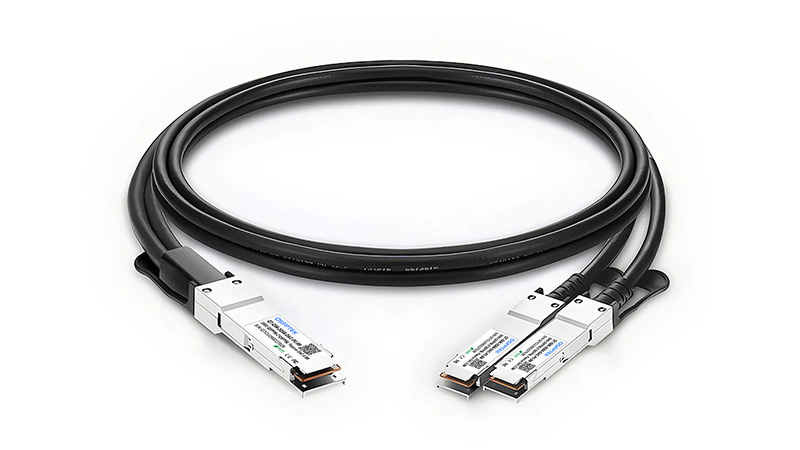
To understand why a 200G link behaves differently depending on the protocol running across it, we must examine their transport and flow-control mechanisms. Regardless of the protocol chosen, successfully bringing up any high-density 200G link relies on robust physical media, such as deploying 200G DAC cables for short-reach top-of-rack connections.
Ethernet with RoCEv2: Ethernet is fundamentally a general-purpose packet-switching technology. RoCEv2 carries RDMA transport traffic over Ethernet using UDP/IP encapsulation. This allows RDMA applications to operate across routed IP networks while retaining much of the RDMA transport model. However, it also introduces additional network-layer considerations, including IP routing, congestion management, and packet delivery behavior. Conventional Ethernet does not provide the same link-level credit-based flow control used by InfiniBand. For latency-sensitive RoCEv2 deployments, network operators typically combine mechanisms such as Priority-based Flow Control and Explicit Congestion Notification with congestion-control algorithms like DCQCN. These features can help reduce packet loss under congestion, but their effectiveness depends heavily on proper configuration, buffer management, and traffic engineering.
InfiniBand HDR: InfiniBand was purpose-built for low-latency, high-throughput cluster computing as a native switched fabric. It uses credit-based flow control to regulate traffic at the link level: a sender must have sufficient credits, indicating available receiver buffer space, before transmitting data. Meanwhile, a centralized Subnet Manager handles fabric discovery, configuration, and path management. This architecture helps prevent receiver-buffer overruns caused by congestion and reduces dependence on Ethernet-style PFC configuration. However, it does not guarantee that all forms of packet errors, congestion, or retransmissions are eliminated across the entire fabric.
RDMA and AI Cluster Performance
Modern AI training, particularly large language model training, relies heavily on collective communication operations such as All-Reduce, All-Gather, and Reduce-Scatter. These operations allow GPUs distributed across multiple servers to exchange data and synchronize model parameters or gradients during training. During collective operations, communication delays at individual nodes can extend the completion time of a training iteration. When synchronization becomes a bottleneck, faster nodes may have to wait for slower participants, reducing overall GPU utilization.
RDMA is central to both architectures. Both InfiniBand and RoCEv2 support RDMA, allowing a NIC to transfer data directly between registered memory regions on remote systems with minimal host CPU involvement. By reducing data copies and kernel processing in the data path, RDMA helps lower CPU overhead and improve communication efficiency for high-performance workloads.
Native InfiniBand provides a purpose-built transport and fabric architecture for high-performance computing. RoCEv2 can also deliver high RDMA performance over Ethernet, but achieving consistent results at scale requires careful attention to congestion control, queue management, and network configuration.
Comparing 200G InfiniBand HDR and 200GbE RoCEv2
Choosing the Right 200G Interconnect
Choosing between these two technologies requires a comprehensive assessment of your application workloads, existing infrastructure, and your team’s operational expertise and technical maturity.
For large-scale AI and HPC clusters:
If your primary workload involves training large neural networks on massive GPU clusters, where synchronization latency between nodes directly impacts training time, InfiniBand offers a network architecture specifically designed for such scenarios. Its credit-based flow control mechanism regulates data transmission at the link layer, while a centralized Subnet Manager facilitates unified management of network configurations and data paths. In large-scale, scale-out environments, InfiniBand’s centralized subnet management and link-level credit-based flow control help simplify network administration, reducing the need for complex PFC configuration and congestion tuning typical of Ethernet. However, before deployment, you should evaluate your team’s familiarity with managing a Subnet Manager, assess your existing switch infrastructure, and consider the future scaling requirements of your cluster.
For converged data center environments:
If your infrastructure must support a diverse range of workloads, such as general-purpose virtualization, containerized microservices, and high-performance block storage, a 200GbE Ethernet solution utilizing RoCEv2 offers greater flexibility. It integrates seamlessly with existing enterprise routing and network virtualization technologies, such as BGP and EVPN-VXLAN. That said, deploying RoCEv2 requires meticulous planning regarding QoS and congestion management. You must ensure that your data center switches support ECN marking and PFC, and verify that both your network interface cards and the broader network infrastructure are correctly configured for congestion control mechanisms like DCQCN. Furthermore, your operations team should establish clear configuration and validation standards, with a focus on traffic prioritization, buffer thresholds, and network congestion behavior.
 DAC and AOC Cabling Considerations
 DAC and AOC Cabling Considerations
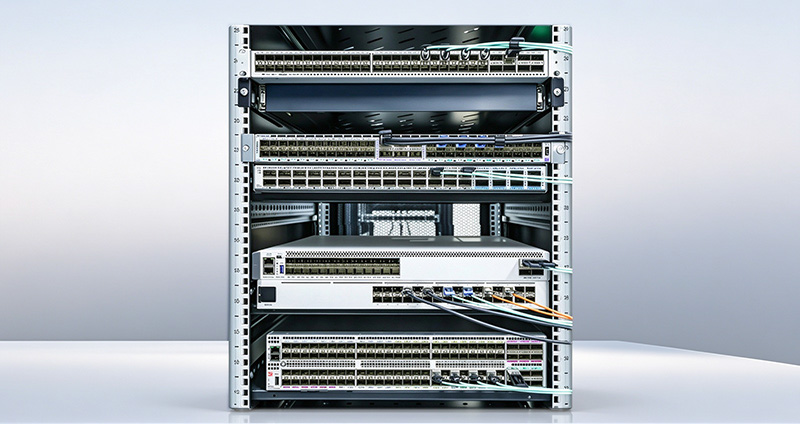
In a 200G data center network, the choice between DAC and AOC is largely determined by link distance, cable routing requirements, and platform compatibility. Physical layer connectivity plays a vital role in maintaining signal integrity across 200G links.
Passive QSFP56 DAC Cables: Because passive DAC cables use direct electrical connections rather than optical transceivers and fiber links, they offer a simple and cost-effective option for short-reach 200G interconnects. However, cable length, insertion loss, signal integrity, and platform-specific FEC requirements must still be considered when designing 200G links. In supported configurations, a 200G QSFP56 port can be split into two 100G links using a compatible breakout cable. This requires the source port, downstream interfaces, and network devices to support the same breakout mode and lane mapping.
Active Optical Cables (AOCs): For longer connections where passive copper cable length or routing constraints become limiting, active optical cables can provide a practical alternative. For InfiniBand HDR deployments, AOCs are also available in a range of lengths and breakout configurations, including 200G-to-dual-100G options (note that these breakout options depend on specific protocol and device support). These assemblies can simplify connectivity when copper cabling is unsuitable or when longer cable runs are required. Engineers should still verify the supported protocol, reach, and endpoint compatibility.
Conclusion
Aligning the network architecture with workload requirements is only part of the design process. Engineers must also verify cable compatibility, breakout configurations, link reach, and endpoint support. By evaluating both the network protocol and physical interconnect, data center teams can build 200G infrastructures that scale reliably across AI, HPC, and enterprise workloads.


share
