


QSFP112 vs OSFP: Which 400G Form Factor Should You Choose?
Author
Date 11/10/2026

Upgrading a data center to 400G forces you to make tough hardware decisions, and picking the right optical transceiver form factor is easily one of the most critical. You need to get the physical packaging right because it dictates your cooling strategy, rack density, and how easily you can scale up later. Right now, QSFP112 and OSFP are the two main contenders. They approach bandwidth and thermal limits in completely different ways, so you have to look closely at what your host platforms actually require before buying anything.
What Are QSFP112 and OSFP?
What Is a QSFP112 Transceiver?
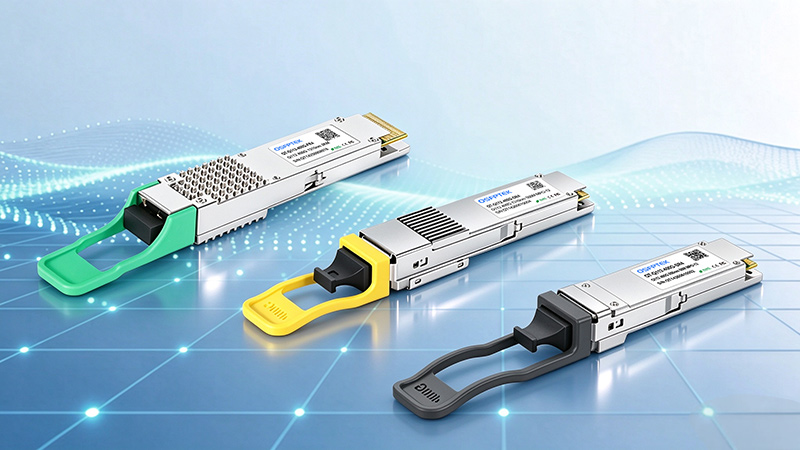
A QSFP112 (Quad Small Form-factor Pluggable 112) transceiver is a high-speed pluggable module designed for 400G network connectivity. It uses four electrical lanes operating at 112Gbps each, with PAM4 modulation, to achieve an aggregate data rate of 400Gbps. QSFP112 retains the compact physical dimensions of the traditional QSFP form factor, making it the same size as QSFP28 and QSFP56 modules, while offering significantly higher electrical interface speeds and bandwidth. With its high port density and performance, QSFP112 form factor is widely used in 400G Ethernet, InfiniBand networks, and AI data center interconnects.
What Is an OSFP Transceiver?
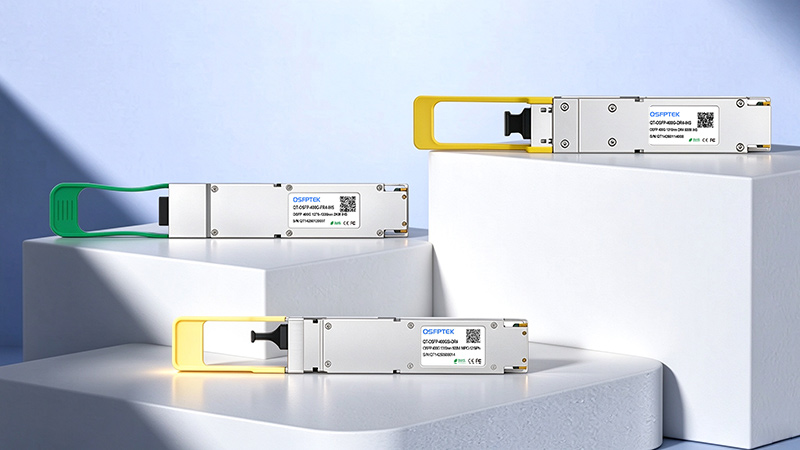
OSFP (Octal Small Form-factor Pluggable) is a pluggable transceiver form factor designed for high-speed network connectivity, primarily supporting 400G and 800G applications. In 400G applications, OSFP transceivers typically use eight electrical lanes operating at approximately 50Gbps each, with PAM4 modulation to achieve an aggregate data rate of 400Gbps. Based on their cooling structures, OSFP transceivers are generally available in two designs: IHS (Integrated Heat Sink), which features exposed cooling fins integrated into the module, and RHS (Riding Heat Sink), which has a relatively flat top and relies on the host device's cooling structure for heat dissipation.
QSFP112 vs OSFP: Key Differences at a Glance
The following shows the main differences between two types of 400G optical module form factors.
How to Choose Between QSFP112 and OSFP for 400G?
Form Factor and Host Compatibility
In most cases, the hardware you already have sitting in your racks makes the QSFP112 versus OSFP decision for you. QSFP112 retains the compact physical dimensions of the QSFP family, making it suitable for devices designed to support QSFP112 modules. However, compatibility with standard QSFP cages should not be assumed, as host electrical specifications and module support also matter. OSFP has a completely different physical design and requires dedicated OSFP ports. It is widely adopted in high-performance data center switches, where its eight-lane architecture supports higher bandwidth applications.
Bandwidth Requirements and Upgrade Plans
QSFP112 primarily used in 400G applications through a 4 × 112G PAM4 architecture. It is suitable for networks with current 400G connectivity requirements. OSFP supports a broader range of speeds. Standard OSFP can support 400G, 800G, and 1.6T applications through different electrical lane configurations, including 8 × 100G PAM4 for 800G and 8 × 200G PAM4 for 1.6T. For networks that mainly use 400G connections, QSFP112 is a good fit. OSFP is worth considering when planning a move to 800G or 1.6T, especially in large-scale data center deployments.
Power Consumption and Cooling Requirements
Power consumption and thermal management depend on module design, internal components, and host cooling capabilities. QSFP112 has a compact housing, making it suitable for space-constrained equipment. OSFP offers different cooling designs, including IHS and RHS. IHS modules feature integrated cooling fins, while RHS modules have a relatively flat top and rely more on host-side cooling structures.
Port Density and Deployment Cost
The QSFP112 maintains a compact form factor, enable switches to fit more ports in the same amount of rack space. This is beneficial for deployments where port count and rack space are major considerations. However, OSFP's larger form factor may limit the number of ports that fit on a switch's front panel depending on the design.
The deployment cost also depends on the network infrastructure that is already in place. Organizations that are currently using QSFP-based systems have a lower cost-of-ownership when they choose to upgrade with QSFP112 as this allows them to utilize their existing, compatible switch design and cabling setup. On the other hand, organizations that want to deploy OSFP must invest in new hardware (designed specifically for OSFP cages) which will increase their upfront investment. However, organizations that plan to transition to 800G or beyond may find that OSFP provides them with more flexibility for future upgrades.
Recommendations for Different Network Scenarios
Standard enterprise data centers and edge computing sites rarely need to push past 400G in the near future. For these setups, the QSFP112 is the smartest financial and technical choice. It fits into dense spaces and keeps deployment costs manageable. Hyperscale facilities and AI training clusters operate in a completely different reality. In those racks, OSFP dominates the core switching layer because nothing else handles the intense heat and provides the necessary scaling. Even in those massive AI fabrics, network engineers still rely heavily on QSFP112, but they specifically use it to terminate the optical links down at the server network interface cards.
Can QSFP112 and OSFP Connect to Each Other?
QSFP112 and OSFP modules cannot be directly plugged into each other's ports because they have different physical dimensions and cage designs. A QSFP112 module will not fit into an OSFP port, and an OSFP module cannot be installed in a QSFP112 port. However, physical differences don't stop QSFP112 and OSFP devices from communicating with each other on the same network. They can be connected using compatible optical transceivers at both ends or purpose-built QSFP112-to-OSFP cables. The key is to make sure that both sides support the same data rate, network protocol, and transmission specifications.
Frequently Asked Questions About OSFP and QSFP112
Q: Is OSFP better than QSFP112?
A: Neither form factor is always superior. QSFP112 provides a cost-effective option for 400G networks with a focus on maximizing port density and backward compatibility with existing QSFP-based equipment. OSFP has greater capability to support higher levels of power consumption and improved thermal management, allowing it to be used in high-speed applications such as 800G and future 1.6T networks. The best selection will depend upon the switch design, network requirements and planned upgrades.
Q: Does QSFP112 support 800G network?
A: No, the QSFP112 is designed for 400G applications, using four 100G electrical lanes. You can't just replace the transceiver and upgrade an existing QSFP112 port to 800G.
Q: Is QSFP112 more power-efficient than OSFP?
A: Not necessarily. The power consumption of a transceiver depends more on its internal design, optical technology, and electrical components than on its form factor. Comparable 400G QSFP112 and OSFP transceivers can have similar power requirements. Therefore, QSFP112 does not automatically consume less power than OSFP. When comparing the two, check the maximum power consumption listed in the datasheets for the specific module models.


share
