


1.6T InfiniBand XDR DAC: Why Passive Copper Still Matters in AI Clusters

As InfiniBand XDR pushes single-port bandwidth to 1.6 Tb/s, AI GPU cluster networking is entering a new phase of high-speed interconnects based on 200 Gb/s PAM4 electrical lanes. Behind the pursuit of extreme communication bandwidth, network architects face new physical challenges: as the per-lane electrical interface upgrades to 200 Gb/s PAM4, the power and thermal requirements of 1.6T optical interconnects become increasingly demanding. In high-density GPU racks, deploying large numbers of high-speed optical transceivers can significantly increase switch-port power consumption and overall chassis thermal requirements. In this technological evolution, the 1.6T InfiniBand XDR passive direct attach copper cable has not been phased out. Instead, leveraging its passive, low-complexity physical attributes, it continues to hold significant engineering value for high-speed, short-reach interconnects within the rack.
A Pragmatic Choice for Intra-Rack Short-Reach Interconnects
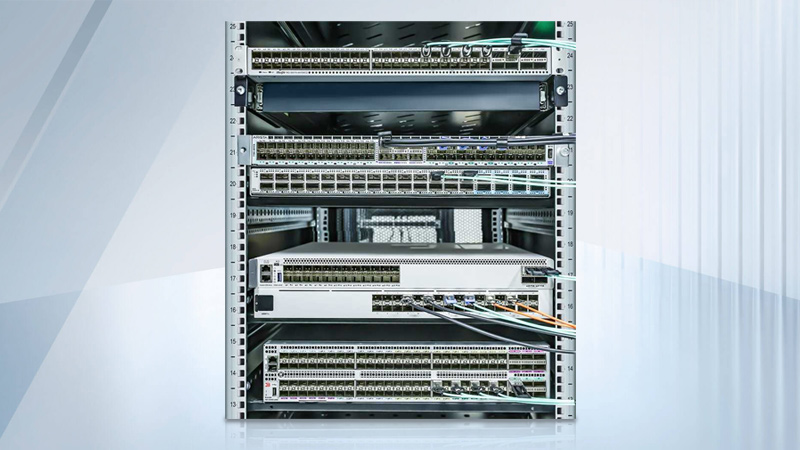
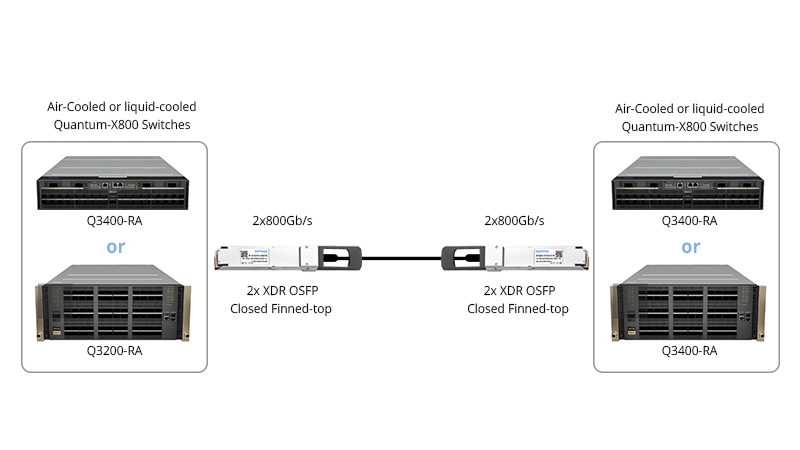
1.6T Passive DACs are primarily designed for short-reach, high-speed connections within data center racks. In current XDR deployment guidance, passive DACs are mainly positioned for two specific scenarios:
Switch-to-Server: In high-density compute racks, AI servers equipped with ConnectX SmartNICs connect directly to top-of-rack switches.
Switch-to-Switch: Used for cascading network equipment within the same rack over extremely short physical distances.
For these extremely short-reach deployments, passive DACs offer two core system-level advantages over other interconnect form factors:
Passive Links for Reduced Power Overhead
True to its name, a passive DAC contains no optoelectronic conversion components, DSP chips, or other active signal-conditioning electronics. Consequently, the cable itself requires no independent power supply. Compared to optical transceivers or Active Electrical Cables that require active signal processing, passive DACs avoid the additional power consumption associated with active signal processing at the link ends, allowing the system to allocate precious power budgets to GPU compute resources.
Simplified Links and Low Latency
For short-reach connections within the rack, passive DACs bypass the optoelectronic conversion paths and the associated active signal processing required by optical transceivers. This simplified physical link reduces extra signal processing and conversion overhead, providing tangible value for AI training clusters that are highly sensitive to end-to-end and tail latency.
Why Aren't All XDR Links Using DACs
While 1.6T DACs offer advantages in power efficiency and link simplicity, they are not a one-size-fits-all solution for 1.6T networks. In the high-speed interconnect ecosystem, physical distance and signal integrity are inherently at odds.
As the cabling distance increases, dielectric and conductor losses become increasingly significant for 224G-class PAM4 electrical signaling over copper. To maintain signal integrity, passive DAC designs typically rely on optimizing conductor gauges, cable structures, and connector designs. However, adopting thicker wire gauges (lower AWG) inevitably results in bulkier cables, increased weight, and larger minimum bend radii requirements.
Therefore, when link distances exceed the viable range of a passive DAC, the network architecture must transition to other interconnect formats: Linear Active Copper Cables (LACCs) or AECs are utilized to span longer distances within the rack, while 1.6T optical transceivers generally become the more appropriate choice for cross-rack, longer-distance, or space-constrained deployments.
QSFPTEK 1.6T InfiniBand XDR DAC: Tackling 200G PAM4 Signal Integrity
In the 1.6T era, the design focus of passive DACs has moved well beyond basic conductor connectivity toward rigorous high-speed signal integrity control. 200 Gb/s PAM4 signaling is highly sensitive to cable loss, impedance discontinuities, and crosstalk. Insufficient control over insertion loss, return loss, or crosstalk in copper cables can degrade signal quality at the receiver, increasing the risk of bit errors and ultimately compromising link stability and cluster communication efficiency.
Targeting high-density intra-rack cabling for 1.6T deployments, QSFPTEK has concentrated its engineering and manufacturing efforts for the 1.6T InfiniBand XDR DAC in three critical dimensions:
High-Speed Cable Structures and Interconnect Processing: Utilizing high-speed copper cable structures and materials optimized for 200G PAM4 links, combined with precision termination techniques, the design focuses on controlling impedance continuity at the connector transition zone, helping control high-frequency insertion loss and return loss at the physical layer.
EMI and Crosstalk Mitigation: To navigate the complex electromagnetic environments inside high-density racks, optimized cable shielding structures and OSFP connector shell designs are implemented. This mitigates external electromagnetic interference risks and effectively suppresses adjacent-channel crosstalk coupling during high-density stacking.
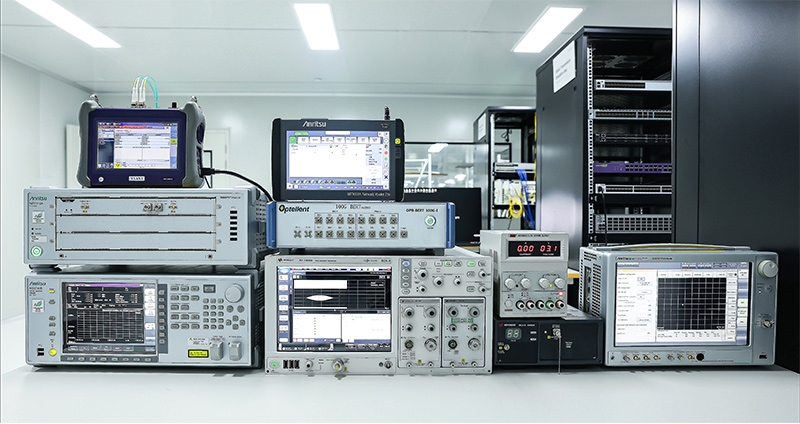
Platform Interoperability Validation: Before market deployment, each generation of high-speed copper cables undergoes rigorous high-speed link and interoperability testing against target InfiniBand platforms (e.g., high-throughput switches and next-generation SmartNICs). This process validates high-speed link stability across various length combinations and verifies link states and error rates under Forward Error Correction conditions based on the specific configurations of the target platforms.
Conclusion
The 1.6T era is no longer dominated by a single interconnect technology. While inter-campus and longer-distance connections rely heavily on optical communications, the 1.6T InfiniBand XDR passive DAC remains a crucial pillar of the short-reach physical layer. Relying on a completely passive architecture, it offers a low-complexity interconnect solution that balances power and latency. When building next-generation AI data centers, matching passive copper, active cables, and optical transceivers to actual distances and physical constraints is essential to balancing link performance, power consumption, cabling space, and Total Cost of Ownership.


share

