


How Ultra Ethernet is Shaping the Future of AI Workloads
Author Moore
Date 11/06/2026

As AI workloads become more extensive and complex, traditional data center networks are struggling to keep up. In response to the extreme demand for ultra-high bandwidth, ultra-low latency, and deterministic network performance for large-model training, a new networking paradigm has emerged: Ultra Ethernet (UE). Tailored specifically for AI and high-performance computing (HPC), Ultra Ethernet is a low-level networking architecture that is rapidly becoming the core backbone of next-generation data centers.
A Quick Guide to Ultra Ethernet and the UEC Alliance
Ultra Ethernet is a major technology initiative spearheaded by the Ultra Ethernet Consortium (UEC). The consortium brings together numerous industry giants, including AMD, Arista, Broadcom, Cisco, HPE, Intel, Meta, and Microsoft. Their core vision is clear: to drive the deep evolution of traditional Ethernet technology so that it can perfectly meet the demanding requirements of AI/ML workloads; and to deliver, through an open and highly interoperable ecosystem, the extreme performance that was previously achievable only by closed, proprietary networks such as InfiniBand.
UEC is committed to rearchitecting a complete network protocol stack—from the underlying physical layer all the way up to the transport layer. Its goal is to ensure that Ultra Ethernet can truly achieve lossless, low-latency, and highly scalable node-to-node communication while retaining the two core advantages of traditional Ethernet: an “open ecosystem” and “extreme cost-effectiveness.”
Why Is Ultra Ethernet So Critical in the Age of AI?
In fact, Ethernet has risen to the forefront of the supercomputing revolution. Data as of 2024 shows that, in the TOP500 supercomputer performance rankings, Ethernet has successfully overtaken InfiniBand (39.2%) with a 48.5% share, and it is appearing with increasing frequency in major supercomputing clusters.
However, modern AI and HPC workloads are extremely bandwidth-hungry, highly latency-sensitive, and require extremely high determinism in network traffic. Even traditional Ethernet equipped with the RoCE (RDMA over Converged Ethernet) protocol is prone to exposing weaknesses—such as packet loss, increased congestion, and a lack of fine-grained traffic control—when faced with the extreme demands of AI clusters with tens of thousands of cards, thereby hindering the entire system's computational performance.
Ultra Ethernet was created precisely to address these pain points. It introduces a brand-new congestion control mechanism, intelligent packet scheduling algorithms, and a true lossless transport layer. These underlying innovations work in concert to push network throughput to its limits while minimizing long-tail latency and network jitter, ensuring that computing clusters can achieve the most efficient horizontal scaling across tens of thousands of GPUs.
As an active participant in the evolution of next-generation AI networks, QSFPTEK has consistently kept a close eye on the progress of the UEC ecosystem. In response to the interconnect needs arising from the transition from traditional Ethernet to Ultra Ethernet, QSFPTEK continues to optimize its product portfolio of 400G, 800G, and even 1.6T optical modules and cables. The company is committed to helping enterprise data centers embrace the open Ethernet ecosystem while building a low-latency network foundation capable of supporting extreme AI computing power.
The Evolution from Traditional Ethernet to Ultra Ethernet Switches
The rise of AI data centers is inextricably linked to the continuous evolution of Ethernet switch technology. Since its inception in May 1973, Ethernet has kept pace with the changing demands of computing through its exceptional architectural flexibility and adaptability, gradually establishing itself as the dominant global networking standard.
There are five significant advancements of the Ethernet switch has undergone :
Local Area Network (LAN) Switches: These switches pioneered cost-effective, high-bandwidth connectivity, establishing Ethernet as the de facto standard for campus and enterprise networks.
Metropolitan Area Network (MAN) Switches: Introduced Layer 3 routing capabilities, successfully breaking down the barriers of physical buildings and expanding Ethernet coverage to the entire city.
Carrier-grade switches: These comprehensively enhance link reliability, QoS (Quality of Service), and security mechanisms, achieving the stringent high availability standard of 99.999% and enabling global carriers to deliver massive volumes of voice, video, and data services across continents.
Data Center Switches: With the explosive growth of cloud computing, these switches have evolved to incorporate EVPN, RDMA, and highly automated network features, effortlessly supporting large-scale, seamless scaling of millions of virtual machines and exabyte-level storage in cloud environments.
Ultra Ethernet Switches: Represent Ethernet's official transformation into the next-generation computing network foundation, it optimized for AI and HPC workloads, marking the ultimate leap into the field of supercomputing.
What Are the Differences Between Ultra Ethernet and Existing Network Protocols?
Although current protocols such as TCP/IP, RoCE, and InfiniBand are attempting to mitigate high-traffic spikes through optimizations (such as early congestion control mechanisms), their underlying architecture is still designed for 'general-purpose networks.'
This general-purpose nature results in a severe lack of targeted advanced features when facing extreme AI and HPC scenarios—such as robust dynamic multipathing, minimalist configuration logic, and high availability and resilience in large-scale clusters. When enterprises force these traditional protocols onto AI workloads, they often encounter architectural vulnerabilities and severe performance bottlenecks.
In contrast, the Ultra Ethernet Consortium (UEC) has directly drawn upon the practical experience of its leading members in hyperscale (e.g., 10,000-card-scale) AI and HPC deployments to tailor and rebuild an end-to-end network framework. The UEC has moved beyond the 'treating symptoms rather than causes' approach of single-point optimization. By adopting a holistic perspective of coordinated hardware and software innovation, it has completely shattered the performance ceiling of traditional Ethernet or any single networking technology, truly delivering a highly efficient interconnect solution 'built for AI.'
How Does Ultra Ethernet Work?
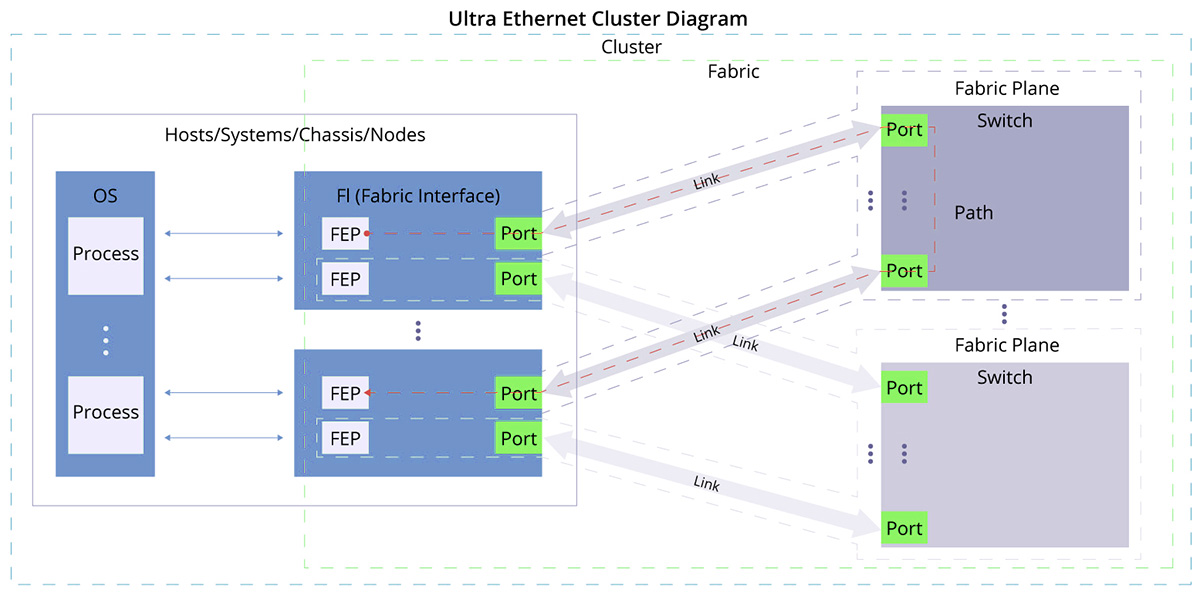
At the architectural level, the Ultra Ethernet system is built around clusters as its core building blocks, primarily interweaving compute nodes with the underlying Fabric network infrastructure. Compute nodes connect to the network via Fabric interfaces (i.e., high-performance network cards), and each physical interface natively supports multiple logical Fabric endpoints (FEPs). The entire network is physically and logically divided into multiple independent data planes, with interconnections between FEPs within each plane typically implemented through a matrix of high-performance switches.
To precisely adapt to the underlying traffic characteristics of different business scenarios, the Ultra Ethernet cluster primarily offers two core operating modes:
-
Parallel Job Mode:Tailored for high-performance computing (HPC) and distributed AI training. This mode supports high-concurrency, many-to-many communication among a massive number of nodes, ensuring efficient synchronization and seamless execution of large-scale parallel computing tasks.
-
Client/Server Mode:Focuses on data-intensive use cases. This mode supports a highly reliable, persistent “request-response” interaction mechanism between clients and dedicated server nodes, making it an ideal choice for scenarios requiring high-frequency, stable resource sharing—such as distributed storage access and parameter server allocation.
Summary
Ultra Ethernet is much more than just "faster Ethernet." It is a complete reimagining of the operational logic underlying data center networks in the AI era. With the joint endorsement of numerous industry leaders and a clear technical roadmap, Ultra Ethernet is quickly becoming the cornerstone of next-generation AI computing networks.
Facing this historic shift in networking paradigms, QSFPTEK is fully prepared and has launched high-performance 800G Ultra Ethernet switches specifically designed to handle the demanding AI workloads of the future. Are you ready to inject more powerful network momentum into your AI data center? Contact the QSFPTEK team today to explore our high performance switch portfolio—deeply optimized for HPC/AI scenarios—and our full-stack high-speed interconnect solutions.


share
