


Development Trends and Evolution Path of PON Modules

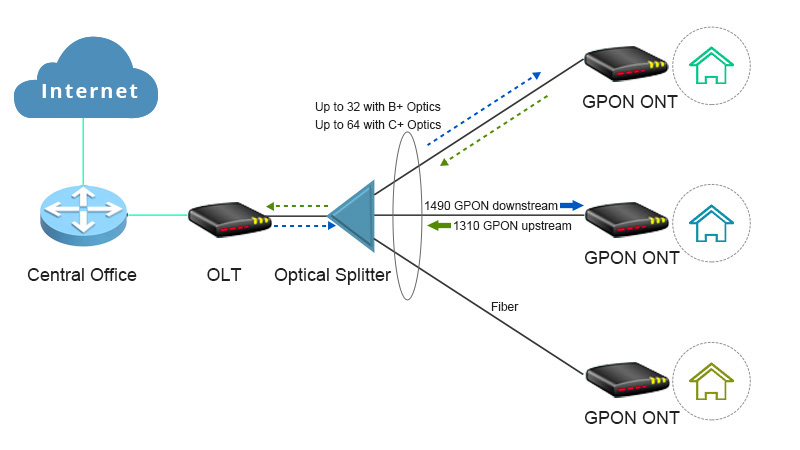
As the most mature and widely deployed optical access technology in the broadband access field, PON (Portable Optical Network) has undergone multiple generations of evolution, with its core component, the PON optical module, being a key component. The PON module performs the photoelectric conversion between the OLT (Optical Line Terminal) and ONU (Optical Network Unit), enabling high-speed transmission on the access side through uplink and downlink communication at specific wavelengths. With the continuous growth in demand for gigabit broadband, industrial internet, and wireless fronthaul services, PON optical modules are evolving towards higher speeds, higher integration, and greater intelligence. This article will guide you through understanding what a PON transceiver is, its development trends, and its evolution path.
What is a PON Module
Simply put, a PON module is an optical transceiver deployed on an OLT and ONU to transmit and receive optical signals. Through uplink and downlink transmission at different wavelengths, it forms the foundation of a broadband access network together with the ODN. Its core functions include: modulation, amplification, and wavelength control at the transmitter; photoelectric detection and signal recovery at the receiver; and clock recovery, FEC, and low-latency control required for high-speed links.
Unlike data center optical modules, PON modules operate in a more complex environment:
First, they need to ensure a high optical power budget in passive networks. Second, they must operate stably under conditions of high splitting and long-distance transmission. Simultaneously, PON transceivers need to be compatible with different generations of PON systems, and due to the large-scale deployment required by operators, their cost needs to be as low as possible. In other words, PON modules not only need to be inexpensive but also need to offer powerful performance and flexible compatibility.
The Evolution of PON Modules
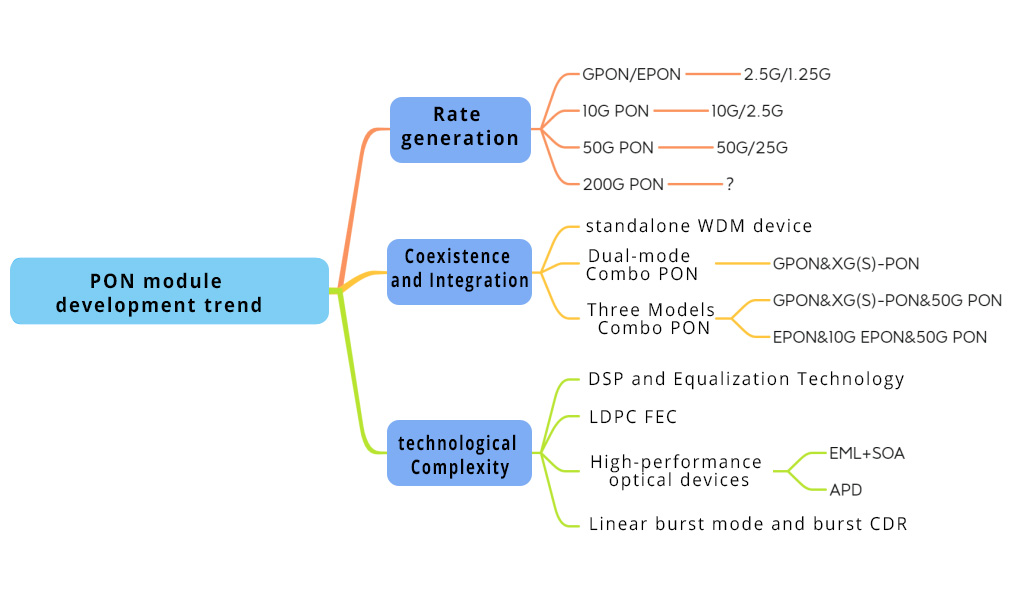
Looking back at the entire history of PON technology development, its evolution has followed a clear path: higher bandwidth, lower latency, and lower cost while maintaining compatibility with existing networks. Currently, PON technology has clear generational divisions, from 1G PON to 10G PON. Now, with 50G PON entering the commercial stage and the future 100/200G PON, it exhibits a clear trend of generational speed development.
Currently, 10G PON is very mature and has been deployed on a large scale in home broadband, enterprise access layers, and fixed-mobile converged networks. This includes XG PON, XGS PON, and 10G EPON, which achieve 10Gbps downlink speeds and provide more powerful optical splitting capabilities, laying a solid foundation for gigabit access.
With the ITU-T G.9804.x standard system largely complete, 50G PON has been officially identified as the dominant next-generation PON technology. Its single-wavelength downlink rate can reach 50Gbps, while uplink supports multiple combinations of 12.5G/25G/50Gbps. Driven by the demands for low-latency services and multi-service support at 10 Gigabit access points, 50G PON technology is being deployed on a large scale in pilot projects.
According to evolutionary trends, after 50G PON, the focus is gradually shifting to ultra-high-speed PON systems with single-wavelength 100G or even 200G. Considering the bottlenecks of traditional direct modulation/direct detection technologies, future 200G PON may introduce coherent technologies or more advanced high-speed optoelectronic devices, providing space for long-term evolution.
From Standalone to Multi-mode Combo PON
The most expensive component in PON network construction is not the optical module, but the ODN (Optical Distribution Network). This part is buried underground and in users' homes, and operators cannot simply tear it down and rebuild it for speed upgrades. Therefore, the core principle of PON evolution is to ensure the compatibility of the new PON with the existing ODN. This makes compatibility one of the key priorities in PON module design. By using wavelength-division multiplexing and integrating multiple generations of BOSA, PON modules at different speeds can operate on the same ODN. During 10G PON deployments, GPON + XG(S) PON combo modules are commonly used. These modules combine two sets of transmit and receive systems into a single unit, allowing both legacy and new networks to run at the same time. It enables upgrading more smoothly and helps reduce the upgrade cost of migrating to a higher speed PON network.
With the introduction of 50G-PON, the industry is shifting towards a tri-mode coexistence solution of GPON + 10G PON + 50G PON. Currently, some manufacturers have achieved 50G PON tri-mode combo optical modules and have begun to explore miniaturized tri-mode modules based on the SFP architecture to meet the requirements of high-density deployment. However, such modules face challenges such as high power consumption, high heat dissipation pressure, and extremely high integration requirements, and miniaturization is still in the stage of key technological breakthroughs.
High Speed Optical Communication Technology Enabling PONs to Advance Towards Higher Speeds
As the single-wavelength rate of PON modules increases to over 50Gbps, the simple modulation and low-complexity circuitry of traditional PONs are no longer sufficient to meet performance requirements. Therefore, PON transceiver technology needs to accelerate the introduction of mature key technologies from the high-speed optical communication field.
Introduction of DSP and Equalization Technology
50G PON employs DSP and high-speed equalizers to compensate for insufficient device bandwidth, fiber dispersion, and noise effects, thereby improving receiver sensitivity and signal quality. PON has moved from a traditional low-complexity architecture to the carrier-grade signal processing required for high-speed links.
Advanced FEC Mechanism Improves Power Budget
Traditional RS codes can no longer meet the bit error rate requirements of 50G links. Therefore, the system uses a more powerful LDPC forward error correction mechanism to provide additional power margin for high-splitting ratio, high-loss ODNs.
Comprehensive Upgrade of High-Performance Optoelectronic Devices
To achieve 50Gbps speed, key components within the PON module have been upgraded. Its OLT-side transmitter adopts an EML+SOA architecture to provide high output power and meet power budget requirements. On the ONU side, the transmitter tends to use high-power DML (Digital Microwave Oscillator), which may require the integration of a TEC (Digital Transducer) to meet wavelength accuracy requirements. The receiver, on the other hand, widely adopts APD (Active Detector) and is researching solutions such as SOA+PIN (Optical Array of Optical Aspects) to improve sensitivity.
The integration of low-latency technologies
For latency-sensitive applications such as 5G fronthaul and industrial control, 50G PON supports mechanisms such as Dedicated Active Wavelength (DAW) and Cooperative DBA (CO-DBA), further reducing latency and jitter from the protocol to the device level.
Conclusion
In summary, the development trend of PON modules focuses on higher bandwidth, stronger coexistence capabilities, and more complex technology integration, gradually building the foundation for future access networks. In the future, PON transceivers will continue to play a crucial role in the construction of key and common access networks such as high-speed broadband, industrial internet, and wireless fronthaul.


share

