



Sort by:
-
 1.6T InfiniBand XDR DAC: Why Passive Copper Still Matters in AI Clusters
Explore why 1.6T InfiniBand XDR Passive DACs remain crucial for AI GPU clusters. Learn how passive copper balances power, latency, and SI in 200G PAM4 links.Leslie 09/24/2026 38Read More >
1.6T InfiniBand XDR DAC: Why Passive Copper Still Matters in AI Clusters
1.6T InfiniBand XDR DAC: Why Passive Copper Still Matters in AI ClustersExplore why 1.6T InfiniBand XDR Passive DACs remain crucial for AI GPU clusters. Learn how passive copper balances power, latency, and SI in 200G PAM4 links.Leslie 09/24/2026 38Read More > -
 Massive AI Workloads Are Coming: What Changes Is Data Center Infrastructure Undergoing?
As AI workloads expand across servers and racks, the final performance of the entire system increasingly depends on the coordinated operation of elements such as computing power, networking, storage, power supply, and cooling. This article will examine these changes and the practical challenges they bring to large-scale AI infrastructure.Moore 09/18/2026 32Read More >
Massive AI Workloads Are Coming: What Changes Is Data Center Infrastructure Undergoing?
Massive AI Workloads Are Coming: What Changes Is Data Center Infrastructure Undergoing?As AI workloads expand across servers and racks, the final performance of the entire system increasingly depends on the coordinated operation of elements such as computing power, networking, storage, power supply, and cooling. This article will examine these changes and the practical challenges they bring to large-scale AI infrastructure.Moore 09/18/2026 32Read More > -
 OSFP vs OSFP224: Inside the 1.6T Upgrade
Planning an AI cluster network upgrade? This article analyzes the key differences between OSFP and OSFP224. It explores how 1.6T OSFP224 addresses signal integrity challenges at a baud rate of 106.25 Gbaud, as well as the practical application of RHS in system-level thermal management and its backward compatibility mechanisms.Leslie 09/18/2026 32Read More >
OSFP vs OSFP224: Inside the 1.6T Upgrade
OSFP vs OSFP224: Inside the 1.6T UpgradePlanning an AI cluster network upgrade? This article analyzes the key differences between OSFP and OSFP224. It explores how 1.6T OSFP224 addresses signal integrity challenges at a baud rate of 106.25 Gbaud, as well as the practical application of RHS in system-level thermal management and its backward compatibility mechanisms.Leslie 09/18/2026 32Read More > -
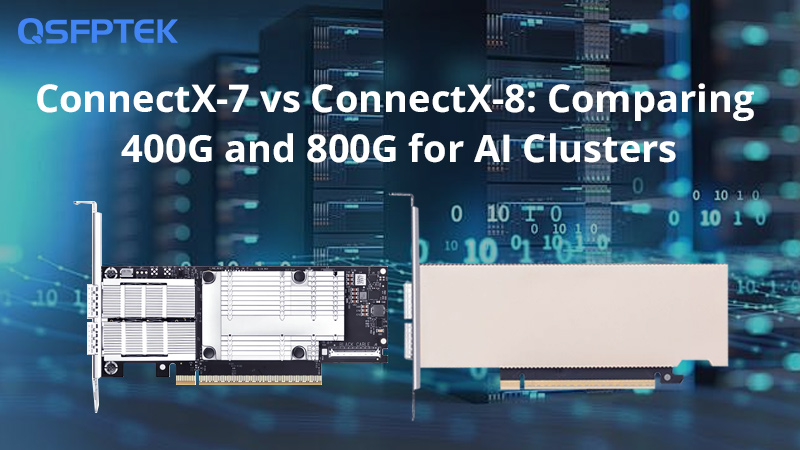 ConnectX-7 vs ConnectX-8: Comparing 400G and 800G for AI Clusters
Compare NVIDIA ConnectX-7 and ConnectX-8, including 400G vs. 800G, NDR vs. XDR, PCIe, transceivers, cables, and AI cluster use cases.Yana 09/16/2026 111Read More >
ConnectX-7 vs ConnectX-8: Comparing 400G and 800G for AI Clusters
ConnectX-7 vs ConnectX-8: Comparing 400G and 800G for AI ClustersCompare NVIDIA ConnectX-7 and ConnectX-8, including 400G vs. 800G, NDR vs. XDR, PCIe, transceivers, cables, and AI cluster use cases.Yana 09/16/2026 111Read More > -
 800G to the Server: Branch Links and NIC Deployment in AI Clusters
Analyze end-to-end 800G breakout links in AI clusters. Discover how to balance ToR thermal loads, 112G PAM4 link loss, and PCIe 5.0 NIC hardware offloading.Leslie 09/15/2026 33Read More >
800G to the Server: Branch Links and NIC Deployment in AI Clusters
800G to the Server: Branch Links and NIC Deployment in AI ClustersAnalyze end-to-end 800G breakout links in AI clusters. Discover how to balance ToR thermal loads, 112G PAM4 link loss, and PCIe 5.0 NIC hardware offloading.Leslie 09/15/2026 33Read More > -
 NVIDIA ConnectX-8 C8180 vs C8240: Architectural Differentiators and SuperNIC Selection for AI/HPC
This article will analyze two ConnectX-8 network card models with the same hardware and software baseline but with different port mapping and speed options. Provides a comprehensive overview of their technical variations and application scenarios to help network architecture teams make decisions that more closely fit their real-world networking needs.Moore 09/11/2026 64Read More >
NVIDIA ConnectX-8 C8180 vs C8240: Architectural Differentiators and SuperNIC Selection for AI/HPC
NVIDIA ConnectX-8 C8180 vs C8240: Architectural Differentiators and SuperNIC Selection for AI/HPCThis article will analyze two ConnectX-8 network card models with the same hardware and software baseline but with different port mapping and speed options. Provides a comprehensive overview of their technical variations and application scenarios to help network architecture teams make decisions that more closely fit their real-world networking needs.Moore 09/11/2026 64Read More > -
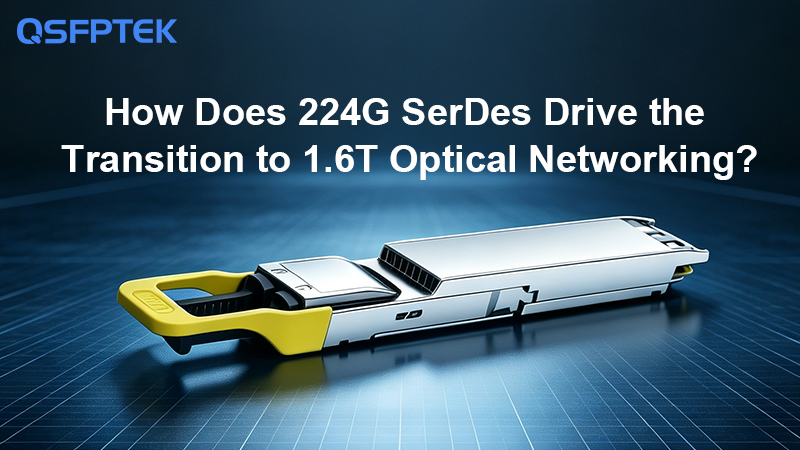 How Does 224G SerDes Drive the Transition to 1.6T Optical Networking?
Discover how 224G SerDes scales networks to 1.6T, breaking down signal integrity challenges and real-world 1.6T transceiver implementations.Moore 09/04/2026 168Read More >
How Does 224G SerDes Drive the Transition to 1.6T Optical Networking?
How Does 224G SerDes Drive the Transition to 1.6T Optical Networking?Discover how 224G SerDes scales networks to 1.6T, breaking down signal integrity challenges and real-world 1.6T transceiver implementations.Moore 09/04/2026 168Read More > -
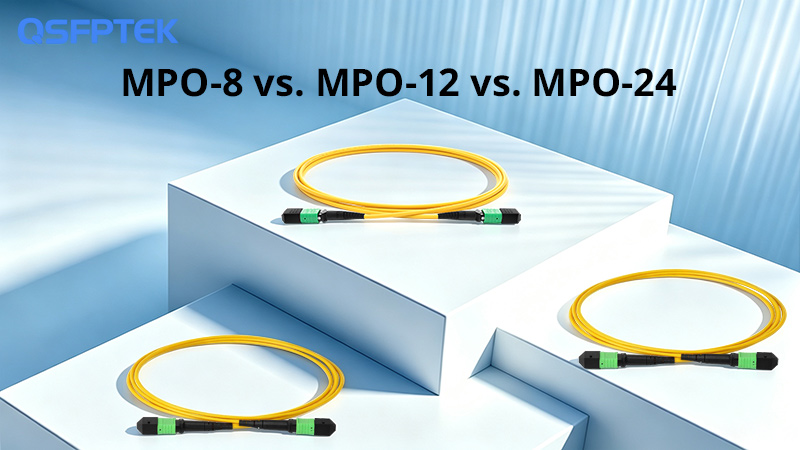 MPO-8 vs. MPO-12 vs. MPO-24: How to Choose the Right Fiber Optic Cable?
Compare MPO-8, MPO-12, and MPO-24 fiber optic cables. Learn their differences, applications, fiber counts, and how to choose the right MPO cable for your data center.Yana 09/04/2026 47Read More >
MPO-8 vs. MPO-12 vs. MPO-24: How to Choose the Right Fiber Optic Cable?
MPO-8 vs. MPO-12 vs. MPO-24: How to Choose the Right Fiber Optic Cable?Compare MPO-8, MPO-12, and MPO-24 fiber optic cables. Learn their differences, applications, fiber counts, and how to choose the right MPO cable for your data center.Yana 09/04/2026 47Read More > -
 Near Packaged Optics vs. Co Packaged Optics: Evolution Paths of 1.6T Networks
Compare NPO and CPO in 1.6T networks. Learn how NPO overcomes yield and thermal challenges as a practical transition toward the ultimate CPO architecture.Leslie 09/04/2026 45Read More >
Near Packaged Optics vs. Co Packaged Optics: Evolution Paths of 1.6T Networks
Near Packaged Optics vs. Co Packaged Optics: Evolution Paths of 1.6T NetworksCompare NPO and CPO in 1.6T networks. Learn how NPO overcomes yield and thermal challenges as a practical transition toward the ultimate CPO architecture.Leslie 09/04/2026 45Read More > -
 Silicon Photonics and CPO Break 1.6T Network Limits
Discover how Silicon Photonics and CPO break 1.6T network power limits in AI data centers. Explore QSFPTEK's 1.6T and 800G high-efficiency optical solutions.Leslie 09/01/2026 34Read More >
Silicon Photonics and CPO Break 1.6T Network Limits
Silicon Photonics and CPO Break 1.6T Network LimitsDiscover how Silicon Photonics and CPO break 1.6T network power limits in AI data centers. Explore QSFPTEK's 1.6T and 800G high-efficiency optical solutions.Leslie 09/01/2026 34Read More >
first
flipPage
last
