


Everything You Need to Know About Optical Circuit Switch

The booming development of cloud computing, big data, and artificial intelligence has led to a dramatic increase in network bandwidth demand. Data centers and network service providers are also facing increasingly stringent bandwidth and latency requirements. Against this backdrop, optical circuit switching has become an industry focus. Traditional switches, when handling high-volume, long-distance communications, not only suffer from high latency and power consumption, but are also limited by the processing capabilities of their switching chips, making them unable to meet these demands. Optical circuit switching, on the other hand, enables end-to-end link transmission directly at the optical layer, eliminating the need for optical-to-electrical signal conversion. This provides a low-latency, low-power solution for data transmission. This article will explain what optical circuit switching is and its specific applications.
What is OCS and How Does It Work
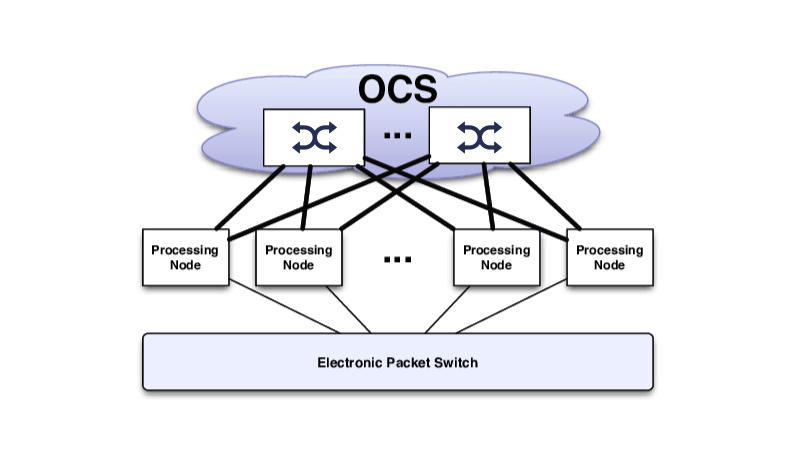
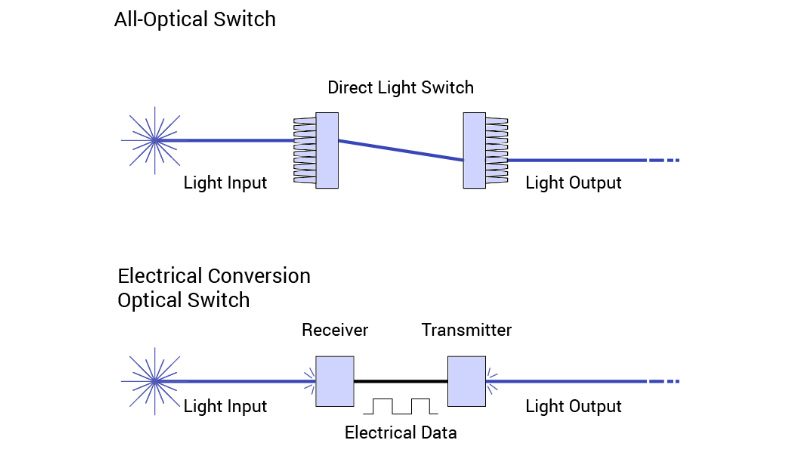
An OCS is a network device that uses optical devices for data exchange. It establishes direct physical channels between different fiber optic links through optical cross-connect technology, enabling direct optical signal transmission, eliminating the optical-to-electrical-to-optical or electrical-to-optical-to-electrical conversion required by traditional switches. This significantly reduces latency and power consumption associated with signal conversion. The OCS also controls the connection and disconnection of optical switches and manipulates optical signals within optical cables, creating transmission paths for signals that minimize signal loss and latency.
The key components of an OCS are optical switches, wavelength division multiplexing (WDM), and optical amplifiers.
As the backbone of communication systems, optical switches route optical signals from one port to another without the optical-to-electrical conversion required by traditional switches. There are many types of optical switches, including liquid crystal switches, micro-electromechanical system (MEMS) switches, and silicon photonic switch arrays. They provide the physical connection between optical signals and can be selected based on specific needs.
WDM multiplexing multiplexes multiple optical signals using different wavelengths onto a single optical fiber, significantly increasing network capacity and enabling devices to handle large amounts of data. Optical amplifiers are key components in long-distance transmission, ensuring optical signal integrity and data reaches its destination intact. They boost the strength of optical signals as they travel through the network.
OCS Working Principle
The operating principle of an OCS is similar to telephone circuit switching. When two ports need to communicate, the controller configures a path in the optical switch matrix, using optical components to route the optical signal from one fiber to another, forming an independent physical optical path.
During this process, optical signals are transmitted directly without conversion to electrical signals or electronic chip parsing and buffering. Because the process does not involve signal retiming, error correction, or packet forwarding, it achieves extremely low end-to-end latency and transmission speeds approaching the speed of light. Once the optical path is established, both communicating parties enjoy exclusive use of the link resources until the communication ends or the controller issues a new command. This dedicated link and near-light-speed transmission speed make OCS highly advantageous in applications requiring high speed, stability, and extremely low latency.
Advantages of OCS
OCS has gained popularity due to its following advantages.
High Bandwidth: OCS supports high-speed signal transmission from 1G to 800G, offering flexible adaptability. Because it doesn't require optical modules, it has no rate limitations and has the potential to evolve to higher speeds such as 1.6T and 3.2T.
Low Latency: Because OCS eliminates the need for optical-to-electrical conversion, buffering, and processing during peak hours, it only incurs the physical delay of optical signals traveling through the medium. Light travels at extremely high speeds, making it suitable for applications that are extremely sensitive to latency.
Low Power Consumption: During signal transmission, signals don't require optical-to-electrical conversion, eliminating the processing required by the DSP and switch chips. This significantly reduces OCS power consumption and meets energy conservation requirements.
High Reliability: Because OCS uses dedicated transmission links, it offers extremely high reliability, virtually no congestion, and stable service quality.
Scalability: Because OCS operates directly over optical fiber without optical modules, it can be easily expanded by adding more fiber switches and optical fibers to meet bandwidth requirements in various scenarios.
Disadvantages of OCS
Of course, despite its advantages, OCS also has certain limitations.
First, mainstream OCS switching speeds are slow, with switching times in the millisecond range, compared to nanoseconds for traditional switches. This makes OCS unsuitable for bursty services that require microsecond-level scheduling.
Second, its granularity is insufficient. Unlike traditional switches, it cannot flexibly process small packets, and can only establish port-level optical paths. This results in poor handling of short-duration traffic and dynamic bursts.
Third, OCS hardware costs are high, requiring extensive fiber cabling. Furthermore, its operational and maintenance costs are high, making its deployment and application unsuitable for some small and medium-sized networks.
Finally, OCS relies on a control system for scheduling and requires integration with SDN or dedicated scheduling software to achieve intelligent scheduling. Otherwise, its operational complexity and maintenance costs are high.
Applications
Large Data Center Interconnection
For large, cross-regional data center interconnection, OCS provides stable, ultra-high bandwidth support, meeting the needs of data replication, migration, and business expansion. It also establishes extremely low-latency, highly reliable optical links between data centers, ensuring information transmission. Furthermore, it reduces overall data center energy consumption and provides flexible data transmission.
High-Performance Computing Cluster Interconnection
Since HPC computing tasks require extensive communication between nodes, OCS can establish fixed optical paths between computing nodes, giving them exclusive access to the entire link and transmitting signals at near-light speeds, providing high bandwidth and low latency.
Defense and Scientific Research Networks
Due to the highly confidential nature of defense and scientific research, data transmission requires high security and timeliness. OCS establishes dedicated links that are private and fixed, unused for other purposes. This provides high security and extremely low latency, making it ideal for secure information transmission applications.
Conclusion
Optical circuit switching, with its advantages of high bandwidth, low latency, and low energy consumption, plays a vital role in data centers, high-performance computing, and latency-sensitive applications. Although its cost is relatively high and its switching speed is limited, with the continuous development of technology, it is possible to develop it in tandem with traditional switches to build more efficient and energy-efficient networks.


share

