


Everything You Should Know About 1.6T DAC Cables

With the widespread adoption of AI, 1.6T DACs are becoming increasingly sought after. As the training volume of large AI models continues to expand, the growth rate of data center intranet traffic has completely surpassed the growth level of the traditional cloud computing era. For modern GPU computing clusters, high-speed data communication between nodes has become a key bottleneck, no longer limited to the computing power performance of a single GPU card. Against this backdrop, data center network architectures are steadily iterating from 400G and 800G to 1.6T high-bandwidth architectures. Especially in the InfiniBand XDR networking architecture, the requirements of ultra-bandwidth, ultra-low latency, and high-density deployment have placed new standards on the underlying interconnect transmission solutions. Compared to traditional optical module solutions, 1.6T DACs, with their advantages of low power consumption, low latency, and high cost-effectiveness, have become the preferred short-distance interconnect solution for AI computing clusters.
What is a 1.6T DAC
A 1.6T DAC is a high-speed copper direct-connect solution primarily used for short-distance, rack-mount interconnects between switches, GPU servers, and storage nodes. Unlike optical modules, DACs do not require photoelectric conversion; they transmit high-speed electrical signals directly through copper cables. Due to its simpler structure, lacking optical chips and photoelectric conversion, it boasts lower power consumption and lower latency.
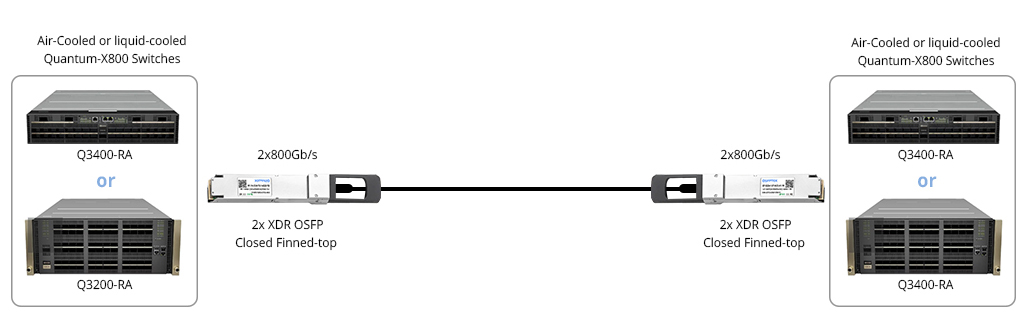
Mainstream 1.6T DACs are typically based on an OSFP224 package design, employing a Twin-port 2x 800G architecture and PAM4 modulation. Internally, it achieves a total bandwidth of 1.6Tbps through multiple 200Gbps PAM4 electrical channels. This means a single 1.6T DAC can accomplish the data transmission required by multiple high-speed cables in the past. For AI data centers, this high-density deployment significantly reduces rack cabling complexity while improving switch port utilization and lowering overall operating costs.
Why Does the 1.6T Engine Rely on Active DAC
In 25G and 100G network applications, passive DACs can meet the needs of most short-distance transmission scenarios. However, when single-channel rates increase to 200Gbps, the limitations of traditional passive copper cables become apparent, and the integrity of signal transmission faces challenges.
In high-frequency, high-speed transmission scenarios, transmission defects such as insertion loss, inter-symbol interference, signal jitter, and near-end crosstalk are further exacerbated. Therefore, to ensure transmission stability and signal quality at 200G and higher speeds, active DACs are used. Active DACs integrate equalization, signal amplification, and pre-emphasis signal conditioning units, effectively compensating for signal loss and distortion during high-speed transmission.
In data deployment, ACC not only significantly improves link stability but also effectively extends copper cable transmission distance. In long-term, high-load, uninterrupted operation environments such as AI computing clusters, active DACs offer more outstanding adaptability and application advantages compared to traditional passive DACs.
PAM4 Becomes the Key to the 1.6T DAC
The core reason why the 1.6T DAC can achieve such high bandwidth is the development and widespread adoption of PAM4 modulation technology.
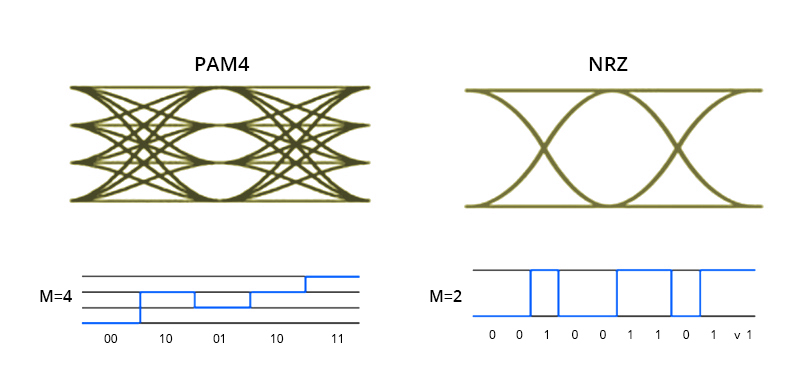
Traditional NRZ signals can only carry 1 bit of data per symbol, while PAM4 can transmit 2 bits of information. This is equivalent to doubling the bandwidth efficiency without significantly increasing the frequency.
However, PAM4 also has significant drawbacks. Due to its reduced level spacing, the system becomes more sensitive to noise, meaning that high-speed links require stronger signal processing capabilities. Especially at 200Gbps per channel, even minor jitter or crosstalk can cause a rapid increase in the bit error rate.
The 1.6T DAC is essentially more than just a copper cable; it has become a complex high-speed interconnect system integrating high-speed SerDes, electrical optimization, and signal compensation capabilities.
The Value of a 1.6T DAC in the InfiniBand XDR
InfiniBand XDR represents a significant development direction in current AI and HPC networks, with its core objective being to solve the low-latency communication problem in large-scale GPU clusters.
Compared to traditional Ethernet, InfiniBand emphasizes ultra-low latency, high throughput, RDMA capabilities, and high synchronization efficiency between large-scale nodes.
During large model training, GPUs frequently need to synchronize gradients and exchange parameters. If network latency is too high, even with powerful GPUs, training efficiency will decrease due to communication bottlenecks.
A 1.6T DAC is perfectly suited for this scenario. Since the DAC does not require photoelectric conversion, its link latency is typically lower than that of optical module solutions. Furthermore, within a rack or between adjacent racks, the DAC offers lower power consumption and higher deployment density. This is a crucial advantage for AI data centers, which increasingly emphasize energy efficiency.
Applications
The primary applications of the 1.6T DAC are short-distance connections within AI and HPC clusters, particularly in environments with extremely high requirements for bandwidth, latency, and stability, such as:
Connections between GPU servers and switches
Rack interconnects in Spine-Leaf architectures
NVMe over Fabrics high-speed storage networks
High-density InfiniBand XDR clusters
In these scenarios, the 1.6T DAC offers significant advantages over optical modules in terms of low power consumption, low latency, high bandwidth, and deployment complexity, effectively reducing cabling complexity and subsequent operating costs.
Conclusion
For short-distance transmission scenarios, the 1.6T DAC is not only a low-cost alternative but also a critical infrastructure that balances bandwidth, latency, power consumption, and optimized cabling. Especially in InfiniBand XDR networks, high-speed ACC DACs better meet the low-latency, stable communication requirements of large-scale GPU clusters. Furthermore, as AI clusters continue to expand, the role of the 1.6T DAC in data centers will further increase.


share

