


OSFP vs. OSFP-XD: Which Delivers Better 1.6T Transceiver Performance?

The rapid development of AI is driving upgrades to global computing infrastructure. NVIDIA’s Blackwell-series GPUs list 1.6T transceiver as standard, directly boosting market demand from an early 2 million units to 4–8 million units, achieving a doubling in growth. It is estimated that shipments of 1.6T optical modules will reach over 1 million units in 2025, marking the fastest growth in the history of optical communications. This article introduces 1.6T transceiver modules and compares the OSFP and OSFP-XD form factors, providing guidance for enterprises planning 1.6T networks.
Tracing the Evolution of Optical Transceivers from 100G to 1.6T
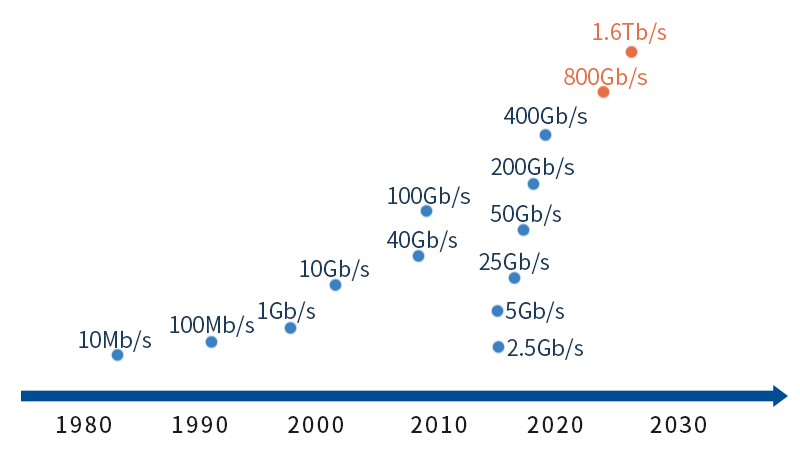
Over the past few years, optical modules have undergone rapid development from low speeds to 1.6T modules. Each generation has introduced new technologies and higher speeds in order to meet the growing demands of networks.
100G Module Beginnings (2015–2018)
100G transceivers adopt the mainstream 4×25G architecture, achieving a total throughput of 100 Gbps.
In terms of modulation, the 100G transceiver module primarily uses the mature and cost-effective NRZ modulation. Regarding packaging, early CFP and CFP2 modules were relatively large and mainly used for long-distance transmission, while the smaller QSFP28 package, with its similar size to 40G QSFP+, quickly became the mainstream choice for deploying 100G networks in data centers. These modules consumed over 3W per port.
With these technical characteristics, 100G optical modules are widely used in data center backbone interconnection, core router connections, and long-distance trunk transmission, opening a new stage for the popularization and evolution of high-speed networks.
400G Optical Transceiver Advances (2019–2022)
To achieve network speeds up to 400G, the industry can no longer rely on simply increasing the number of channels. Therefore, 400G optical modules have introduced a series of key technological innovations, the most crucial of which is PAM4 modulation technology. The 400G interface standard, 4x 100G PAM4 and 8x 50G PAM4, has been officially proposed by the IEEE and is used in 400G optical transceivers. In the packaging area, QSFP-DD and OSFP have both dominated 400G as high-speed connectivity needs demand.
800G Transceiver Module Expansion (2023–2025)
800G optical modules are considered a natural evolution of 400G, and their structure is predominantly an 8×100G PAM4 one. And it's important to note that the 800G era also formally ushered in the CPO and LPO exploration phase.
1.6T Optical Transceiver Innovation (2025–2027)
As a core device for the interconnection of next-generation data centers and AI computing power, 1.6T module transceiver has a variety of technology content, covering chip integration, signal processing, packaging process and new materials dimensions aspects. The progress of 1.6T modules in 2024 is expected to primarily focus on testing, certification, and small-batch production. Large-scale production is expected to begin in 2025.
Why 1.6T Optical Modules Shaping the Future of AI Networking and Data Centers?
In an era of explosive growth in demand for artificial intelligence and computing power, data center networks are facing unprecedented bandwidth pressure. The emergence of 1.6T optical modules is not a simple speed upgrade, but a core technology that fundamentally breaks through existing bottlenecks and leads future architectural changes.
Enhancing Bandwidth and Data Rate Capabilities
The 1.6T transceiver module employs more advanced optical technology, significantly improving bandwidth utilization and transmission rate, enabling higher-density and more efficient data transmission. It can meet the demands of modern data centers for massive data transmission, achieving full resource utilization through higher port density without requiring additional server room space. With sophisticated modulation and multiplexing technologies, the 1.6T module can transmit more data per unit time, reduce transmission latency, and improve the overall network service quality, becoming a key foundation for future data center architecture and operational upgrades.
Reducing Power Consumption and Optimizing Efficiency
The 1.6T optical module achieves higher energy efficiency through the use of multiple innovative technologies. Its silicon photonics and co-packaged optics (CPO) design reduces power consumption, making it ideal for hyperscale data centers.
Supporting High-Performance Data Center Networks
1.6T optical modules are the key to supporting high-density data center networks, meeting the requirements of increasing bandwidth-efficient transmission. They pass more data across the network and are responsible for complex topologies like Spine-Leaf, which leads to increased scalability and better low-latency performance. In addition, 1.6T modules are backwardly compatible with current systems and can be upgraded instead of replacing equipment en masse to assist enterprise data centers in maintaining good operability against a rising business load.
1.6T OSFP Modules Overview
Why is the OSFP MSA Essential in Optical Communication?
OSFP MSA brings a wide range of advantages to optical communications through its standardized high-speed optical module design. The OSFP form factor has followed a clear and steady upgrade path. The first-generation 400G OSFP adopted 8×50G PAM4 technology. By 2023, the 800G OSFP became the market mainstream, utilizing 8×100G PAM4. Entering 2025, the 1.6T era begins, achieving new breakthroughs through silicon photonics integration and coherent optical technologies. It's backward compatibility allows seamless system integration during upgrade while keeping existing operation running. These attributes can be used to improve performance and flexibility in data-rich centers.
What is 1.6T OSFP Transceiver Module?
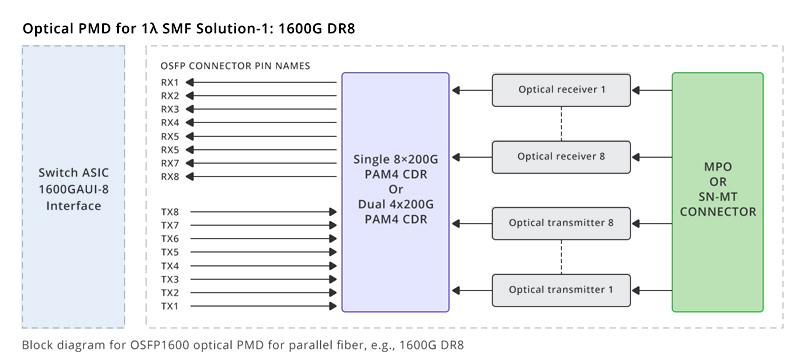
In 2022, the OSFP MSA introduced the OSFP1600 specification. Also known as 1.6T OSFP or OSFP 224G, this module features 8×200G host interfaces, overcoming the electrical performance challenges while maintaining mechanical reliability and full backward compatibility with 400G and 800G OSFP modules.
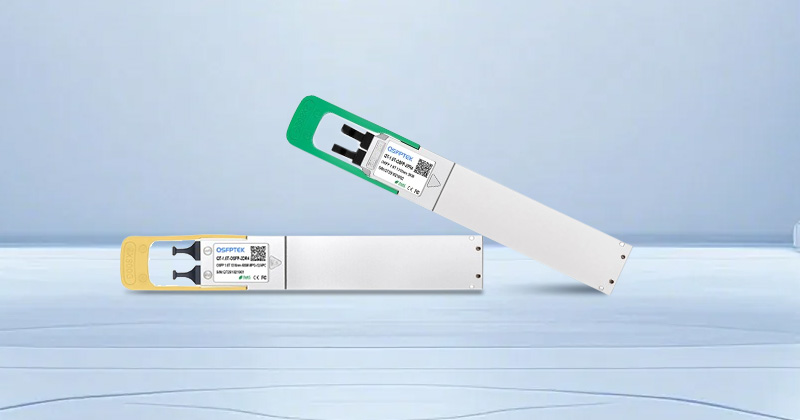
The 1.6T OSFP achieves an aggregate bandwidth of 1.6T across 8 channels, each delivering 200Gbps. By providing higher total bandwidth with fewer channels, it enhances data transmission efficiency. The OSFP 224G is equipped with an integrated heatsink that optimises system performance, making it an ideal solution for hyperscale data centers, supercomputing environments and HPC networks.
1.6T OSFP-XD Modules Overview
What is OSFP-XD Form Factor?
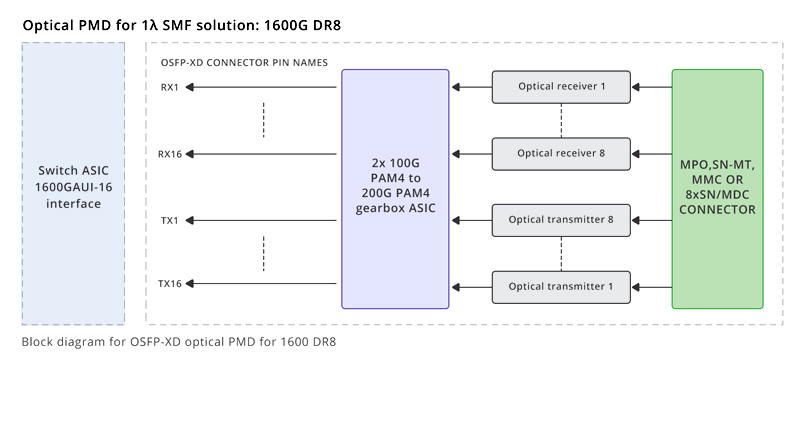
OSFP-XD (Octal Small Form Factor Pluggable – eXtra Dense) is an ultra-high-density optical transceiver form factor. Compared with the traditional OSFP, OSFP-XD expands the number of lanes from 8 to 16. Currently, it can achieve a total bandwidth of 1.6T with 16 lanes at 100 Gb/s, and in the future, it has the potential to deliver 3.2T with 16 lanes at 200 Gb/s. The OSFP-XD is designed with high-power compatibility, copper cable compatibility and maximize port density.
What is 1.6T OSFP-XD Transceiver Module?
A 1.6T OSFP-XD transceiver is a high-density, pluggable optical module for data centers and AI clusters that uses the OSFP-XD form factor to transmit data at a 1.6 Terabit per second rate. It features advanced technologies like PAM4 modulation and silicon photonics to enable high-speed, low-power data links.
Comparison Between OSFP-XD and OSFP for 1.6T Optical Transceivers
Appearance
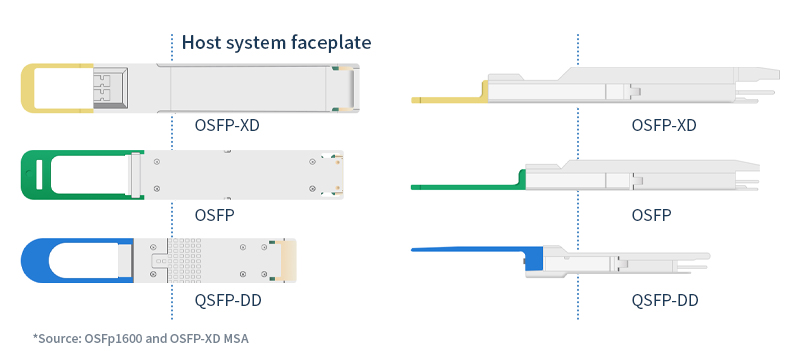
Compared with OSFP1600 modules, the OSFP-XD is slightly longer and adds a second row of contacts on the internal PCB or the card within the module, doubling the number of high-speed electrical signals. The OSFP-XD transceivers is about 20% larger in volume than the OSFP1600, with its internal volume for passive DAC applications increased by over 12%.
Channels and Bandwidth
OSFP employs 8 channels to achieve 1.6T bandwidth at 200G per channel, while OSFP-XD, with 16 channels, delivers the same 1.6T bandwidth using current 100G channels and allows for future upgrades to 3.2T at 200G per channel, providing greater flexibility for channel expansion.
Heat Dissipation and Thermal Design
The OSFP form factor can meet the thermal requirements of 1.6T transceivers with a standard heat sink, making it suitable for modules with typical power consumption. In contrast, the OSFP-XD design offers more thermal headroom, supporting up to 40W of heat dissipation to accommodate future high-power modules such as 1600-ZR and 3200G.
Power Consumption
OSFP 224G generally operate at lower power levels, keeping power density in line with 400G and 800G applications. In contrast, OSFP-XD supports higher power levels and allows for increased port density in limited space, enhancing overall system energy efficiency.
Which Is the Right Choice for Your 1.6T Ethernet Network: OSFP or OSFP-XD?
So for 1.6T network planning enterprise, the existing infrastructure, business scale, and future expansion needs will be all have to be considered. 1.6T OSFP adopts an 8-lane design, and is compatible with most of the switches available in the market. It is ideal for medium-sized data centers or for upgrading existing 400G/800G equipment, offering stable interconnections and reliable operation. For enterprises looking to upgrade their networks, rapidly expand capacity. OSFP, which is built on a mature ecosystem, is the more dependable choice.
In contrast, OSFP-XD features a 16-lane design that may be incompatible with most mainstream equipment, making it primarily suited for experimental testing, performance evaluation, or cutting-edge research projects. However, it is not recommended as the primary option for current production networks. When planning to take 1.6T OSFP-XD solutions, enterprises shall evaluate their current equipment and optical module technologies compatibility first, and even checking out early-stage technical risk is recommended.
Conclusion
Choosing between 1.6T OSFP and OSFP-XD form factors requires careful consideration. Keeping pace with industry trends, QSFPTEK has launched 1.6T transceiver modules designed for next-generation data centers and AI computing infrastructure. You can contact our technical team to discover the most suitable upgrade options and products for your network architecture.


share

