


What is the 400G QSFP112 Optical Transceiver

As one of the solutions to address the ever-increasing demands for higher speeds and performance in data center networks, the 400G QSFP112 meets the needs of data centers with its high performance, low power consumption, and excellent compatibility. What is the 400G QSFP112, and why is it an ideal choice for next-generation data centers? This article will provide you with a detailed understanding.
What is a 400G QSFP112
The QSFP112 is a four-channel pluggable optical module package based on 112G PAM4 electrical signals, using existing QSFP modules and cage/connector systems. Compared to the QSFP56, the QSFP112 achieves twice the bandwidth density with the same number of channels. Each of the four channels in the QSFP112 supports a transmission rate of 112Gbps.
The 400G QSFP112 module features a low-power design, typically consuming less than 10W. It also employs optimized heat dissipation structures, such as a flat-top design, to improve heat dissipation efficiency and ensure stable operation in high-density racks.
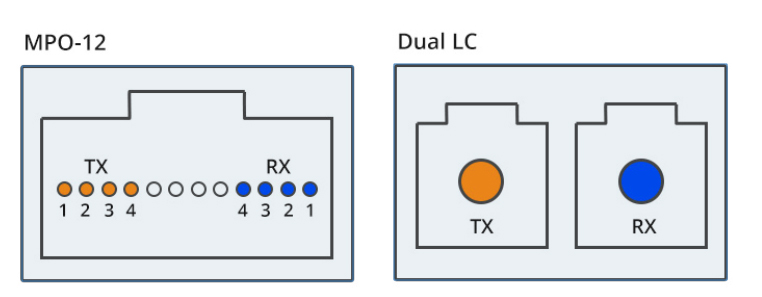
The QSFP112 offers two interface types: MPO-12/APC and Dual LC. This design allows for easy connection to existing modules, enabling rapid network upgrades to 400G.
Types of 400G QSFP112
The 400G QSFP112 comes in different types to meet various application needs. Common types include single-mode and multi-mode. The multi-mode type is the 400G QSFP112 SR4, suitable for short-distance transmission within data centers, with a transmission distance of 50m. Single-mode types include the 400G QSFP112 DR4, DR4+, and FR4, with transmission distances of 500m and 2km, respectively. Below is a comparison of their specific parameters:
Different Between 400G QSFP112, OSFP, and QSFP-DD
Common 400G module packages include QSFP-DD and OSFP. While all three can achieve 400G bandwidth, they differ in some parameters and applicable scenarios.
QSFP-DD, the most common 400G optical module package, has 8 electrical channels, each with a rate of 50Gbps. It is smaller than OSFP and almost the same size as QSFP112, but lacks a heat dissipation structure. It is typically used in core layers or long-distance interconnects.
OSFP, like QSFP-DD, has 8 electrical channels. It is the largest and has the highest power consumption. OSFP has a heat dissipation shell, providing excellent heat dissipation performance, and is typically used in high-power AI interconnect scenarios.
QSFP112 transmits through 4 electrical channels, each supporting 112Gbps. It combines the small size of QSFP-DD with the heat dissipation structure of OSFP, offering excellent heat dissipation. This makes it very suitable for ToR links and high-density edge computing node deployments.
Advantages of QSFP112
Compared to QSFP-DD and OSFP packages, QSFP112 offers several advantages:
First, QSFP112 reduces the number of electrical channels to half that of QSFP-DD and OSFP for the same bandwidth, resulting in four channels. This effectively reduces power consumption and heat generation, making it suitable for green data center construction.
Second, it has a smaller footprint. While using the OSFP form factor, QSFP112 offers a smaller footprint, providing more 400G ports in the same space, thus increasing overall network density.
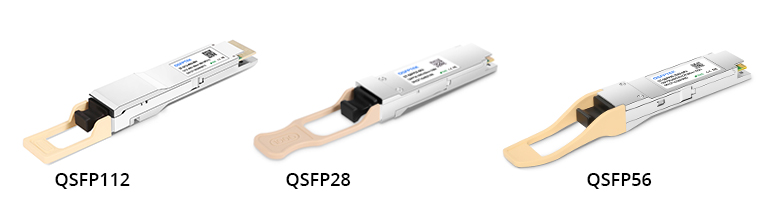
Third, QSFP112 is compatible with QSFP28 and QSFP56 physical interfaces, supporting plug-and-play functionality, simplifying deployment and maintenance, and reducing operational complexity and deployment risks.
Finally, its low power consumption, compact structure, and improved thermal design give QSFP112 excellent thermal management capabilities. This makes QSFP112 ideal for deployment in rack-top devices or edge computing nodes.
Applications of 400G QSFP112
High-Density Data Centers: In high-density, large-scale data centers, the sheer number of links between switches creates extremely high demands for power consumption, density, and heat dissipation. The 400G QSFP112, with its small size, low power consumption, and excellent thermal architecture, is the preferred choice in this scenario.
AI and HPC Clusters: AI training clusters are susceptible to latency between nodes. The QSFP112, with its 112G PAM4 electrical interface, significantly reduces physical-level data processing latency. Furthermore, the QSFP112 utilizes the latest chip technology, offering higher integration and faster signal recovery, resulting in lower latency compared to 50G PAM4 modules.
Edge Data Centers and Regional Nodes: In distributed edge computing, some nodes are power-constrained. The QSFP112 module, with its lower power consumption than QSFP-DD and OSFP modules, provides more stable 400G interconnects in these power-constrained nodes. This satisfies bandwidth requirements while avoiding the increased costs associated with over-deployment.
Conclusion
The 400G QSFP112 optical module is one of the key solutions in the fields of 400G Ethernet and AI connectivity. With its 112G PAM4 technology per channel, low power consumption, high-density design, and strong compatibility, it has become a key transition solution for data centers moving from 400G to 800G.


share

