


200G DAC vs AOC Cable: A Practical Selection Guide for Data Centers

As AI, cloud computing, and high-speed data center networks continue to grow, the need for higher bandwidth is increasing rapidly. While 400G and even 800G networks are becoming more popular, 200G connectivity still remains an important solution for many data centers. Among the most widely used 200G interconnect options, DAC and AOC cables each offer different advantages in cost, distance, and deployment flexibility. This article compares 200G DAC and AOC to help you choose the right solution for different deployment scenarios.
200G Active Optical Cable and 200G Direct Attach Copper Overview
What is an AOC Cable for 200G Ethernet?
200G Active Optical Cable is a pre-terminated cabling solution that combines optical transceivers and multimode fiber into one unit. You can directly connect both ends to network devices without purchasing separate transceivers and fiber cables, making deployment simpler and more convenient.
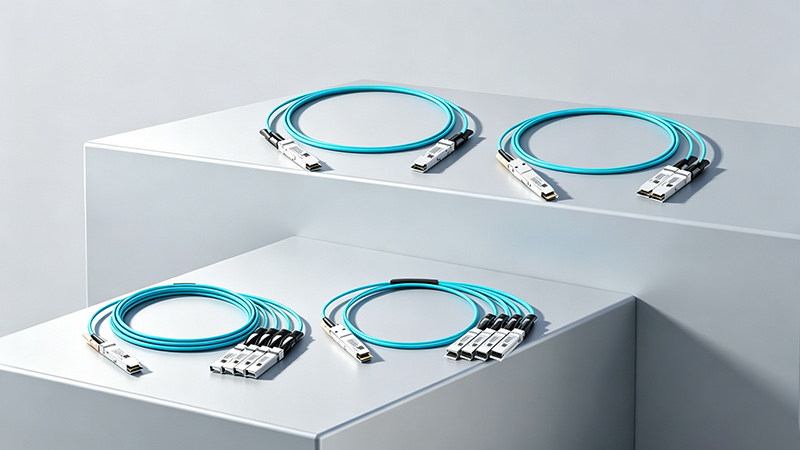
Because it uses fiber optic transmission, 200G Ethernet AOC offers low signal loss, strong resistance to electromagnetic interference, and longer transmission distances, typically ranging from several meters to over 100 meters. In addition, AOC cables are lighter and easier to manage than copper cables.
What is a DAC Cable for 200G Ethernet?
A 200G DAC (Direct Attach Copper) is a high-speed cable solution that uses copper conductors for data transmission. Like AOC, it features integrated connectors on both ends and can directly connect switches, servers, and storage devices.
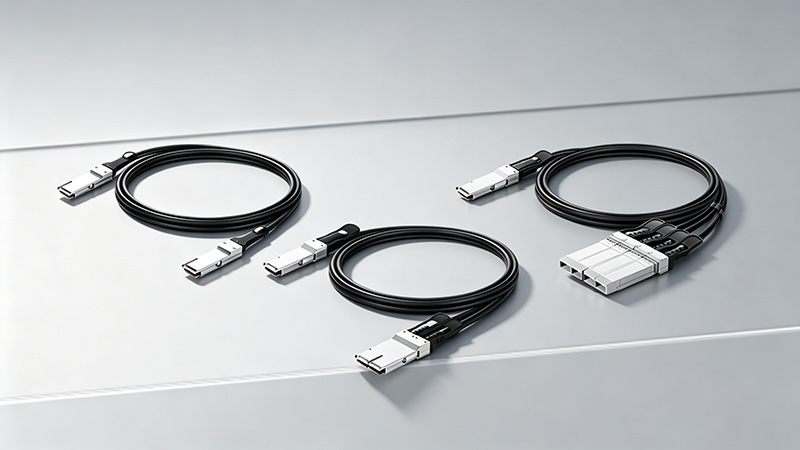
The main advantage of 200G DAC is its low cost. Since it does not require optical components or optical-electrical conversion, DAC is usually more affordable than AOC solutions. It is mainly used for short-distance connections, such as server-to-switch links within the same rack.
200G Ethernet DAC can be divided into Passive DAC and Active DAC. Passive DAC is suitable for very short distances with lower power consumption, while Active DAC supports slightly longer distances by improving signal quality. However, due to the limitations of copper transmission, DAC cables are generally used for distances of 1 to 5 meters.
Common Form Factors of 200G AOC and DAC
QSFP56 Form Factor
QSFP56 can be regarded as an upgrade from QSFP+ and QSFP28. It adopts a 4-channel design, with each lane supporting 50G transmission through PAM4 modulation technology, allowing a total bandwidth of 200Gbps.
Compared with earlier QSFP+ and QSFP28 form factors that mainly use NRZ signaling, QSFP56 introduces PAM4 encoding to achieve higher transmission efficiency without significantly increasing the number of channels.
QSFP-DD Form Factor
QSFP-DD, short for Quad Small Form-factor Pluggable Double Density. Compared with QSFP56, QSFP-DD provides a higher lane density by supporting up to 8 electrical channels.
Depending on the modulation technology used, QSFP-DD can support different transmission rates. With NRZ, it can achieve 200G transmission, while PAM4 modulation enables much higher bandwidth, including 400G Ethernet applications.
Key Differences That Impact Your Decision About DAC vs Fiber AOC
Transmission Distance
Transmission distance is one of the most obvious differences between DAC and AOC. Since 200G Ethernet DAC uses copper cables, it is typically designed for short-distance connections of 1 to 5 meters, making it ideal for connections within the same rack. In contrast, 200G Fiber AOC uses optical fiber and can support much longer distances, making it more suitable for inter-rack and longer in-data-center connections.
Power Consumption
200G DAC cable uses less power than fiber AOC. Passive DAC cables, in particular, require very little power because they do not use optical-electrical conversion components. AOC cables integrate optical transceivers and therefore require additional power for electro-optical conversion. However, compared with separate transceiver solutions, AOC still provides good power efficiency.
Cost Efficiency
DAC is usually the cheaper option. Its simple design means it doesn't need lasers or optical parts, so it's cheaper than AOC. This is one reason why DAC is so popular for linking data centers that are close together. AOC is more expensive, but it works better and is worth the extra money in some situations.
Latency
DAC has lower latency than AOC because it transmits signals directly through copper cables, while AOC requires optical-electrical signal conversion. But the difference is normally very small and is hardly noticeable in most data center networks. For normal network setups, both AOC and DAC can provide reliable connections with low delay.
Electromagnetic interference (EMI)
Resistance to electromagnetic interference is another key difference. Since DAC uses copper cables, it is more susceptible to EMI. Fiber active optical cable, on the other hand, uses optical fiber and is immune to electromagnetic interference, allowing it to provide more stable signal transmission in high-density and high-noise environments. This is one of the major reasons why 200G active optical cable is becoming increasingly popular in large-scale data centers and high-speed networks.
AOC Cable vs DAC Cable Management Considerations
Cable Thickness and Flexibility
Since 200G Ethernet DAC cables are made with copper conductors they are generally thicker and heavier than AOC cables, especially as speeds and distances increase. AOC cables, on the other hand, utilize optical fiber to be able to become thinner and lighter as well as allowing easier routing becoming organized.
Rack Density and Space Utilization
Reasonable optimization of rack space utilization becomes more needed when data center port density goes up. Due to their larger thickness, DAC cables can take up more space and cause extra challenges for cabling in larger-scale deployments. Thin AOC cables permit greater cable density in smaller rack spaces.
Airflow and Thermal Impact
Dense deployments of 200G DAC cables may restrict airflow and reduce cooling because they are thicker. AOC cables are thinner and do not block airflow as much, resulting in a better thermal performance.
So AOC is usually more suitable for maximizing airflow and preventing overheating in the large data centers that need good cooling.
Deployment Scenarios: 200G DAC vs AOC
Intra-Rack (Same Rack)
For connections within the same rack, 200G Ethernet DAC is usually the more common choice. Since the distance between servers, switches, and storage devices is typically short, most links only require 1 to 5 meters of cabling. DAC offers lower cost and lower power consumption, making it ideal for short-distance intra-rack connections. In addition, cabling within the same rack usually does not require long cable lengths, allowing DAC to provide cost-effective high-speed connectivity.
Inter-Rack (Across Racks)
The AOC is preferred in cases of inter-rack communications. The actual distance of DAC cable is limited and generally can not exceed the distance between racks, but the AOC through optical fibers carries high-speed transmission to longer distances and at a more stable rate.
Compared with DAC, AOC cables are also lighter and thinner, making cable management easier in large-scale data centers. As a result, AOC is commonly preferred for inter-rack connectivity.
AI/HPC Clusters
Networks in AI clusters and high performance computing environments carry large volumes of very high speed data traffic which requires not just very high bandwidth but also stable transmission of heavy cable. However, AOC supports longer distances and more resilient EMI resistance and better cable management than any copper-based solution, which makes it the escalate go-to for GPU interconnects and AI training networks.
However, in some ultra-short-distance GPU connections, DAC may still be used to reduce deployment costs.
Leaf-Spine Architecture
In Leaf-Spine architectures, Leaf switches must connect to multiple Spine switches through high-speed links, creating a large number of network connections. For server-to-Leaf connections within the same rack, DAC is commonly used, while AOC is typically preferred for Leaf-to-Spine links across racks.
This is because AOC provides longer reach, better cable management, and more stable signal transmission, helping meet the high-bandwidth and high-density requirements of modern data centers.
Conclusion
Both 200G DACs and AOCs come in QSFP56 and QSFP-DD form factors, each with its own characteristics about transmission distance, cost, power consumption, cabling methods, and deployment flexibility. Simply put, DACs are suitable for short-distance connections, while AOCs are better suited for long-distance or high-density cabling scenarios. Understanding the differences and applicable scenarios of both will help you choose the right 200G solution for your data center.


share

