


The Difference Between OSFP IHS vs OSFP RHS

As 800G and 1.6T high-speed optical modules gradually enter the large-scale deployment stage, heat dissipation capability has become a crucial factor affecting module stability. As one of the current mainstream high-speed packaging standards, OSFP (Octal Small Form-factor Pluggable) has developed two main structural solutions to address different heat dissipation requirements: OSFP IHS (Integrated Heat Sink) and OSFP RHS (Riding Heat Sink).
Although both maintain consistency in electrical interfaces and transmission performance, they differ significantly in heat dissipation structure, deployment environment, and applicable scenarios. Understanding the differences between these two designs helps in selecting the more suitable optical module solution for deployments in switches, AI clusters, and high-density data centers.
What is an OSFP IHS (Integrated Heat Sink)?
An OSFP IHS (Integrated Heat Sink) is an OSFP packaging solution that integrates the heat dissipation structure directly into the module body. Unlike traditional designs that rely on on-device heat dissipation structures, IHS modules possess complete heat dissipation capabilities, with the heat sink manufactured as a fixed component integrated with the module.
This design allows heat generated by the module to be conducted from the internal chip to the external environment more quickly, thereby improving overall heat dissipation efficiency. Depending on the external structure, OSFP IHSs are generally classified into two types: Finned Top and Closed Top.
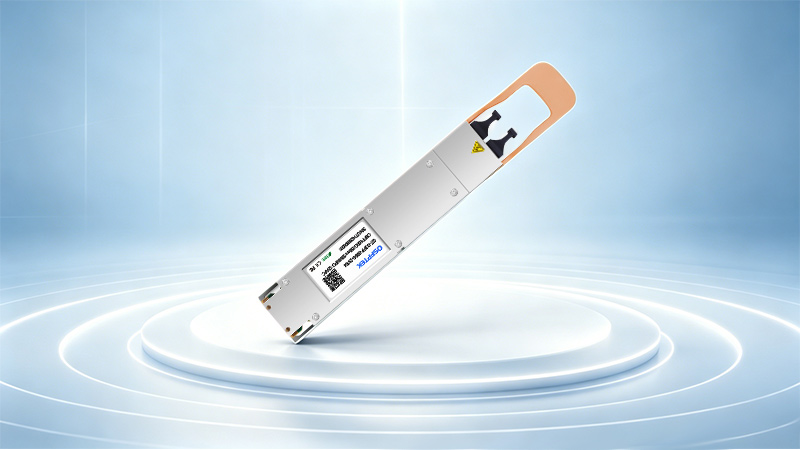
Finned Top: Enhanced Heat Dissipation Design for High-Power Scenarios
Finned Top uses an exposed heat sink fin structure, with the heat sink located directly on the top of the module. By increasing the contact area with airflow, heat exchange efficiency is significantly improved, facilitating the rapid removal of heat generated during module operation.
Due to its strong heat dissipation capabilities, this type of design is typically used in high-power, high-speed optical modules such as 800G and 1.6T, as well as environments with high heat dissipation requirements, such as AI clusters and high-density switches.
Closed Top: Balancing Space Utilization and Heat Dissipation
Closed Top features a top-closed housing design, resulting in a flatter and more compact appearance. The heat dissipation structure is integrated within the module, minimizing external protrusion while ensuring adequate cooling capacity.
This design is better suited for applications with strict requirements on device space, module height, or chassis layout, achieving a good balance between heat dissipation performance and structural compactness. Therefore, it is commonly found in some switches and standard data center environments.
Since the heat sink is integrated within the module, OSFP IHS can achieve the designed cooling effect under standard equipment airflow conditions without relying on additional host-side cooling structures. This independent cooling capability provides better deployment flexibility in high-bandwidth, high-port-density environments.
For high-speed optical modules such as 800G and 1.6T, heat dissipation capacity directly affects long-term operational stability and link reliability. As AI computing clusters and hyperscale data centers place higher demands on power consumption and heat density, OSFP IHS solutions with efficient heat dissipation designs are gradually becoming the mainstream choice.
To address these application needs, QSFPTEK has launched several high-performance OSFP IHS 1.6T optical modules, including the 1.6T OSFP 2×DR4, 1.6T OSFP DR8, and 1.6T OSFP 2×FR4 models. While providing ultra-high-speed transmission capabilities, these modules also ensure heat dissipation stability in high-power scenarios, providing reliable support for next-generation AI networks and data center interconnects.
Key Advantages of OSFP IHS Optical Modules
A Cooling Solution Better for Air-Cooled Environments
OSFP IHS utilizes an integrated heatsink and module design, fully leveraging the internal airflow of the switch for heat dissipation. The fixed heatsink fins on the top of the module directly contact the airflow, accelerating heat exchange efficiency and resulting in superior cooling performance in mainstream air-cooled data center environments.
For high-power optical modules such as 800G and 1.6T, this design enhances cooling capacity without altering the existing air-cooling architecture, helping to ensure module stability under high loads.
Plug and Play, Simplified Deployment
Since the cooling structure is integrated into the module at the factory, users can deploy and use it directly without additional cold plates, cooling accessories, or dedicated cooling components.
This design retains the traditional pluggable optical module usage, adapting to most mainstream switch platforms and making installation, maintenance, and replacement more convenient. Simultaneously, it maintains relatively consistent cooling performance across different devices, reducing deployment and maintenance complexity.
Limitations of OSFP IHS Optical Modules
Heat Dissipation Capacity Limited by Air Cooling Conditions
While OSFP IHS improves heat dissipation efficiency through integrated heat sinks, its heat exchange still primarily relies on the exchange between the top heatsink fins and the internal airflow. Therefore, actual heat dissipation performance largely depends on the switch's airflow design, air volume, and the airflow environment around the module.
As power consumption continues to increase or deployment density further increases, the heat dissipation margin provided by traditional air-cooling solutions gradually shrinks, and heat dissipation capacity will face certain limitations.
Deployment Challenges Arising from Increased Module Height
To achieve a larger heat dissipation area, OSFP IHS typically employs an exposed heatsink fin design. While this structure facilitates heat release, it also increases the overall module height and may affect the internal airflow organization.
In ultra-high-density deployment environments, the additional structural height and air resistance can increase the difficulty of heat dissipation planning, placing higher demands on chassis space utilization and overall cooling efficiency.
What is OSFP RHS (Riding Heat Sink)?
OSFP-RHS (Riding Heat Sink) is an OSFP packaging solution designed for high-power optical modules and advanced thermal architectures, often referred to as Flat Top OSFP. Unlike traditional Finned Top or Closed Top OSFP modules, the RHS design eliminates the integrated heatsink within the module. The top features a flat metal structure approximately 9.5mm high, providing a larger contact area and more efficient heat conduction channels for system-side thermal components.
The key feature of this design is shifting the heat dissipation responsibility from the module itself to the device side. The module itself no longer bears the primary heat dissipation function; instead, heat is conducted directly through contact with the Riding Heat Sink, cold plate, or liquid cooling system within the chassis. Compared to traditional air-cooling solutions, the heat transfer path is shorter, resulting in higher system-level thermal efficiency.
Because it eliminates the need for integrated heatsink fins, OSFP-RHS maintains a lower module height, making it more suitable for high-density port designs, stacked cage structures, and next-generation network platforms such as liquid-cooled switches. With the increasing power density of AI data centers and hyperscale clusters, this design is gradually becoming one of the key heat dissipation solutions for high-end network equipment.
To avoid incompatibility with standard OSFP slots, the OSFP-RHS has undergone specialized mechanical optimization. Its limiting structure differs from that of ordinary OSFP modules, allowing it to be used only with cages that support the RHS specification. This specialized design not only ensures system compatibility but also further enhances overall thermal reliability.
By centralizing heat dissipation capabilities for unified management on the device side, the OSFP-RHS maintains high power handling capacity while providing more flexible system design space and stronger thermal expansion capabilities. Therefore, it is particularly suitable for next-generation high-density switches, liquid-cooled network equipment, and AI data center infrastructure deployment scenarios.
Advantages of OSFP RHS (Riding Heat Sink) Optical Modules
More Flexible Maintenance
Although employing a system-side cooling architecture, OSFP-RHS retains the characteristics of pluggable optical modules, supporting online hot-swapping. Maintenance personnel can perform module maintenance just like replacing traditional optical modules, without downtime or direct contact with the liquid cooling medium or cooling loop. This design is particularly important in high-density network environments, effectively reducing maintenance complexity, shortening fault handling time, and minimizing impact on business operations.
Easier Integration into Liquid Cooling Infrastructure
Compared to a completely redesigned cooling architecture, OSFP-RHS is more like an upgrade to the existing pluggable ecosystem. By transferring cooling capacity to the device-side cold plate or liquid cooling system, it can improve overall cooling capacity while preserving the original network architecture, without requiring large-scale modifications to racks and server platforms.
For data centers gradually transitioning from traditional air cooling to liquid cooling, OSFP-RHS provides a relatively smooth evolution path. It takes into account factors such as compatibility, deployment costs, and upgrade cycles, enabling enterprises to prepare for future higher-power network devices and AI clusters while controlling investment risks.
Limitations of OSFP RHS (Riding Heat Sink) Optical Modules
Limited Heat Dissipation Range
While OSFP-RHS, when combined with a cold plate, can support higher power consumption levels, its primary heat dissipation path remains concentrated in the top area of the module. Heat on the bottom and sides still requires auxiliary cooling via internal airflow, resulting in less than uniform heat dissipation coverage.
For most high-performance network devices, this solution is sufficient. However, in extremely high power density scenarios, compared to full-coverage cooling solutions like immersion liquid cooling, OSFP-RHS still lags behind in terms of extreme heat dissipation capacity and temperature uniformity.
High Requirements for Thermal Interface Quality
The heat dissipation effect of OSFP-RHS largely depends on the contact quality between the module and the cold plate. Factors such as the performance of the thermal interface material (TIM), the flatness of the contact surface, and the uniformity of applied pressure directly affect heat transfer efficiency.
Insufficient contact between the cold plate and the module, uneven pressure distribution, or aging of the thermally conductive material will significantly increase thermal resistance, leading to decreased heat dissipation efficiency. In high-power operating environments, this not only reduces the system temperature margin but may also affect long-term operational stability. Therefore, compared to traditional air-cooled modules, OSFP-RHS places higher demands on device design and assembly processes.
OSFP IHS vs. OSFP RHS: What are the core differences?
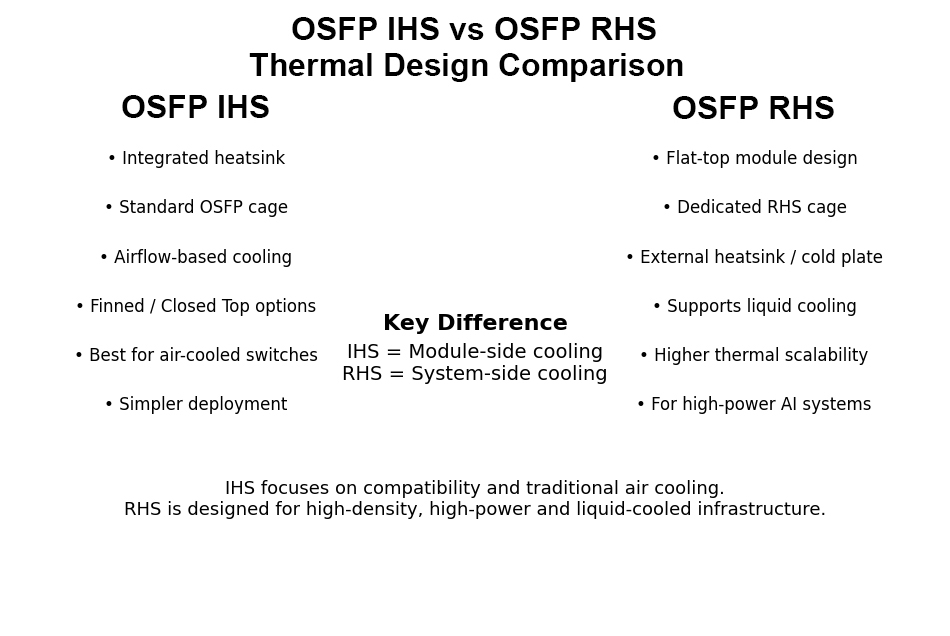
In the OSFP ecosystem, IHS (Integrated Heat Sink) and RHS (Riding Heat Sink) represent two completely different cooling approaches. While both can meet the cooling requirements of high-speed optical modules, they differ significantly in structural design, cooling architecture, system integration methods, and applicable scenarios.
From a design philosophy perspective, OSFP IHS emphasizes the module's own complete cooling capability. The heatsink is directly integrated inside the module, dissipating heat through contact between the top fins and the airflow within the device. Therefore, it can be directly deployed in standard air-cooled switches without the need for additional cooling components.
In contrast, OSFP RHS shifts the cooling capability to the device side. The top of the module features a flat design, eliminating integrated heatsink fins and instead achieving heat conduction through contact with the Riding Heat Sink, cold plate, or liquid cooling system within the chassis. This approach provides stronger system-level cooling capabilities and aligns better with the development trend of high-density deployments and liquid-cooled data centers.
In short, IHS is more suitable for traditional air-cooled network environments, with mature deployment methods and high compatibility; RHS, on the other hand, is designed for next-generation network platforms with higher power consumption and higher density, providing greater scalability for liquid cooling and hyperscale AI clusters through device-side thermal architecture.
Neither is inherently superior; rather, they correspond to different data center cooling strategies. For current switching networks that are still primarily air-cooled, OSFP IHS is often a more direct choice; while for AI data centers and high-performance computing environments that are evolving towards liquid-cooled infrastructure, OSFP RHS demonstrates a more significant long-term advantage.
Conclusion
OSFP IHS and OSFP RHS each play their own role. IHS modules are more flexible, easier to deploy in different setups, especially in existing data centers that still rely mainly on air cooling. RHS is a different story—it leans more toward higher heat handling, and it fits better in environments where density is going up fast, like AI or HPC clusters, especially those already moving toward cold plate or liquid cooling designs.
Choosing between them usually comes down to the actual setup. Power level, how the chassis handles heat, where it’s going to be deployed, and whether there’s a plan for future upgrades—all of that matters in practice. In the end, it’s less about which one is “better” in general, and more about what fits the system without creating bottlenecks in performance, efficiency, or cost.


share

