


A Practical Guide to Choosing the Right Cable Between Copper and Fiber

Copper cables and fiber optic cables, as key infrastructure for modern networks, are suitable for different network environments. Due to their different transmission media, they offer varying bandwidth, transmission distance, transmission power, deployment flexibility, and future scalability. This article will provide a detailed understanding of the characteristics and applicable scenarios of each, helping you build your network architecture more efficiently and cost-effectively.
Choose the Right Cable Based on the Transmission Distance
Transmission distance is a crucial factor to consider when deciding between copper and fiber cables. Copper cables typically include Cat5e, Cat6, Cat6a, Cat7, and Cat8. They support transmission rates from 1Gbps to 40Gbps, with a maximum transmission distance typically under 100 meters. This makes them popular for office LANs, small business networks, and connections within and between cabinets.
Fiber optic cables offer greater flexibility in transmission distance and data transmission capacity than copper cables, ranging from a few hundred meters to tens of kilometers. Without a fiber amplifier, multimode fiber typically supports transmission within 2 kilometers, while single-mode fiber can reach up to 40 kilometers. Fiber optic cables also offer low loss, high bandwidth, and resistance to electromagnetic interference, making them an ideal choice for medium- and long-distance transmission, high-density transmission, and environments subject to electromagnetic interference.
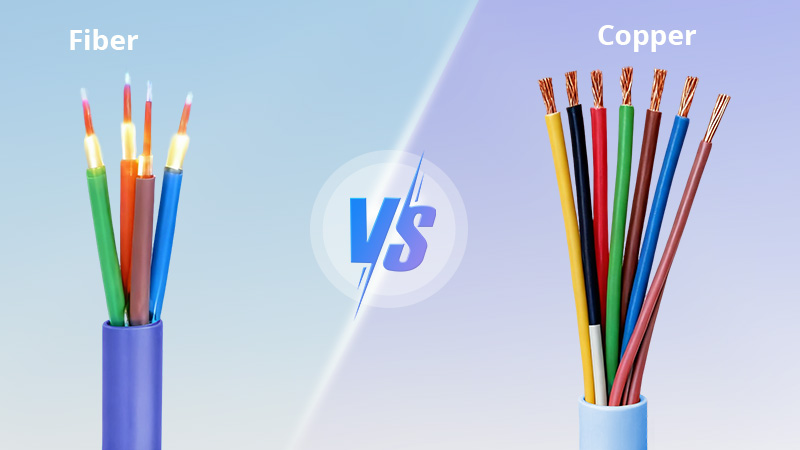
QSFPTEK offers a variety of copper and fiber optic cables in various specifications. The differences in transmission distance and transmission speed are as follows:
Copper vs. Fiber PoE Functional Considerations
Besides transmission distance, power supply support is also a key factor to consider. Copper cables can simultaneously provide power and data to network devices via PoE technology, making it easier to deploy PoE-enabled devices such as access points, cameras, and VoIP phones. Because a single copper cable eliminates the need for separate power cables, it can provide both data and power, allowing for deployment anywhere, significantly simplifying installation.
In contrast, fiber optic cables cannot directly provide power and require independent power connections near the network devices. This means that a single fiber cable cannot meet both power and data transmission needs. Therefore, if your network primarily utilizes PoE, copper cables are more suitable. You can also combine copper and fiber optic cables to meet both long-distance and PoE requirements.

Device Density and Scalability
Fiber optic cables offer significant advantages in high-density or large-scale network deployments. Although copper cables are significantly cheaper than fiber optic cables, their limited transmission distance, size, and weight can lead to congested patch panels and restricted cooling airflow in high-density deployments, increasing operational and maintenance costs. Furthermore, copper cables don't support the same high transmission rates as fiber optic cables. Furthermore, their smaller diameter significantly improves cabinet space utilization, facilitating air circulation and heat dissipation within the cabinet.
In terms of scalability, if you want to upgrade from 1Gbps to 10Gbps using Cat5e cabling, you'll need to replace all copper cables to achieve the higher speed. Fiber optic cables, on the other hand, offer greater flexibility and support higher transmission speeds. Upgrading from 1G to 10G or even 100G requires no rewiring; simply replacing network equipment is required. This flexible scalability significantly reduces the cost and risk of network upgrades for data centers and large enterprise networks.
Selection of Typical Application Scenarios
In actual applications, the choice of copper vs fiber cable depends on the network architecture.
If you're working in an office or home network, copper cable is more cost-effective. It's easy to install, low-cost, and highly durable, making it less susceptible to damage during use. Its support for PoE also allows for flexible device deployment.
If you're working in a large data center or HPC environment, fiber's high bandwidth, long reach, and low latency ensure smooth business operations. Fiber also offers excellent resistance to electromagnetic interference, preventing packet loss and other issues during data transmission.
Of course, a hybrid deployment of copper and fiber is generally the best solution, with fiber used in the backbone and aggregation layers, and copper deployed at the access layer and connecting PoE devices. This approach not only accommodates a variety of applications but also manages deployment costs and offers considerable flexibility.
Conclusion
Copper and fiber optic cables have their own advantages in different applications. When you need PoE or are deploying a small LAN, copper cable is easy to deploy, low-cost, and maintain. However, when you need long-distance transmission or in large data centers, fiber optic cables offer high bandwidth, low latency, and longer transmission distances. The decision between copper and fiber optic cables depends on your specific application.


share

