


200G QSFP56 vs QSFP-DD: A Detailed Comparison of Form Factor and Modulation Technology

In recent years, the expansion of optical communications and the internet has been almost breakneck. Users are demanding ever-increasing bandwidth, network traffic is skyrocketing, and the capacity of telecom backbone networks is soaring by 50% to 80% annually. To keep pace, the transmission speed of optical communication systems has been continuously increasing, from the early 10G, 25G, and 40G generations to today's 100G, 200G, and 400G levels.
While 100G optical transceivers remain the mainstream solution, the market is no longer satisfied with this. The need to fit more ports into smaller equipment while also reducing power consumption has led to the development of faster transmission technologies. This is why 200G and 400G optical transceivers are so important. They offer significant advantages in bandwidth density and energy efficiency over previous generations, and are becoming a key upgrade direction for data centers and backbone networks.
Today's article will discuss 200G optical transceivers—a rising hot topic. It is not as simple as simply doubling the speed, but a comprehensive evolution in performance, architecture and application levels.
200G Optical Transceiver Introduction: QSFP56 vs QSFP-DD
As the name suggests, a 200G optical module is a high-speed optical communication module that supports transmission rates of 200Gbps. Currently, the two mainstream form factors are 200G QSFP56 and 200G QSFP-DD.
QSFP56, short for Quad 50G Small Form Factor Pluggable, is an evolution of the 40G QSFP+ and 100G QSFP28. It was developed for 200G Ethernet environments and has four channels, each operating at speeds between 50G and 56Gb/s. The QSFP56 is better than the previous version because it uses PAM4 modulation instead of NRZ encoding. This means it can send more data using the same bandwidth. Common types of cable include QSFP56 SR4 (short-reach multimode) and QSFP56 FR4 (long-reach single-mode). This series of modules is widely used in data center upgrades, significantly improving bandwidth utilization while maintaining interface compatibility.
Another type is QSFP-DD, short for Quad Small Form-factor Pluggable Double Density. It complies with IEEE 802.3bs and the QSFP-DD MSA standards. "Double density" means it has twice the number of interfaces compared to the standard QSFP28, supporting higher signal rates. This module can achieve 200G transmission with 25G x 8 channels using NRZ modulation, and 50G x 8 channels using PAM4 modulation, for a total rate of up to 400G. Due to these features, QSFP-DD is widely used in high-performance computing, cloud networks, and large-scale backbone transmission systems.
Overall, QSFP-DD is compatible with 400G networks, while QSFP56 is more suitable for current 200G Ethernet applications. With its low power consumption, simple thermal design, and mature interfaces, it is currently the most widely used form factor for 200G optical modules.
Comparison of Packaging and Port Density
200G QSFP56(4×50G)
The QSFP56 module maintains the same form factor as earlier QSFP modules, measuring approximately 70mm × 18mm × 13mm. It uses four channels, each with a data rate of 50Gbps, for a total bandwidth of up to 200Gbps. This design is a good mix of performance and size, packing a lot of data into a small space. For example, a standard 1RU rack can accommodate up to 36 QSFP56 ports, making it suitable for network environments with high bandwidth and port count requirements.
200G QSFP-DD(8×25G)
The QSFP-DD is slightly larger, measuring 87mm × 18mm × 13mm. It has eight high-speed channels, each of which can handle up to 50 billion bits per second (50 Gbps), for a total of 400 billion bits per second (400 Gbps). While only a few of these channels are usually used in 200G applications, its size makes it easy to switch to 400G networks. Due to its denser design, a 1RU rack can accommodate up to 64 QSFP-DD ports, nearly double the port density of QSFP56.
Overall, both modules are designed for high-speed data communication scenarios and offer excellent pluggable features. The QSFP56 is lighter, consumes less power, and has more manageable deployment costs. The QSFP-DD is a better option for data centres that need to expand their bandwidth. While they are different in how they are designed and what they can do, they have both made it so that lots of people are using 200G optical modules.
Comparison of Modulation Technology
200G QSFP56 (PAM4 Modulation)
The QSFP56 module has four channels for transmitting and receiving data, each capable of reaching speeds up to 56 Gbps. Its PAM4 technology enables each signal cycle to carry more information, significantly boosting data transmission speeds. PAM4 is now the most common solution for 200G optical modules. This means that it can send more data at the same time as it uses less bandwidth. It also uses the same signal frequency as before.
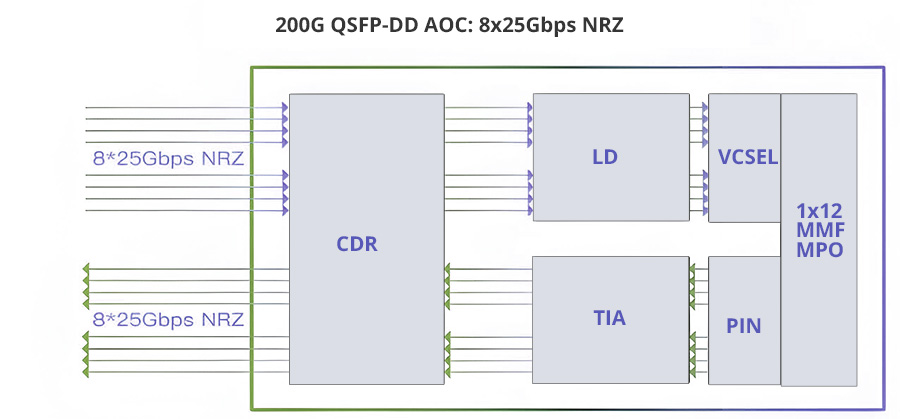
200G QSFP-DD (NRZ/PAM4 Modulation)
The QSFP-DD module adopts an eight-lane structure, with each lane transmitting up to 25 Gbps under NRZ or 50 Gbps under PAM4 modulation. When running in NRZ mode, it delivers a total bandwidth of 200 Gbps, while PAM4 pushes it up to 400 Gbps. This dual-mode capability allows QSFP-DD to flexibly fit into different network setups and evolving speed demands.
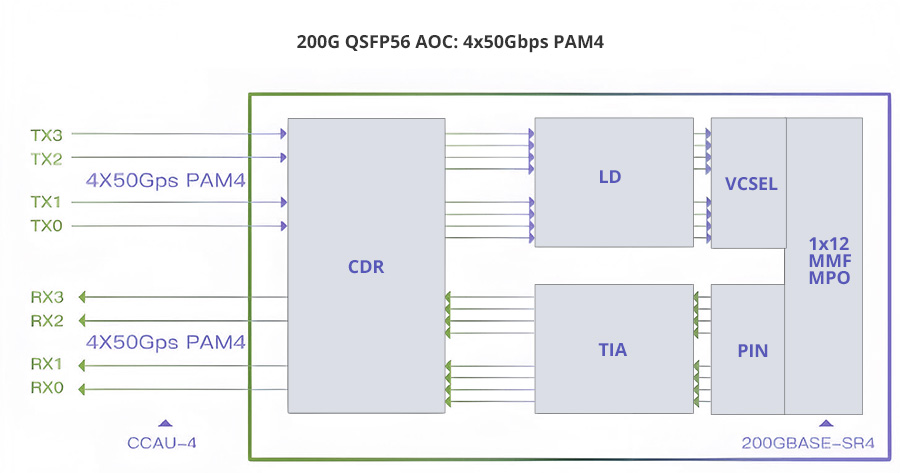
Compared to traditional NRZ (non-return-to-zero) modulation, PAM4 signals can transmit twice as much data within the same bandwidth. By expanding the original two-level signal to four levels, PAM4 halves the symbol rate, effectively reducing transmission losses. This feature makes PAM4 a significant breakthrough in high-speed optical communications, laying the technical foundation for optical modules capable of 200G and higher speeds.
Comparison of Architecture Solution
200G QSFP56 — DSP Solution
QSFP56 typically uses a type of modulation called PAM4, which can achieve speeds of up to 200Gb/s in a 4x50G channel configuration. PAM4 can carry more data per unit bandwidth, but is more sensitive to noise and distortion. Therefore, it needs a digital signal processor (DSP) to make sure the signal is recovered properly. DSPs provide greater link fault tolerance and performance optimization, but they incur additional power consumption and cost, necessitating a trade-off between performance and energy efficiency during design.
200G QSFP-DD — Fully Analog Architecture
A common full-analog implementation of QSFP-DD uses NRZ modulation and operates at 8x25G. This solution keeps signals working well without needing complicated digital signal processors (DSPs). This means that the system is almost as fast as DSP-based solutions. Fully analog designs are better than digital designs because they use less power and are cheaper to make. This is because they are simpler and have fewer parts. This makes them good for situations where there is a delay or where energy efficiency is important.
Comparison of Backward Compatibility
QSFP-DD's dual-density design supports 4- and 8-lane configurations and is backwards compatible with QSFP+, QSFP28, and QSFP56, facilitating smooth migration between devices of varying speeds. QSFP56 is also compatible with QSFP+ and QSFP28, providing a more flexible upgrade path from 40G/100G to 200G, enabling deployment to choose the right solution based on cost, power consumption, and future expansion requirements.
200G QSFP56 Product Introduction
200G QSFP56 SR4
The 200G QSFP56 SR4 module is a full-duplex optical module based on multimode fiber. It features four independent transmit and receive channels, each capable of up to 53.125 Gb/s, and total bandwidth of 200 Gb/s. The module utilizes an 850nm wavelength parallel optical design and is compatible with 70 meters of OM3 multimode fiber (or 100 meters of OM4 fiber), making it ideal for short-distance, high-speed interconnects.
The interface uses an MTP/MPO-12 APC connector, compatible with standard multimode fiber patch cables. The module features a 38-pin electrical connector for high-speed signal input and output. The SR4 module offers compact design, low latency, and low power consumption, making it a popular choice for inter-cabinet interconnects or aggregation layer applications in data centers.
200G QSFP56 FR4
The 200G QSFP56 FR4 module is designed for medium- and long-haul optical communications and utilizes quad-wavelength multiplexing (CWDM) technology. Using four EML lasers, the module converts 4x50G PAM4 electrical signals into four optical signals with center wavelengths of 1271nm, 1291nm, 1311nm, and 1331nm, corresponding to the CWDM wavelength range defined by the ITU-T G.694.2 standard.
It uses a duplex LC connector for the optical part and also has a 38-pin electrical interface, which allows it to send signals over distances of up to 2 kilometres. The FR4 module is better than the SR4 module for connecting equipment rooms or campus-level networks. It can send information over longer distances while using less power. It is one of the options that can be used for a wider range of applications in the 200G QSFP56 series.
Conclusion
While QSFP-DD currently dominates 400G Ethernet, this doesn't mean QSFP56 is obsolete. For data centers where bandwidth requirements haven't yet reached 400G, the 200G QSFP56 optical module remains a reliable and efficient solution. It strikes an excellent balance between performance, power consumption, and compatibility, making it a viable option for bandwidth upgrades in medium- to large-scale networks.
For those planning a gradual transition to 400G, the 200G QSFP-DD optical module offers a more cost-effective solution. This form factor is compatible with future higher-speed network architectures, preserving the investment value of existing systems while facilitating smooth future expansion to 400G. In other words, QSFP56 is suitable for current stable operating environments, while QSFP-DD is more of a transitional option for the next phase.


share

