


Can QSFP28 100G LR4 and 100G CWDM4 Transceivers Operate on the Same Link?

Background: Why Does this Question Come Up in 100G Deployments?
In 100G network deployments, whether QSFP28 100G LR4 and 100G CWDM4 can be used on the same link is a very common question. This usually occurs during network expansion or equipment replacement, when different types of optical modules already exist at both ends of the link, and users often want them to be able to interoperate directly to avoid additional procurement and improve deployment efficiency.
Furthermore, these two modules use QSFP28 form factor, single-mode fiber, and LC interfaces, they appear identical in appearance and connection method, easily leading one to assume they are technically compatible. However, identical packaging does not equate to identical optical parameters.
A Quick Look at QSFP28 100GBASE-LR4 and 100GBASE-CWDM4 Modules
100G QSFP28 LR4 Transceiver Modules Overview
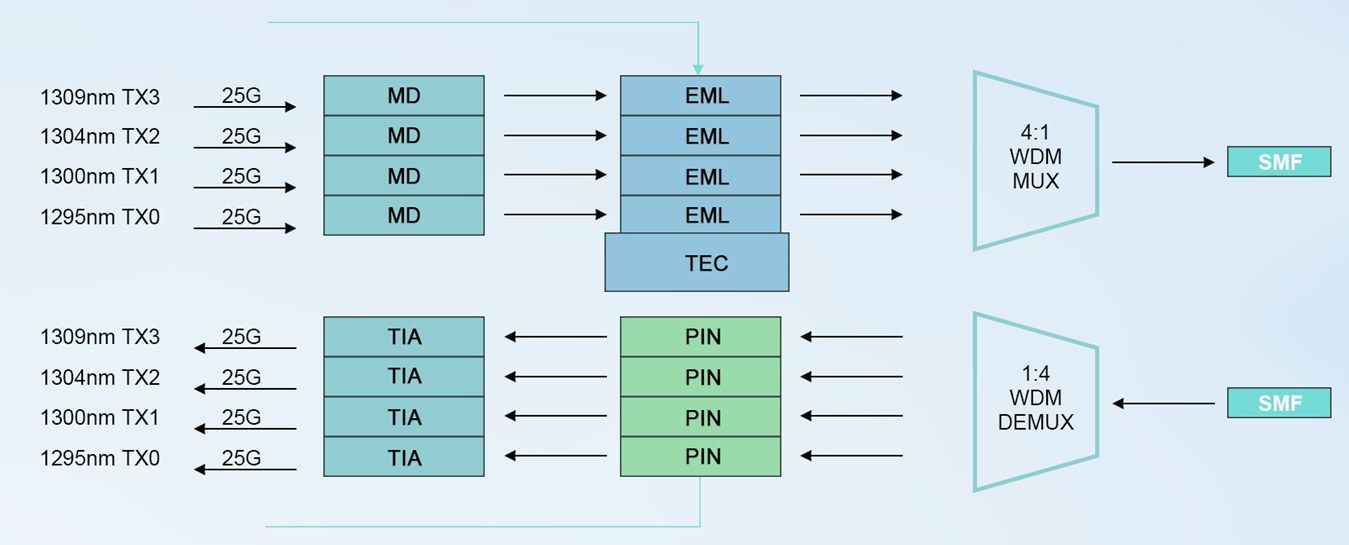
The QSFP-100G-LR4 utilizes LAN-WDM technology, with a wavelength range of 1295 nm to 1310 nm. Each channel operates at 25.78 Gbps, resulting in a total transmission rate of 103.125 Gbps. The QSFP28 100G LR4 transceiver module with duplex LC connectors reaches a link distance of up to 10km over OS2 single-mode fiber.
100G QSFP28 CWDM4 Transceiver Modules Overview
The QSFP28 100G CWDM4 is based on CWDM technology and uses four optical wavelengths at 1271 nm, 1291 nm, 1311 nm, and 1331 nm. Each channel runs at 25.78 Gbps, providing a total data rate of 103.125 Gbps. It has a typical transmission distance of 2km and employs a duplex LC interface.
LR4 vs CWDM4: Specs and Differences
To clarify the differences, we have summarized the key technical specifications:


Factors Affecting 100G LR4 and 100G CWDM4 QSFP28 Modules Interconnection
Electrical Interface and Protocol Standard
The 100G QSFP28 LR4 and 100G QSFP28 CWDM4 are fully compatible in terms of electrical interface and protocol, both following QSFP28 MSA standards and supporting the same 100 Gbps data rate. This allows them to be inserted into the same QSFP28 port and operate normally at the electrical level. However, electrical compatibility does not guarantee optical interoperability—the ability to establish a link ultimately depends on the optical layer.
Optical Wavelength
The 100G QSFP28 LR4 uses LAN-WDM technology with channel wavelengths of 1295~1310nm, whereas the 100G QSFP28 CWDM4 uses CWDM technology with channel wavelengths of 1271 nm, 1291 nm, 1311 nm, and 1331 nm. Because an optical module must receive the matching wavelength to correctly decode the signal, the mismatch in wavelengths between these two modules means that a receiver may fail to recognize the signal, potentially causing the link to fail or resulting in extremely high bit error rates.
Optical Power Range
The LR4 receiver has a defined maximum input power limit, called the overload point, and exceeding it will result in distortion of the signal. The CWDM4 transmitter, however, has an output power range that does not fully align with the LR4 receiver, and in some cases, it may exceed the LR4's overload point. As a result, even though the two modules can be physically plugged, the mismatch in optical power can cause the link to become unstable or prevent it from being successfully established.
Can LR4 and CWDM4 100G Optical Modules Operate on the Same Link?
In most cases, 100G QSFP28 LR4 and 100G QSFP28 CWDM4 optical modules cannot operate directly on the same link. While they utilize the same QSFP28 form factor, carry the same 100 Gbps data rate, and are electrically compatible, their optical properties are vastly different. The two modules use different wavelength grids and have different optical power specifications, which prevents the receiver from properly interpreting the incoming signal.
For this reason, network deployments natively assume that the same type of optical module is used on both ends of a fiber link. These modules ensure proper wavelength alignment, receiver sensitivity and optical power to get the link working reliably.
How to Make 100G QSFP28 LR4 and QSFP28 CWDM4 Coexist in the Same Network?
Although QSFP-100G-LR4 and QSFP-100G-CWDM4 cannot be directly connected, they can still operate within the same network.
Scenario-Based Module Selection
In practical deployments, the choice between QSFP28 100G LR4 and 100G CWDM4 modules mainly depends on transmission distance and application requirements. For links within a campus or up to about 2 km, CWDM4 is typically used as it has a much lower power consumption and cost, making it suitable for large-scale deployments such as connecting two data center rooms about 1.5 km apart. For longer links across a campus, typically up to 10 km, LR4 is a better option because its narrower wavelength spacing provides more stable long-distance transmission, such as interconnecting two data centers over a 10 km link.
Using Optical Repeaters or Adapters
In certain scenarios, optical repeaters can be used to enable interoperability between LR4 and CWDM4 signals. In this case, the LR4 signal is connected to an optical repeater or adapter. Then optical repeater translates the LR4 wavelengths into the corresponding CWDM4 wavelengths. The CWDM4 receiver can then recognize the converted signal and establish the link. However, the repeater must support 100G transmission rates, and introducing additional devices may increase overall network complexity as well as deployment and maintenance costs.
Using WDM Multiplexer
Wavelength division multiplexing (WDM) can also allow LR4 and CWDM4 signals to be transmitted over the same fiber. For this approach, the QSFP28 LR4 signal and the CWDM4 signal enter same WDM multiplexer. At the receiving end, a WDM demultiplexer separates different wavelength signals. It is worth noting that deploying WDM equipment increases the number of devices in the network and adds additional complexity, which requires careful planning and ongoing maintenance.
Using Optical Power Adjustment (Experimental Use Only)
In theory, the transmit power of a CWDM4 module can be reduced with an optical attenuator to prevent overloading the LR4 receiver. However, this approach does not resolve the fundamental issue of wavelength mismatch between the two modules, meaning the receiver still cannot properly decode the signal. As a result, this method is generally suitable only for testing or special experimental scenarios and is not considered a practical solution for routine network deployment.
Conclusion
In summary, while QSFP-100G-LR4 and QSFP-100G-CWDM4 cannot interoperate directly due to differences in wavelength and optical power, they can coexist within the same network. In more complex setups, optical repeaters or adapters and WDM multiplexers can enable interoperability, allowing networks to leverage the advantages of both module types.


share

