


What is the 25GBASE-T, and What is its Application in the SMB Network

25GBASE-T is a 25Gb Ethernet technology defined by IEEE, operating over common twisted-pair copper cabling. With the increasing use of SMB networks, this type of interface is receiving more attention. It is primarily used for short-distance connections within SMB networks, such as between switches and servers, or for interconnecting switches. The design increases the speed to 25 Gbps over traditional copper cabling while retaining the functionality of the existing cabling.
The following content will briefly examine how 25GBASE-T works, its benefits, and where this interface stands in today's SMB network compared to other 25G connection methods.
25GBASE-T Standard and Key Technologies
The 25GBASE-T specification was finalized in 2016, enabling 25Gbps Ethernet transmission over twisted-pair copper cabling. Support links up to about 30 meters long. It typically requires Cat8 structured cabling systems, which need cables with high electrical specifications.
From a technical perspective, 25GBASE-T is not a completely redesigned solution. It is more of an advancement from 10GBASE-T and incorporates some concepts originally intended for 40GBASE-T. Within a 30-meter range, the implementation difficulty is no different from that of the previous two generations, so no major changes are needed to the architectural design. This facilitates easier implementation of network upgrades during actual deployment.
This technology is achieved through more sophisticated digital signal processing, advanced mechanisms for echo and crosstalk suppression, high-speed serial-to-parallel decoding circuits, and SFP28 interfaces. Many of these components were not developed from scratch but optimized based on existing systems, enabling the reuse of off-the-shelf equipment.
The ultimate result is a relatively stable 25 Gbps, even in a copper cabling environment, without requiring fiber-optic connections.
25GBASE-T Key Advantages
Performance and scalability are the easiest aspects to understand. The 25GBASE-T can achieve 25Gbps on a single copper cable link. This is about twice the bandwidth of 10GBASE-T. It also saves more panel space than 40GBASE-T, which needs four channels. For SMB networks, this means that network I/O can be increased without completely rebuilding the entire network architecture. Many next-generation servers and storage nodes are designed for 25G, making them easy to use.
Compatibility is also relatively worry-free. 25GBASE-T retains the standard auto-negotiation mechanism, allowing it to work with older systems, such as 10GBASE-T or 40GBASE-T environments. Network upgrades don't necessarily require a complete replacement all at once; equipment can be replaced gradually, resulting in a smoother process and less aggressive on-site modifications.
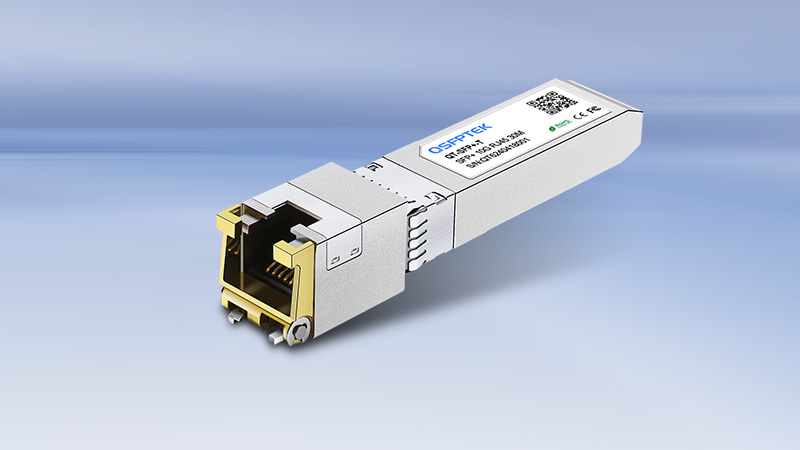
Cost is also a frequently discussed area. The single-channel 25G solution reduces the number of switching chip ports needed, resulting in fewer switches, cables, and interface components. This means that the initial investment and ongoing maintenance costs are lower. Cat8 copper cabling and RJ45 interfaces are easy to find and widely used, so they are not dangerous.
Another reason for its existence is its flexibility. 25GBASE-T can achieve approximately 30 meters of cabling over copper, which is enough for common ToR, MoR, or EoR layouts. On the other hand, DAC copper cabling usually only goes a few meters, which makes it hard to connect from one rack to another. 25GBASE-T is often easier to manage when interconnecting racks or entire rows of devices, a difference that becomes even more pronounced in large-scale SMB networks.
25GBASE-T in SMB Network Applications
In real-world use, 25GBASE-T is often found in cloud environments or large SMB networks. It is used for short-distance connections between switches and servers. You can connect it using standard RJ45 patch cords, and it's installed like traditional copper cabling networks. You don't need to adapt it to a new interface system.
It can also be seen in aggregation layer scenarios, such as connections between racks in MoR or EoR layouts. As long as the distance is controlled within about 30 meters, the link is usually quite stable, and this range can generally cover the interconnection needs between one or even several rows of racks.
Some SMB network cabling environments are more complex and do not rely on a single medium. In these cases, 25GBASE-T can also be used in combination. Copper links can coexist with DACs, AOCs, or fiber optics, with different solutions allocated based on distance and budget, allowing for more flexible overall planning rather than a uniform fiber-optic structure.
However, it is not suitable for all scenarios. For short connections within a rack, such as a few meters, passive DACs are often a better choice. They are more cost-effective and energy-efficient, offering a significant advantage. On the other hand, if the link is more than 30 meters long or there is significant electromagnetic interference at the site, multimode or single-mode fiber is usually better because it's easier to ensure stable transmission.
25GBASE-T vs. Other 25G Connectivity Options
In today's SMB networks, there are multiple 25G access methods, each with its own application scope. DAC, AOC, and optical module links all coexist, with the main differences typically focusing on distance, power consumption, and cabling methods.
From an overall positioning perspective, 25GBASE-T is more like a middle-ground option among copper cabling solutions. Compared to DACs, it can transmit signals over longer distances without requiring optical modules for fiber connections. It's easy to get 30-meter transmission in a Cat8 cabling environment. In top-of-rack (ToR) or end-of-rack (EoR) setups, this feature is often ideal for connecting racks without incurring high costs.
In cloud SMB network environments, it's frequently used at the switch-to-server layer. The RJ45 interface is familiar to everyone, and with auto-negotiation, it's also compatible with 10GBASE-T, so you don't have to replace cabling during upgrades. It also works well with common network architectures, such as leaf-spine, fat tree, or traditional three-layer architectures, without requiring a complete redesign to add more bandwidth.
Tips: When considering a 25G solution:
For very short connections within a server rack, typically under 5 meters, a DAC is usually more convenient and energy-efficient. There's no need to switch to other solutions in these scenarios.
When a certain degree of cabling flexibility is required, 25GBASE-T is a better choice. Copper cable links can easily reach around 30 meters, and patch cords and patch panels are relatively easy to manage, making them suitable for interconnecting cabinets or rows of devices.
If the distance is increased further or there is significant field interference, AOC or fiber-optic links are usually considered. These solutions are more stable over long distances and are less affected by environmental factors.
Conclusion
Overall, 25GBASE-T strikes a realistic balance between performance, cabling flexibility, and cost. RJ45 interfaces can be used again; the upgrade from 10G to 25G is relatively simple, daily maintenance is less demanding, and it still increases bandwidth significantly, making it suitable for SMB network environments that are growing.
Leveraging QSFPTEK's extensive real-world testing experience and interoperability verification capabilities, network deployments are more likely to achieve stable results while also leaving space for future expansion. These validated solutions provide a relatively stable, scalable infrastructure that achieves a practically usable balance between performance and reliability.


share

