


Flat-top vs. Finned-top 400G OSFP Transceivers: How to Choose for Your Data Center?

The OSFP form factor has been adopted in a variety of 800G modules and 400G optical transceivers. As transmission rates increase, effective heat dissipation remains a challenge for high-speed transmission. This article will explain the thermal management design differences between 400G OSFP flat-top vs. finned-top modules and explore their optimal applications.
OSFP 400G Optical Transceivers Overview
What is OSFP Form Factor?
The OSFP (Octal Small Form-factor Pluggable) package is a hot-swappable, high-speed optical transceiver module designed for data centers and telecommunications, supporting high bandwidth like 400G and 800G by using eight electrical lanes for data transmission. It features enhanced thermal management due to its larger size compared to other form factors, making it suitable for high-power applications, and it is a standard defined by the OSFP MSA (Multi-Source Agreement).
What is 400G OSFP Module?
A 400G OSFP module is a high-speed optical transceiver designed for 400 Gbps data transmission in modern data centers and high-bandwidth networks. It uses eight electrical lanes, each transmitting at 50Gb/s with PAM4 modulation, to achieve its 400G bandwidth.
400G QSFP-DD vs. OSFP Transceiver Module, What's the Difference?
Before exploring the differences between 400G QSFP-DD and OSFP, let's briefly examine the QSFP-DD form factor.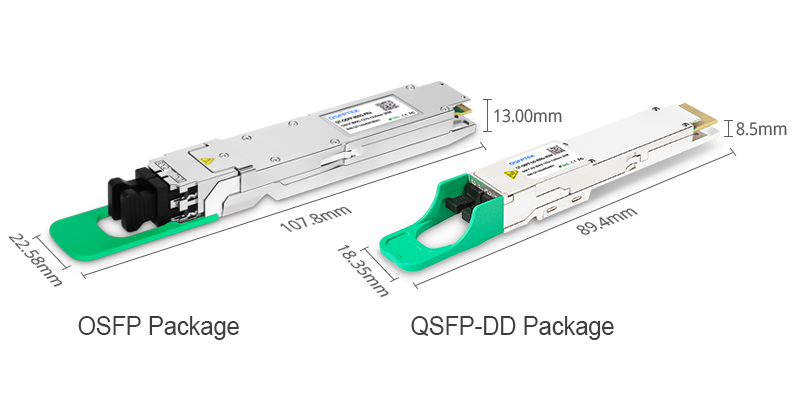
The QSFP-DD package stands for Quad Small Form Factor Pluggable Double Density and is a high-speed transceiver module that supports up to 400Gbps and higher data rates in a compact size, ideal for data centers and high-performance computing. It doubles the electrical lane count of previous QSFP28 modules to eight, allowing for higher bandwidth over the same physical port. Key features include backwards compatibility with earlier QSFP+ and QSFP28 standards, support for higher speeds using PAM4 modulation, and support for high port density in equipment racks.
Next, let's compare the 400G QSFP-DD and OSFP optical modules.
Why Cooling Design Matters in 400G Transceivers?
In modern data centers, 400G transceivers carry enormous amounts of data traffic, which in turn increases power consumption and heat. If module's heat is not effectively dissipated, it will lead to signal attenuation, unstable transmission, and even equipment damage. Therefore, cooling design is particularly important in high-speed 400G optical transceivers. Finned-top and flat-top designs are two key heat dissipation solutions for OSFP 400G optical modules, and their differences directly impact application scenarios and performance.
The following section provides a detailed introduction to flat-top and finned-top designs.
Understanding Flat-top OSFP Module
What is Flat-top Design?
Flat-top modules most commonly refer to optical transceiver modules that feature a flat, smooth top surface, rather than a finned or protruding heat sink. This structure itself does not have strong active heat dissipation capabilities, but relies more on external thermal management.
Advantages of OSFP Flat-top Transceivers
Compactness: Flat-top OSFP modules occupy less physical space, allowing for higher port density and improved utilization of networking equipment in high-bandwidth environments.
Easy to Integrate: OSFP flat top transceivers are physically smaller and so are easier to install, replace, remove or scale out. This simplifies upgrades and adds flexibility when you need to start accommodating a growing network.
Limitations of OSFP Flat-top Fiber Transceivers
Inadequate Heat Dissipation: Without the extra surface area of fins, flat-top OSFP transceivers rely on external airflow or passive cooling. This makes them less effective at dissipating the significant heat generated by high-bandwidth 400G and 800G applications, potentially leading to reduced performance and lifespan.
Ideal Use Cases for 400G OSFP Flat-top Modules
Space-Constrained Applications: Its low-profile design makes it an ideal choice for space-constrained applications, such as compact GPU servers or network cards with integrated heat sinks.
Applications Requiring Less Cooling: For applications with moderate power consumption, or where cooling can be facilitated by the host system, flat-top OSFP offers a low-cost and viable alternative.
What is Finned-top OSFP Module?
What is Finned-top Design?
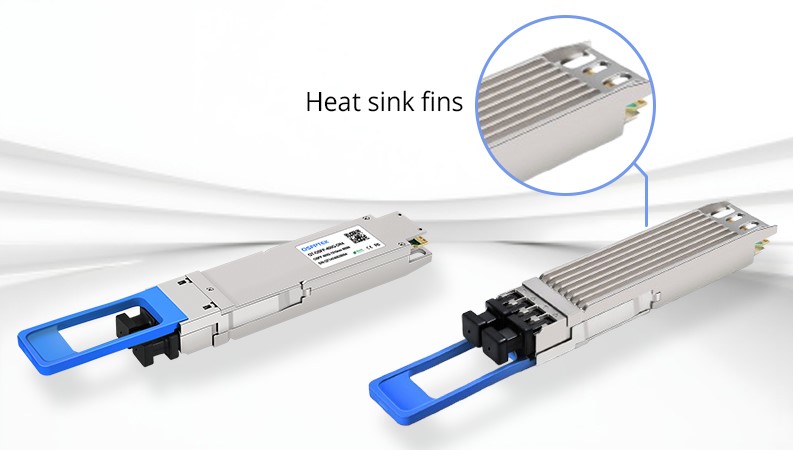
The finned-top design adds heat sink fins to the top of the optical module to enhance the transceivers' heat dissipation. By increasing surface area and improving airflow, this design enables the module to maintain a safe operating temperature in high-power, high-density, or airflow-restricted environments, preventing overheating and ensuring long-term stable operation.
Advantages of OSFP Finned-top Transceivers
Enhanced Heat Dissipation: The extended fins on the top of the transceiver create a larger external surface area, which significantly improves heat transfer away from the optical components.
Stable Performance: Because the finned-top design prevents overheating, these OSFP transceivers can work continuously under heavy loads that are indispensable for demanding AI and machine learning applications.
Device Protection: Effective thermal management can protect the transceiver's delicate internal components from high temperatures, prolonging devices life span.
Limitations of OSFP Finned-top Fiber Transceivers
Vertical Space Requirement: The most significant limitation is the greater vertical space needed for the fins, which are a heat dissipation mechanism.
Incompatibility with Compact Systems: This added height may limit compatibility with low-profile slots or chassis designed for compact modules.
Higher Production Cost: Finned-top modules require precise thermal design and manufacturing, which often increases production complexity and costs.
Applications of 400G OSFP Finned-top Modules
400G OSFP finned-top modules are appropriate for high‑density, high‑power data‑center environments, and thrive in situations where thermal management is crucial. It supports high-throughput applications such as AI training clusters and cloud computing. Its robust heat dissipation makes it the preferred choice for large-scale, high-performance networks.
Finned-top vs Flat-top Design: Technical Comparison
Finned-top or Flat-top Design, How to Choose?
The technical comparison above clearly demonstrates that both the Finned-top and Flat-top OSFP designs have their own advantages and limitations. The actual selection process should be based on the load, space constraints, and deployment environment.
High-Power, High-Performance Scenarios
For data centers or high-performance switches where modules operate under heavy workloads and generate considerable heat, finned‑top transceivers are advised. Their heat‑sink design effectively dissipates heat, providing stable transmission and lasting reliability.
Space-Constrained or Low-Heat Scenarios
For space-limited equipment, such as network adapters, edge devices, or standard racks, flat-top transceivers are more suitable. Their low-profile design saves space, features a simpler structure, and offers lower cost, making them ideal for moderate power applications.
FAQs About 400G OSFP Finned-top and Flat-top Transceivers
Q: If my data center has an excellent cooling system, do I still need OSFP finned-top modules?
A: If the data center has a strong cooling system and good air circulation, flat-top OSFP modules can usually meet the heat dissipation requirements. However, in high-power, high-density environments, finned-top modules can provide additional heat dissipation capacity to ensure long-term stable operation of the equipment.
Q: Is there any performance difference between flat-top and finned-top OSFP modules?
A: In terms of optical signal transmission and bandwidth capabilities, there is no inherent difference between the two. However, the Finned-top module's heat dissipation design maintains stable performance in high-power or high-load scenarios, reducing potential performance fluctuations caused by heat.
Q: Is my equipment compatible with finned-top OSFP transceivers?
A: Finned-top modules are taller, so ensure that there is adequate vertical clearance in the device or chassis. We recommend confirming rack and slot specifications before purchasing.


share

