


QSFP-DD vs Other Form Factors: A Complete Comparison of QSFP+, QSFP28, QSFP56, QSFP112, OSFP, and CFP2

QSFP-DD has taken a central place in modern high-speed networks thanks to its high bandwidth density and the ability to work with older QSFP versions. The compatibility makes it easier for data centers to upgrade without replacing everything. This mix of performance and flexibility has turned QSFP-DD into a practical option for scaling bandwidth. That’s why it’s often put side by side with other high-speed module types like QSFP56, QSFP112, OSFP, and CFP2 — each marking a different point in the development of optical transceiver technology and serving its own purpose in network deployment.
To understand the differences between these modules, we must first examine the structure and principles of the QSFP-DD. To truly understand the differences between these modules, we must first examine the structure and principles of QSFP-DD.
What is QSFP-DD?
QSFP-DD stands for "Quad Small Form Factor Pluggable Double Density" and strictly complies with IEEE 802.3bs and the QSFP-DD MSA standards. "Double density" means it has double the number of electrical interfaces compared to traditional QSFP28 modules, enabling higher transmission rates within the same footprint. Using NRZ modulation, each QSFP-DD channel can reach a speed of 25Gb/s, enabling 200G network transmission. Using PAM4 modulation, each channel can reach 50Gb/s, supporting 400G networks. Further increasing this to 100Gb/s PAM4 enables ultra-high-speed 800G transmission.
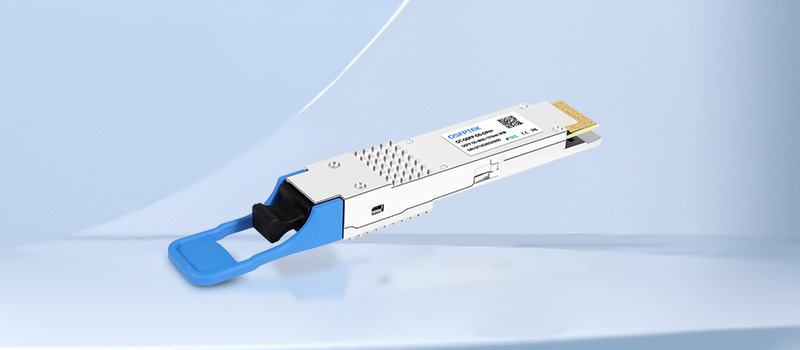
This design not only gives QSFP-DD a significant lead in bandwidth performance, but also offers excellent power consumption and maintainability. QSFP-DD keeps the same pluggable design that makes installation and maintenance pretty straightforward. At the same time, it fits the challenging demands of data centers that need high port density and low power usage. With these advantages, it’s become a key part of 400G and 800G Ethernet setups, forming a reliable base for the next leap toward faster, more advanced network speeds.
What Are The Advantages of The QSFP-DD Form Factor?
The QSFP-DD form factor stands out in today's high-speed network architectures due to its comprehensive advantages in performance, compatibility, and system design. It provides a significant leap forward in transmission capacity, greater flexibility, and scalability for equipment manufacturers and data center operators.
First, high port density is one of QSFP-DD's greatest strengths. Although it shares the same faceplate size as a regular QSFP module, the QSFP-DD uses an 8-lane structure that effectively doubles the bandwidth and boosts port efficiency in switches and servers. This setup lets data centers push more traffic through without taking up extra rack space, creating a denser, more efficient network layout overall. This high-density advantage is virtually irreplaceable for cloud computing and hyperscale data centers, which require rapid bandwidth expansion.
Second, backward compatibility makes network upgrades less of a burden. The QSFP-DD interface is compatible with existing QSFP+, QSFP28, and QSFP56 modules, allowing users to mix and match modules of varying speeds on the same equipment. This flexibility means data centers can seamlessly transition from 100G, 200G, to 400G, and even 800G in phases, while preserving existing investments and eliminating the need for a large-scale hardware replacement.
In high-performance systems, heat dissipation design is also crucial. The QSFP-DD port features systematic optimizations for host device thermal management. The integrated, adjustable heat sink can be flexibly positioned based on the module layout, effectively improving airflow distribution whether installed on top of the module or between modules. This thermal management mechanism not only ensures the stable operation of high-power modules like 400G and 800G, but also improves overall cooling efficiency and reliability, ensuring stable performance even under high loads.
Finally, QSFP-DD’s mature ecosystem and cost benefits make it a strong contender in the market. Most major network and optical module vendors, including QSFPTEK, have made it a core product, creating a reliable supply chain and standard compatibility. This lowers development costs and speeds up adoption. By tackling port density and power challenges while balancing performance and price, QSFP-DD has become a key foundation for modern data centers aiming for fast, stable, and scalable networks.
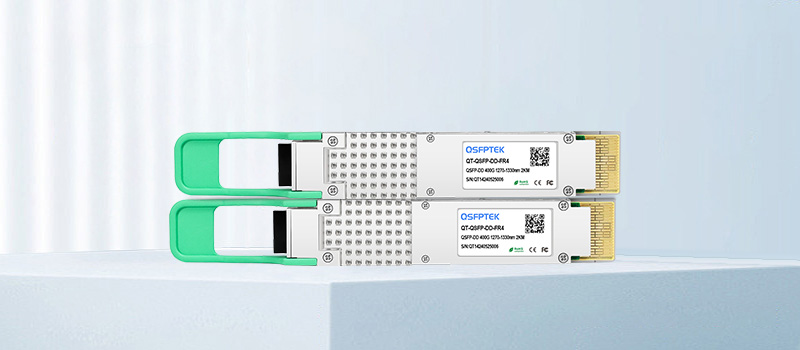
The Difference Between QSFP-DD and QSFP+/QSFP28/QSFP56/QSFP112
The relationship between QSFP-DD and previous generations of QSFP modules can be seen as a combination of "compatibility and evolution." It not only inherits the compact and efficient packaging advantages of the QSFP series, but also advances the technological leap from 40G to 800G through structural and speed upgrades.
In terms of structural design, QSFP-DD shares the exact dimensions as QSFP+, QSFP28, QSFP56, and QSFP112, with the same width, length, and thickness. This consistency allows it to fit into existing equipment panel space smoothly, reducing hardware replacement costs. However, the most significant difference of QSFP-DD lies in its innovative internal architecture—it utilizes an 8-lane electrical interface, while earlier QSFP series modules only used 4. To accommodate this additional set of contacts, the QSFP-DD connector is slightly deeper on the motherboard side, enabling higher signal transmission rates and greater bandwidth density.
QSFP-DD's potential in bandwidth and applications is far greater than ever before. Based on an eight-lane design, it can achieve 200G (8x25G NRZ), 400G (8x50G PAM4), and even 800G (8x100G PAM4) network transmission, becoming a key driver for upgrades in high-performance computing and cloud data centers. By contrast, QSFP+ typically handles 40G Ethernet, QSFP28 targets 100G, QSFP56 reaches 200G, and QSFP112 hits 400G using 4×100G PAM4, marking the upper limit for four-lane pluggable modules. This shows that QSFP-DD not only doubles the data rate but also sets the stage for future higher-bandwidth standards.
Backward compatibility is a key strength of QSFP-DD. Its ports work with earlier QSFP modules, including QSFP28, QSFP56, and QSFP112, allowing users to mix different speeds on the same device and make the most of existing hardware. For instance, a QSFP-DD cage can house 25G NRZ or 50G PAM4 QSFP modules and can later be upgraded to higher-speed QSFP-DD modules as needed. However, when a QSFP112 module is used, the port runs in 4-lane mode, and complete 400G transmission requires a host ASIC that supports 4×100G PAM4, which is currently found only in select high-end switches.
Overall, QSFP-DD represents a significant extension of the traditional QSFP architecture. It doubles the number of channels and speed without sacrificing compatibility, providing an ideal form factor for 400G/800G networks. From the perspectives of system design, bandwidth density, and future evolution, QSFP-DD is a key step in the data center's transition to a higher-speed, more compact network architecture.
The Difference Between QSFP-DD and OSFP/CFP2
QSFP-DD, OSFP, and CFP2 represent different design philosophies for high-speed optical module packaging. They each focus on structural dimensions, thermal design, and application areas, and together they have driven network evolution to the 400G/800G and even 1.6T eras.
Structurally, QSFP-DD and OSFP both use an 8-lane electrical interface, positioning them as the leading high-density packaging solutions today. QSFP-DD keeps the same form factor as traditional QSFP modules, letting equipment makers boost speeds without overhauling their panel designs. The Octal Small Form Factor Pluggable (OSFP) also features an eight-channel design, but the module is slightly broader and deeper, allowing for greater power consumption and thermal management. The CFP series is an earlier generation of large-format form factors, with CFP2 being the current mainstream version, commonly used in 200G and 400G coherent transmission modules (CFP2-DCO). It supports complex modulation schemes such as QPSK, 8-QAM, and 16-QAM, and integrates a DSP chip for digital signal recovery and dispersion compensation.
In terms of size and port density, QSFP-DD is the most compact of the three. Its front panel width matches that of a standard QSFP, allowing it to accommodate more ports per unit space. The QSFP-DD has the highest port density, so that it is suitable for high-performance data centers and cloud networks. While OSFP is larger than QSFP-DD, a 1U chassis can accommodate up to 36 OSFP ports, achieving outstanding density performance. However, CFP2's larger form factor requires more space per port, making it unsuitable for high-density deployment scenarios. Therefore, it is primarily used within equipment rooms or for long-haul backbone transmission, rather than in top-of-rack Ethernet switching environments.
Thermal handling sets QSFP-DD apart from OSFP. Its enhanced cage design and optional heat sinks allow QSFP-DD to reliably manage around 12W of power in standard systems, enough for typical 400G modules and specific 800G modules. OSFP modules, on the other hand, offer greater thermal management advantages. They support a variety of structural options (such as top-finned, top-enclosed, and flat) and achieve heat dissipation exceeding 30W, leaving ample thermal headroom for future 1.6T-class optical modules. In contrast, CFP2 modules, explicitly designed for coherent optics, consume more power, but their larger package provides ample headroom for heat dissipation.
In terms of application scenarios, QSFP-DD is primarily targeted at data center Ethernet networks, suitable for short- to medium-distance interconnects in TOR (Top-of-Rack), leaf-spine architectures, and cloud computing environments. The QSFP-DD is a popular choice for Ethernet and InfiniBand setups, such as NVIDIA's Quantum-2 NDR series, which is used for high-performance computing. CFP2, the highest-end form factor of the three, serves carrier-grade coherent transmission networks and data center interconnect (DCI) scenarios, focusing on addressing signal integrity and modulation complexity issues in ultra-long-distance transmission.
Driving the Future of High-Speed Interconnection with QSFPTEK QSFP-DD
In today's fast-paced networking world, choosing the right optical module is essential for more than just performance. It also affects how easily it can be expanded in the future and how much it will benefit you over time. QSFP-DD is the best option for cloud data centers or backbone networks that need reliable long-distance links. It is flexible and compatible.
QSFPTEK QSFP-DD modules offer low latency, high bandwidth, and dependable interoperability. Thanks to its consistent quality, strict testing, and competitive pricing, our solutions help networks increase speed, density, and energy efficiency, paving the way for more innovative, future-ready data center designs.


share

