


How to Calculate the Speed of Wi-Fi 7?

WiFi 7 has attracted widespread attention due to its theoretical maximum speed of 46Gbps. Compared to WiFi 6's 9.6Gbps, WiFi 7's maximum theoretical speed appears to be a groundbreaking upgrade. However, this dramatic increase has raised questions for many: can WiFi 7 truly reach a maximum speed of 46Gbps? In fact, WiFi 7's maximum speed is a theoretical value achieved through the combination of multiple underlying technologies, representing the theoretical peak throughput at the physical layer, and does not represent the actual internet speed measured on a mobile phone or computer. Nevertheless, this theoretical value remains significant because it represents the upper limit of WiFi 7 technology in terms of spectrum utilization efficiency and concurrent capabilities. This article will provide you with a detailed understanding of WiFi 7 and how its theoretical speed is achieved.
The Difference Between Theoretical and Actual WiFi Speed Performance
Before discussing WiFi 7 speeds, it's necessary to clarify a common misconception: the advertised WiFi speed is not the speed users will ultimately experience. In practical applications, protocol overhead, electromagnetic interference, signal strength, interference between devices, and router performance all affect the actual speed experienced. However, theoretical speed still has its value; it determines the maximum capability of the wireless network under ideal conditions and whether there is still capacity available in multi-user, high-concurrency scenarios. The core significance of the significant increase in WiFi 7's theoretical speed is not to make a single device faster, but to enable multiple devices to operate at high speeds simultaneously.
The Core Logic Behind WiFi 7's Speed
WiFi speed refers to the amount of effective data that can be successfully transmitted through a wireless channel in a unit of time. To understand this, we need to consider how much data can be transmitted at once, how many data streams can be transmitted simultaneously, and how often data is transmitted.
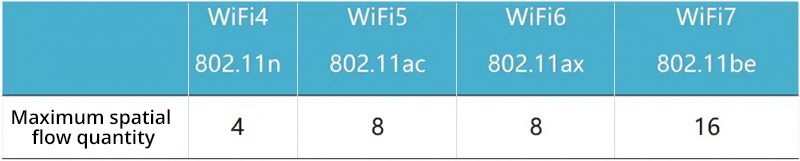
The number of data streams that can be transmitted simultaneously can be understood as the number of parallel data channels; the more channels there are, the greater the throughput. WiFi 7 theoretically supports up to 16 parallel data channels, double the 8 channels of WiFi 6. Under ideal conditions, devices can transmit different data streams in parallel through multiple antennas, significantly increasing the overall speed.
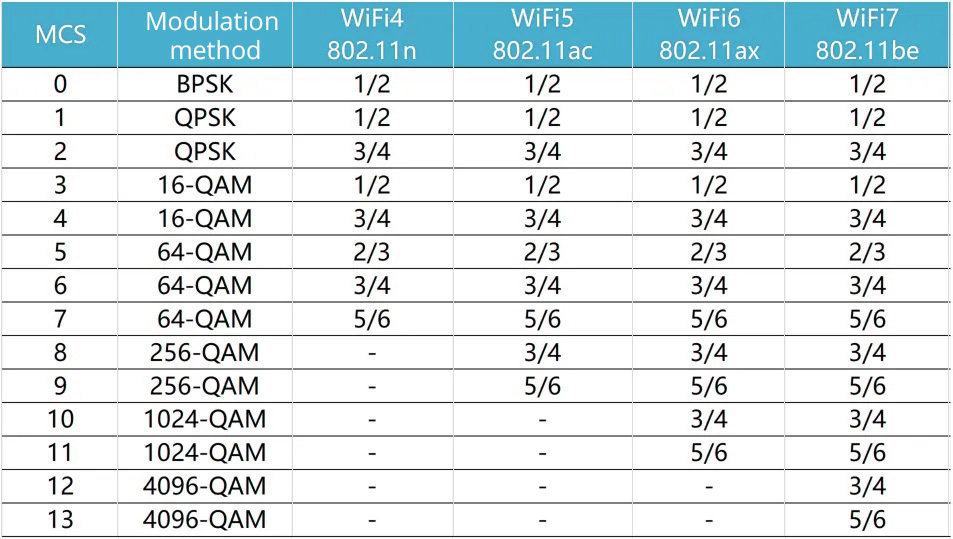
The amount of data that can be transmitted at once is related to the WiFi modulation method. WiFi 7 introduces 4096-QAM modulation, allowing each wireless symbol to carry up to 12 bits of data. The higher the modulation order, the more information can be carried per unit of time, which is one of the important reasons why WiFi 7 significantly increases the speed limit.
The Combined Effect of Bandwidth, Subcarriers, and Time Efficiency
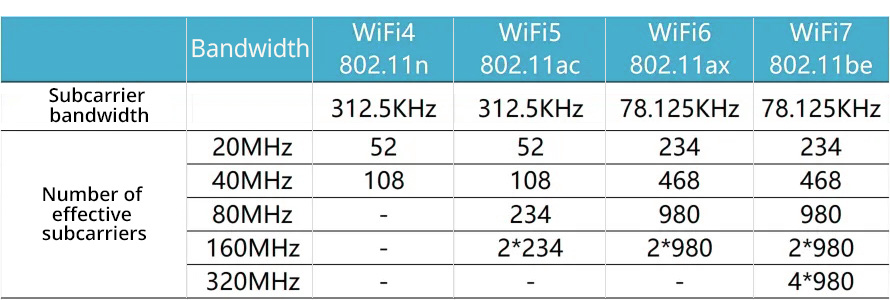
In addition to spatial streams and modulation methods, Wi-Fi 7 also optimizes spectrum and time utilization. Wi-Fi 7 supports an ultra-wide bandwidth of up to 320MHz, which is equivalent to widening the data highway for wireless communication. With wider channels, the number of effective subcarriers available for data transmission also increases. Subcarriers can be understood as small channels in the frequency domain; the more subcarriers there are, the stronger the throughput capacity.
In the time domain, Wi-Fi 7 shortens the symbol time by optimizing the guard interval. The shorter the symbol time, the more symbols can be sent per unit of time, further improving the overall speed. At the same time, to ensure high reliability even at high transmission speeds, Wi-Fi 7 uses a coding rate of up to 5/6, striking a balance between transmission efficiency and error correction capabilities, ensuring stability in high-throughput scenarios.
How is the 46Gbps Speed of Wi-Fi 7 Achieved
By understanding the factors affecting Wi-Fi 7 speed mentioned above, and integrating them together, we arrive at the basic logic for calculating Wi-Fi speed:
Number of data streams x Number of bits per symbol x Coding rate x Number of effective subcarriers ÷ Symbol time.
Under the highest configuration of Wi-Fi 7, with 16 data streams, 4096-QAM modulation, a 5/6 coding rate, 320MHz bandwidth, and the shortest symbol time, the final result is a theoretical peak speed of nearly 46Gbps. This number represents the physical layer limit that Wi-Fi 7 can achieve under ideal conditions and with full hardware configuration, and not the speed that can be measured on a mobile phone or computer in daily use.
What WiFi 7 46Gbps Means for Users
For ordinary users, the significance of WiFi 7 doesn't lie in how many Gbps a single device can achieve in speed tests, but rather in the overall network improvements. In a home network, when multiple devices simultaneously use multiple high-bandwidth applications such as 8K video, cloud-based gaming, or VR/AR applications, the network will not easily become congested. In high-density scenarios, such as businesses and hotels, its concurrent capacity and stability are significantly improved. At the same time, in low-latency applications, the higher throughput also creates the possibility for wireless networks to replace some wired connections.
Conclusion
The 46Gbps high speed of Wi-Fi 7 is the result of spatial parallelism, spectrum expansion, and improved time efficiency. It does not represent the maximum speed that can be measured by devices in everyday applications. Understanding how Wi-Fi 7's speed is calculated allows us to view this theoretical speed of 46Gbps more rationally and to better understand the value of Wi-Fi 7. Beyond just increased speed, it also provides a more practical network for low-latency, multi-user applications.


share

