


What Impacts SFP+ Module Performance? Five Factors You Should Know

While 25G and 40G are becoming increasingly common, 10G SFP+ has not disappeared. For many enterprises, existing networks do not need to be blindly upgraded to higher speeds; 10G SFP+ can still provide sufficiently stable performance at a more controllable cost, making it still very attractive in terms of cost-effectiveness. It adapts well to the ever-evolving network environment, rather than becoming a bottleneck.
However, problems often arise during deployment, including deteriorating transmission quality, an increased bit error rate, unstable links, and frequent disconnections. These situations are often not simply a matter of a single component "failing," but rather the result of a combination of factors. This article will break down the core factors that truly affect the performance of 10G SFP+ modules from five key perspectives.
Product Technical Parameters
The overall performance of 10G SFP+ primarily depends on the module's design and factory parameters. Operating speed, laser type, transmit power, and receive sensitivity all directly affect its stability in actual network operations. Typically, the nominal rate of 10G SFP+ is 10.3125 Gbps. This rate itself is not low, placing higher demands on signal integrity and device compatibility. Problems can be amplified if the system design or environment is not ideal.
Regarding lasers, the common approaches are VCSEL and DFB. VCSELs are a more affordable and energy-saving option for short distances, while DFBs are better for long distances and ensure signal stability. Transmit power and receiver sensitivity are key to link range and stability. If there's a problem with the power or sensitivity, it can cause problems with the signal, even in normal situations. This can make the link less effective.
The Quality of Signal
While static specifications are useful, signal quality is the best way to measure 10G SFP+ performance in production environments. The long-term reliability of a link depends on factors such as jitter, eye diagrams, and return loss. However, the Bit Error Rate (BER) is still one of the most important indicators. By measuring the number of errors at the receiver, a low BER shows a reliable connection and a much lower risk of sudden failures. Jitter is a measure of the instability of the signal over time. It is usually seen together with an eye diagram.
By superimposing numerous signal waveforms into an eye diagram, one can visually determine the "cleanliness" of the signal; a wider eye generally indicates less jitter and noise, and better overall quality. Return loss, on the other hand, focuses on the energy loss caused by reflections in the link. A higher absolute value of return loss indicates less reflection, smoother optical signal transmission, and is naturally more beneficial to module performance.
Operation Temperature and System Cooling
The impact of the operating environment on 10G SFP+ is often underestimated, but in many unstable cases, it is a critical factor. Modules generate continuous heat during operation, when the operating temperatures are excessively high or thermal design capacity is insufficient, modules will experience performance degradation. Commercial-grade SFP+ modules typically operate within a range of 0°C to 70°C, while industrial-grade modules can function in environments spanning -40°C to 85°C. If you use it for too long outside these ranges, you can cause problems like parameter drift, link instability, and even module failure.
Besides temperature, humidity is also important. If it is too high, it can contaminate the fiber optic connector endface, which can result in additional optical loss. Also, things like electromagnetic interference, static electricity, and equipment vibration can also make the module unstable. In terms of power usage, 10G SFP+ usually uses between 1W and 2W, which isn't high for a single module. However, in high-density deployments, heat builds up over time. Without proper airflow and cooling solutions, the risk of performance degradation and even link failure increases significantly.
Module Compatibility and Device Matching
Besides the fiber itself, the compatibility of the module with the entire equipment system directly affects the actual performance. Protocol compliance is the most basic step. 10G SFP+ modules must strictly adhere to standards such as SFP+/MSA and IEEE 802.3ae to maintain normal interoperability across different vendors and network environments, avoiding seemingly occasional problems.
In the real-world deployment phase, device compatibility is equally important. Whether the module is fully recognized by mainstream switches and routers, and whether it can truly achieve plug-and-play functionality, largely determines the stability of the link. If the software doesn't work well with the hardware, even if the hardware specifications seem to be exactly what's needed, there might be times when the software doesn't work or doesn't work right.
Fiber Link and Transmission Media
The fiber optic link is the part that carries the signal. It directly affects how well 10G SFP+ performs. First, it's important to choose the right type of fiber. Short-distance connections within data centers typically use OM3 or OM4 multimode fiber, while metropolitan area networks or backbone networks are more suitable for single-mode fibers such as G.652 and G.655. Choosing the wrong type often causes a big increase in optical loss. The distance the signal travels must also match the capabilities of the transceiver.
For example, 10G SR module is commonly used for distances within a few hundred meters, with a maximum transmission distance of 300 meters. 10G LR can cover 10 kilometers, while 10G ZR is used for longer links, even over 80 kilometers. The condition of the connector and end face is also crucial. LC full-duplex interfaces are the most common type; once the end face is contaminated with dust or oil, it can easily lead to higher insertion loss and reflection problems, ultimately resulting in link instability or even frequent interruptions.
How to Choose the High-Performance 10G SFP+ Module?
When selecting a high-performance 10G SFP+ module, the actual transmission distance should be considered first. For short-distance interconnections between data center racks or within the same server room, multimode SR modules based on VCSELs are usually sufficient; while for long-distance transmission involving metropolitan area or backbone networks, single-mode LR or ZR modules using DFB lasers are more suitable. It's also important to confirm the compatibility. The module must be reliably recognized by existing switches and routers. Ideally, these devices should come from brands that have experience and a solid reputation in the mainstream equipment sector.
There are three main things to consider: transmit power, receive sensitivity, and bit error rate (BER). These things directly impact long-term link stability. It is also crucial to ensure the selected module matches the fiber type and link length. Otherwise, signal strength may be reduced due to excessive distance or interface incompatibility. Finally, it's important to have good after-sales support and clear warranty policies. These policies help reduce risks when using the product and make it easier to maintain.
QSFPTEK 10G SFP+ Transceiver Recommended
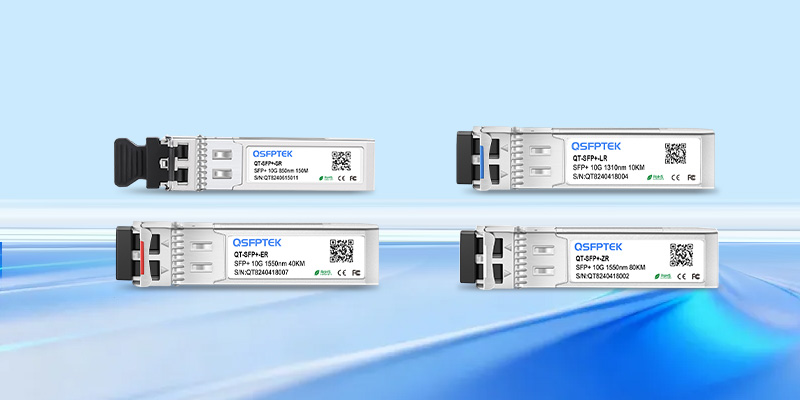
With all those factors in mind, QSFPTEK has a solid lineup of 10G SFP+ modules that check all the right boxes. Whether you’re looking for SR, LR, ER, or ZR models, there’s plenty of flexibility to cover different distances and tough environments.
We don't just ship these out and hope for the best. Every QSFPTEK module is put through its paces with strict compatibility and quality tests to make sure it's truly plug-and-play. Plus, you'll have a solid warranty and a support team that actually picks up the phone, so you can set up your network without the usual deployment headaches. Here are a few QSFPTEK 10G SFP+ module picks worth looking at:


Conclusion
The high-performance 10G SFP+ links need more than just a datasheet. The key is finding the right balance between signal quality, whether the device can work with it, and the actual conditions of the fiber link. To ensure long-term stability, you need to think about more than just the individual modules. We need to consider the whole ecosystem, including environmental factors and link architecture.
Choosing the supplier is also equally crucial. Optical communication solution providers like QSFPTEK not only offer rigorously tested 10G SFP+ modules, but also provide complete solutions from optical modules to fiber optic connections, along with corresponding technical support. This comprehensive capability, from product to solution, helps enterprises maintain stable and efficient transmission in complex and ever-changing network environments.


share

