


How to Choose Between MTP Type A and Type B?

With the continuous development and technological innovation of data centers and high-speed networks, MTP/MPO fiber optic patch cables have become a core cabling solution due to their high density, modularity, and scalability. MTP/MPO patch cables come in several different types, and today I will explain the differences between Type A and Type B. Incorrectly selecting the polarity of an MTP/MPO patch cable can lead to service interruptions and data transmission failures, making it essential to correctly understand the polarity of MTP/MPO patch cables.
What is MTP/MPO Polarity
MTP Polarity refers to the alignment of optical signals from the transmitter to the receiver. For example, after a signal is transmitted from the first optical fiber at the transmitter, is it aligned with the first optical fiber at the receiver? If this alignment is incorrect, signal transmission may fail. Even if the connection appears to be normal, the network may not function properly. Therefore, to ensure accurate signal transmission, polarity standards must be adhered to.
What are MTP/MPO Type A and Type B Cables
According to the TIA-568 standard, Type A and Type B are two polarization types, which also include Type C. However, due to its low efficiency and high cost, it is not commonly used.
MTP/MPO Type A, also known as a straight-through connection, has a one-to-one optical fiber arrangement at both ends. That is, the first fiber on the left end corresponds to the first fiber on the right end. The fiber order remains the same, and there is no crossover. In a Type A solution, a Type A trunk, a Type A cassette, and Type A patch cords are typically used to form a complete link. This solution offers simple cabling and clear logic, making it ideal for simple applications. However, in parallel transmission scenarios, such as 100G SR4, if additional adjustments are not made, the Tx and Rx polarity may not be aligned, so Type B polarity is used.
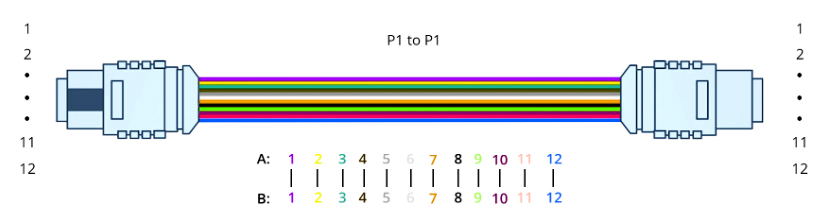
MTP/MPO Type B, also known as a crossed connection, is the exact opposite of Type A, with the fiber arrangement mirrored on both ends of the connector. The first fiber core on the left corresponds to the twelfth fiber core on the right, the second fiber core corresponds to the eleventh fiber core, and so on. This cross-connection ensures the correspondence between the Tx and Rx ends, so Type B is widely used in high-speed parallel networks, such as 40G SR4 and 100G SR4.
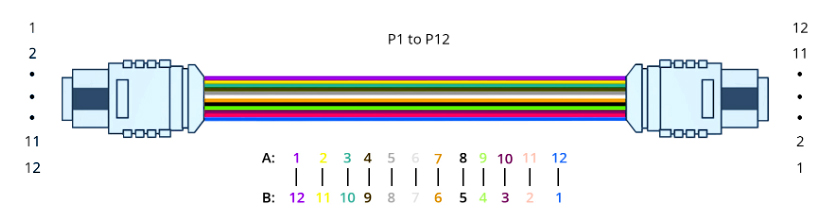
Comparison of MTP/MPO Type A and Type B
MTP/MPO Type A vs. Type B: How to Choose
The choice between Type A and Type B depends on the network architecture and the module types used, as the primary difference between the two lies in polarity arrangement and the correspondence between transmit and receive signals.
If your network primarily uses duplex optical modules, such as 10G SFP+ and 25G SFP28, Type A is generally recommended. Because these modules operate in a one-transmit-one-receive mode, the straight-through Type A is more suitable for point-to-point duplex communication architectures. MTP/MPO Type A can directly connect to 10G and 25G modules by connecting to Type A fiber optic cassettes and LC duplex patch cables, offering strong compatibility and ease of maintenance. Especially in traditional data center architectures with multi-level patch panels or cross-connects, Type A offers greater cabling flexibility while maintaining good polarity management.
For parallel applications requiring high bandwidth, such as those using 40G SR4 and 100G SR4 modules, Type B is a better choice. Because these modules achieve high-speed data exchange through multi-channel parallel optical transmission, their transceivers must correspond to each other. The cross-pair arrangement of Type B optical modules naturally achieves this correspondence, allowing the transmitter signal to be directly transmitted to the receiver without the need for patch cord configuration or polarity adjustment. This feature makes Type B MTP/MPO optical modules ideal for high-speed interconnects between high-performance data center backbone networks and cabinets.
However, what should be done if a network architecture combines both LC duplex and MTP/MPO parallel connections? For example, in breakout connections, Type B is the better choice. When a 100G SR4 is connected to four 25G SRs, the 100G Tx port must correspond to the 25G Rx port, and the Rx port must correspond to the 25G Tx port. This arrangement is inherently cross-paired. Using Type A optical modules requires additional configuration.
In summary, Type A optical modules are suitable for traditional duplex communication environments, while Type B optical modules are designed for high-speed parallel connections. Its natural fiber core alignment automatically matches the polarity of high-speed modules, eliminating the need for additional configuration.
Conclusion
Whether to choose Type A or Type B MTP/MPO cables isn't necessarily superior or inferior; it depends on your network architecture. If your network primarily uses low-speed modular LC interfaces, Type A offers the simplest point-to-point connections. However, when building high-speed parallel links, Type B is more suitable due to its inherent polarity matching.


share

