


How to Interconnect OSFP and QSFP-DD Ports for 400G/800G Networks?

Why OSFP and QSFP-DD Interconnection Matters in 400G/800G Networks?
With the accelerated deployment of 400G/800G networks, data centers often need to use both OSFP and QSFP-DD packages to meet the needs of different devices and scenarios. As traffic continues to grow, the coexistence of multiple high-speed optical modules has become the norm, and the interconnectivity between different interfaces has become a critical issue.
Due to the differences in design between OSFP and QSFP-DD, a lack of suitable interconnection solutions may affect link stability and deployment efficiency. Therefore, achieving efficient interconnection between the two types of ports is an important prerequisite for ensuring flexible network expansion and smooth upgrades.
Overview of 400G/800G OSFP and QSFP-DD Form Factors
What is an OSFP Module and Why It Matters for High-Speed Networks?
OSFP is a new pluggable form factor that supports eight high-speed channels, initially supporting 400Gbps (8x50G or 4x100G). It is slightly wider and deeper than QSFP-DD, but still supports 32 OSFP ports per 1U front panel and 14.4Tbps per 1U switching slot. OSFP optical modules are designed with improved signal integrity and thermal performance, enabling next-generation 800G optical modules to utilize eight 100Gbps (8x100G) channels, allowing for easy upgrades from 400G to 800G. OSFP also offers backward compatibility with 100G QSFP optical modules.
In high-speed networks, OSFP modules not only enable high-density transmission, but also have good heat dissipation and are easy to maintain, allowing data centers to operate stably even with a sharp increase in traffic.
OSFP Finned Top vs OSFP Close Top vs OSFP-RHS Flat Top, What's the Difference?
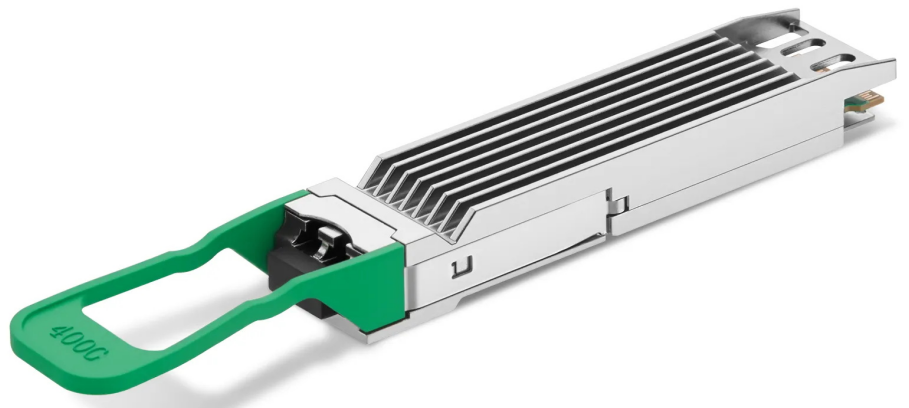
What is OSFP Finned Top Module?
Finned-top OSFP modules feature metal heat sinks on the top, significantly increasing the surface area for heat dissipation and improving airflow efficiency. This design is suitable for high-power, high-density deployments, such as AI data centers or 800G switch environments, but its drawback is that it places high demands on chassis space and airflow design.
What is OSFP Close Top Module?
The OSFP Closed Top design features a cover plate on top of the heat sink fins. The Closed Top design is not only suitable for traditional air-cooled systems, but also highly compatible with liquid-cooled architectures, meeting the deployment needs of different data center heat dissipation solutions.
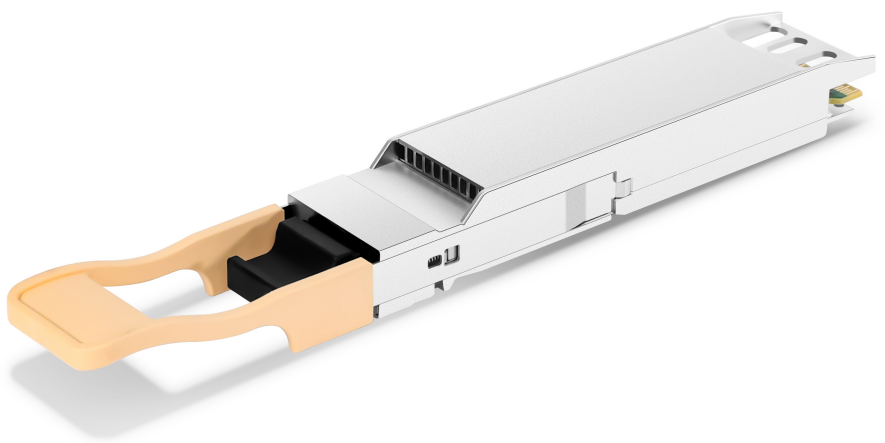
What is OSFP-RHS Flat Top Module?
Contrary to Finned Top, Flat Top modules do not integrate a visible heat dissipation structure. Instead, they employ a flat casing design, leaving the heat dissipation task to the internal cooling system of the switch or server, such as heat sinks, air ducts, or liquid cooling devices. This design helps achieve more unified airflow management and improves the overall thermal design consistency of the device.
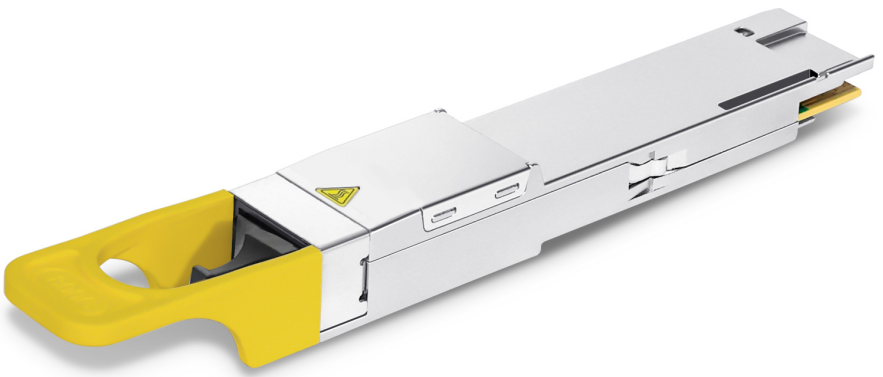
What is a QSFP-DD Module and Its Role in Data Centers?
QSFP-DD (Double Density) is an upgraded package based on traditional QSFP. By expanding the electrical channels from 4 to 8, it supports 200G, 400G, and even 800G transmission rates. Simultaneously, it is backward compatible with QSFP+/QSFP28, enabling existing networks to smoothly transition to higher speeds.
In data centers, QSFP-DD is primarily used to increase port density and overall bandwidth capacity, allowing switches to provide more high-speed connections within limited space. It is widely used in cloud computing, DCI, and other scenarios, and is also one of the mainstream choices for current 400G network deployments.
Basic Principles for Successfully Interconnecting QSFP-DD and OSFP Connectors Transceivers
Ensure Protocol Consistency
The two interconnected modules must adhere to the same communication protocol; for example, an Ethernet module can only interface with another Ethernet module. If different protocols, such as Ethernet with InfiniBand or Fibre Channel are mixed, even if the form factor is identical, the link cannot be established. Therefore, the standards and application scenarios followed by the modules should be clearly defined before deployment.
Match Optical Port Modulation
In optical module interconnection, electrical signal rates may differ, but optical side transmission rates and modulation schemes must remain consistent. For example, when one OSFP module uses a 4×100G PAM4 optical signal, the other QSFP-DD module must also output an optical signal of the same specification; otherwise, normal communication will not be possible.
Maintain Fiber Mode Compatibility
The fiber optic cables used at both ends of the module must be of the same type, i.e., both must be single-mode or multimode. Because the two types differ significantly in operating wavelength, transmission loss, and application scenarios, mixing them can lead to link instability or even complete communication failure.
Solutions for Interconnecting 400G and 800G OSFP and QSFP-DD Ports
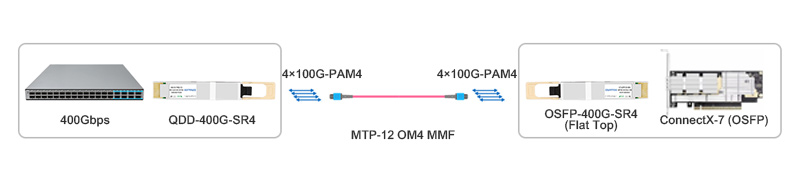
QSFP-DD 400G SR4 to Flat Top OSFP 400G SR4
In short-distance, high-speed interconnects in data centers, 400G QSFP-DD SR4 modules can be deployed on switches, while 400G OSFP flat-top SR4 modules can be used on network adapters, connected via MTP/MPO-12 multimode fiber patch cords. Both modules use four 100G PAM4 parallel optical channels to achieve seamless communication between ports. This cost-effective solution is ideal for high-speed, short-distance connections between ToR switches and servers, typically suitable for fiber optic links not exceeding 100 meters.
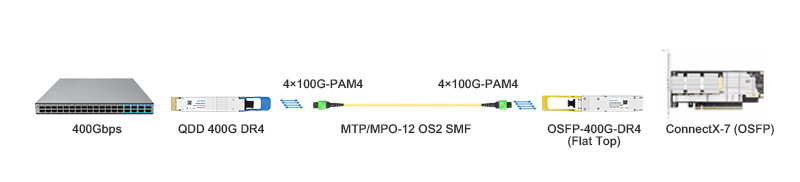
QSFP-DD 400G DR4 to Flat Top 400G OSFP DR4
In scenarios requiring medium to long-distance transmission, the 400G QSFP-DD DR4 and 400G OSFP flat-top DR4 modules offer an efficient interconnection solution. These modules adopt 4×100G PAM4 parallel optical signals to achieve connection between QSFP-DD switch ports and OSFP network interface card ports. Combined with MTP/MPO-12 OS2 fiber cables, this solution supports transmission distances up to approximately 500m.
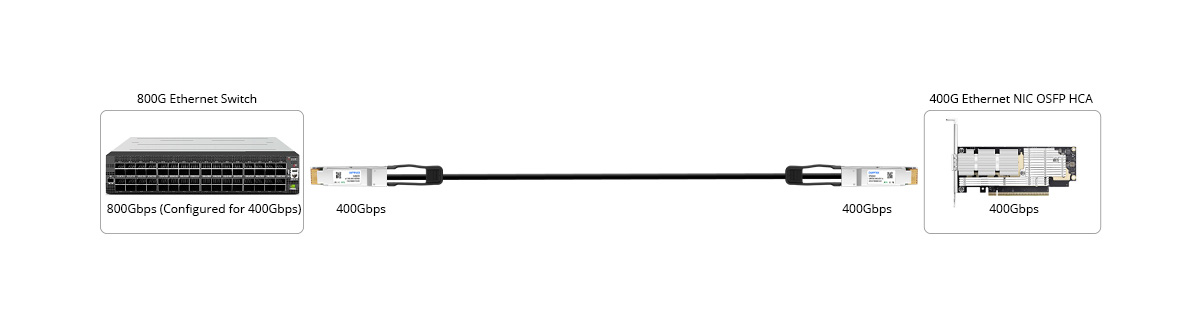
QSFP-DD 400G to Flat Top OSFP 400G DAC
In scenarios involving the interconnection of switches and servers within the same or adjacent racks, DAC or AOC cables offer a simple and efficient solution. 400G QSFP-DD to 400G OSFP flat-top DAC cables enable plug-and-play direct connections between ports without the need for additional optical modules. When using DAC or AOC cables, it is essential to ensure that their modulation scheme matches the port speed of the connected device. For example, if the DAC uses 4×100G PAM4 modulation on the QSFP-DD side, it will be incompatible with a 400G QSFP-DD switch using 8×50G PAM4 modulation.
OSFP 800G Finned Top Breakout to Dual 400G QSFP-DD
In addition to standard 400G-to-400G direct connections, the 800G OSFP finned top module can breakout a single 800G port into two independent 400G ports. This module uses 8×100G PAM4 modulation and connects to two 400G modules on a QSFP-DD switch via two MTP/MPO-12 OS2 fiber optic patch cables, achieving seamless interoperability between the ports.

Conclusion
OSFP and QSFP-DD are two main form factors for 400G/800G optical modules. By confirming protocol consistency, matching optical port modulation, fiber mode compatibility, even if the two modules have different packages, they can still be interconnected.


share

