


Thermal Design Strategies for 400G OSFP Transceivers

Since data centers and high-speed communication networks require continually greater performance from optical modules, OSFP (Octal Small Form-factor Pluggable) modules have surfaced as a primary selection for 400G, 800G, and even 1.6T optical communication setups thanks to their high bandwidth, high density, and excellent thermal management capabilities. Thermal design is one of the key technologies in OSFP modules, as the thermal structure can significantly influence module performance, stability and lifetime.
What is the OSFP 400G Transceiver Module?
The 400G OSFP transceiver module is a high-speed, high-bandwidth, high-density pluggable optical module. It adopts OSFP (Octal Small Form Factor Pluggable) packaging. "Octal" refers to the 8 channels contained in the module. Each channel can support a data transmission rate of 50 Gbps, enabling a total bandwidth of 400 Gbps and meeting the high-speed transmission requirements of modern data centers and hyperscale computer systems.
Why Do OSFP 400G Optical Modules Have Stringent Thermal Requirements?
OSFP optical modules are commonly used in high-bandwidth, high-density data transmission applications such as data center interconnects and high-performance computing clusters. These applications place high requirements on the power consumption control and thermal management capabilities of optical modules. As transmission speeds increase from 400G to 800G and even higher, the integration density of electronic components inside the module continues to rise, leading to a significant increase in heat generated per unit volume. Therefore, the efficient design of heat dissipation has become an important precondition to guarantee normal operation of OSFP optical modules.
Heat Management Strategies for OSFP Optical Modules
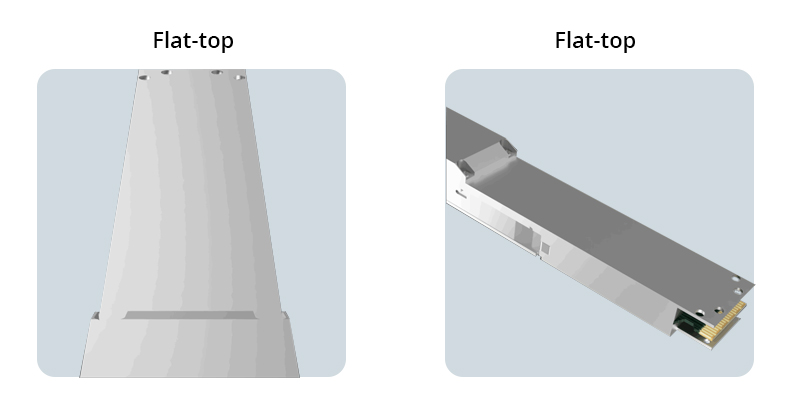
Flat-top Design
The flat-top OSFP optical module has a flat-top metal casing structure and does not include extra heat sinks. Their heat dissipation can be managed through switch cooling. Heat generated during module operation is passively conducted through the metal casing and dissipated by airflow from the chassis ducts and fans. Due to its simple structure and standardized dimensions, the flat-top design offers good mechanical compatibility and high port density, making it suitable for 400G OSFP deployments in scenarios with good switch cooling conditions and mature airflow designs.
Open Finned-top Heatsink
The open finned-top heatsink design integrates exposed metal heat dissipation fins on the top of the OSFP optical module, with spacing between the fins allowing cold air to directly pass through or flow along the fin channels. This is an important factor that increases the efficiency of convective heat dissipation. Through greater heat dissipation surface area and enhanced airflow contact, this design successfully lowers the operating temperature of components within the module. It is generally employed in optical modules featuring higher power use.
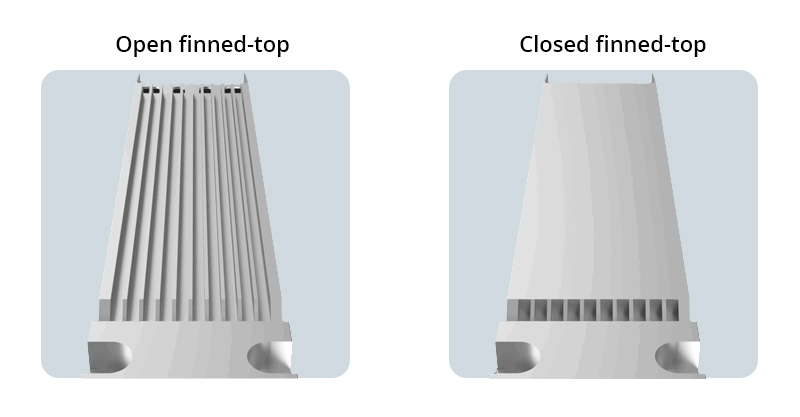
Closed Finned-top Heatsink
The closed finned-top heatsink design also integrates heatsink fins on the top of the OSFP optical module, but the fin structure is partially or completely enclosed by the outer shell, allowing airflow to primarily flow along the fin surface for heat dissipation. Compared to open finned-top design, this structure improves heat dissipation while also guaranteeing the module's mechanical robustness and safeguarding.
Dual-side Heat Dissipation Design
To address the issue of insufficient heat dissipation on the bottom surface of the module, some OSFP optical modules adopt a dual-side thermal design. For example, some optical modules are equipped with an upper heat pipe surface and a lower heat pipe surface on the top and bottom surfaces, respectively. Coolant circulates internally, and the circulation of the coolant is achieved through connecting pipes and a loop structure, thereby improving overall heat dissipation efficiency.
Materials and Manufacturing Process
To further improve heat dissipation efficiency, the OSFP optical module's heat dissipation structure employs high-performance materials and advanced manufacturing processes. For example, T2 copper tubing with a diameter of 0.5-4mm is used as the heat sink, and a complex heat dissipation structure is formed through a bending process. In addition, the surfaces of the heat pipes are tin-plated to increase the contact area with the module body, thereby improving thermal conductivity.
OSFP vs QSFP-DD: Which Offers Superior Heat Management?
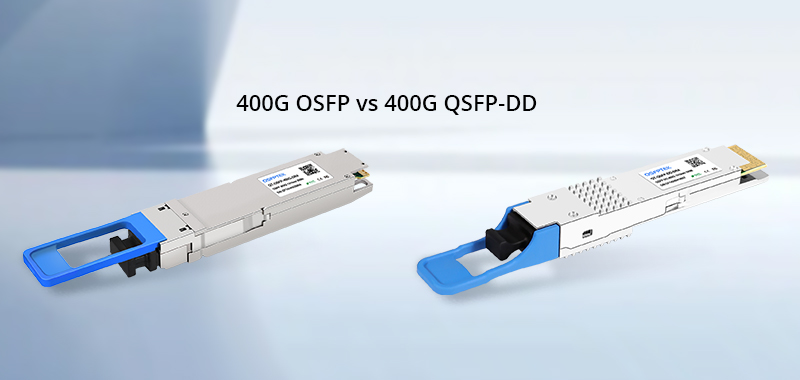
OSFP's large size design gives it a significant advantage in heat dissipation. Through its optimized metal casing and internal heat dissipation channels, its heat dissipation efficiency is more than 30% higher than QSFP-DD. It can stably support optical modules with power of 15W or even higher, such as a 400G LR4 long-distance optical module. When coherent transmission technology is enabled, the power reaches around 14W. The OSFP form factor helps maintain an operating temperature below 65℃, preventing performance degradation from overheating. QSFP-DD has relatively limited thermal dissipation, so they are most appropriate for low-to medium-power applications below 12W. For example, in short-distance interconnects between servers and switches within data centers, optical modules usually operate at 8–10W. QSFP-DD can fully handle these thermal requirements while taking advantage of its high-density design.
OSFP Connector Heat Management in Real-World Applications
Data Centers
Within data centers, massive amounts of data must be transferred at high speeds between servers, switches, and storage devices. OSFP optical modules typically generate significant power consumption. Temperature control is stable by means of flat-top, finned and dual-side thermal solutions as well as rack airflow and system level air cooling. This feat secures the sustainability of 400G or 800G links with longevity for high-density applications.
HPC Clusters
In HPC clusters, high-speed, high-volume data exchange between compute nodes is essential. OSFP optics ensures stability during operation in high-power and high-density applications for reliable interconnection to support the bandwidth needs of all-optical networks.
Edge Computing
Edge computing scenarios are typically deployed in space-constrained nodes with diverse environmental conditions, placing high demands on the stability and reliability of the equipment. The OSFP optical modules could achieve stable high-bandwidth operation, offer high reliable and high-speed interconnect for edge nodes and efficient bandwidth between the local network and core network.
FAQs About 400G OSFP Optical Modules
Q: Can a denser fin pack always improve cooling?
A: No. A denser fin pack does not always improve cooling. Although higher fin density enlarges the heat transfer area, if fins are too close to each other, they cause blockage in air stream and excess flow resistance. This decreased air flow can also result in overall heat dissipation lost. Effective cooling depends on a balanced fin design that optimizes both surface area and airflow, rather than maximizing fin density alone.
Q: What is the core purpose of thermal management in OSFP modules?
A: The cooling of OSFP modules is developed to allow an effective dissipation of heat produced by high-power components like lasers and DSP chips. By simply eliminating the excessive heat, performance and reliability can be improved while preventing damage to sensitive system components.


share

