


SFP-DD vs. QSFP28 AOC: What is The Difference

As data centers and computing clusters continue to evolve toward higher performance and density, 100G has evolved from an "optional upgrade" to a fundamental capability. As overall throughput increases from 3.2T to 12.8T or even higher, port form factor becomes a new bottleneck: panel space is becoming increasingly limited, thermal design margins are being rapidly compressed, and traditional interfaces are no longer just a matter of "whether they can be used," but directly impact system scale, stability, and return on investment (ROI).
During this transition phase, 100G SFP-DD to QSFP28 active optical cables (AOCs) are gradually becoming a viable interconnection solution. It introduces both SFP-DD and QSFP28 interface forms into a single link, providing a low-friction connection method for the coexistence of old and new platforms. To understand the significance of this solution, it's essential to first examine the differences in the technical paths of the two interfaces themselves.
SFP-DD: Squeezing Bandwidth into Limited Space
SFP-DD can be seen as a structural upgrade to the SFP series. Its core goal is not to "make the module bigger," but to double the bandwidth per port with almost no change in form factor. To do this, it uses a dual-channel contact layout at the physical layer, giving you twice the number of electrical channels in the same vertical space.
At the signal layer, SFP-DD uses a 2x50G PAM4 architecture, with each channel operating at 50Gbps. This gives it a total bandwidth of 100G in a very small package size. SFP-DD compatibility is also a key feature. SFP-DD ports can handle 10G SFP+ and 25G SFP28 modules, so hardware platforms can gradually boost transmission speeds without having to replace all the devices.
QSFP28: Stable Solution in a Mature Ecosystem
Unlike the "extreme density route" of SFP-DD, QSFP28 takes a robust engineering approach. It's based on a 4×25G NRZ architecture, with each channel transmitting in parallel at 25Gbps, aggregating to form a complete 100G bandwidth.
Having entered the market earlier, QSFP28 has become the standard interface for mainstream 100G switches, routers, and core network equipment. Its physical size is approximately twice that of the SFP series. This makes the panel larger, providing more surface area for heat dissipation and more space for efficient PCB routing. Basically, when it comes to the system as a whole, it's all about finding a balance between "space" and "stability." This makes QSFP28 more likely to stay cool and work well over time and under high power.
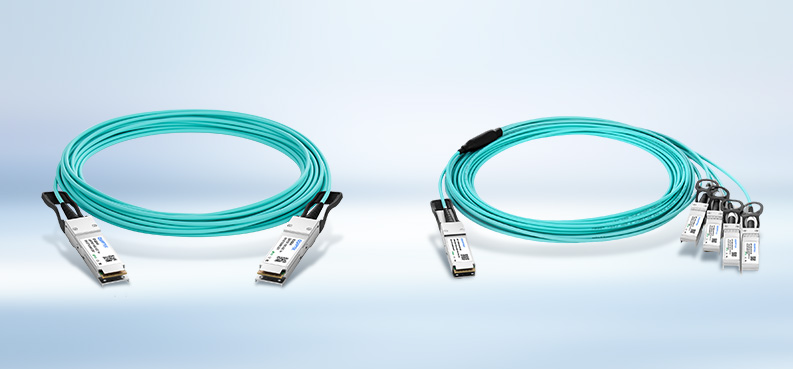
QSFP28 Direct and Breakout AOC cable
Breaking Down the Core Differences Between the Two Interfaces
PAM4 vs. NRZ
The main difference is in the modulation technology. The QSFP28 uses a 4×25G NRZ architecture, a very mature modulation method that is easy to implement, requires less reliance on complex signal compensation, and is stable in latency-sensitive applications. However, this comes at the cost of requiring four physical channels, thicker cables, and more panel space occupied by the ports.
The SFP-DD, on the other hand, uses 2×50G PAM4. Compared to NRZ, PAM4 can carry twice the amount of information per unit time, enabling it to achieve 100G throughput with just two channels. Efficiency gains come with more complex signal processing ,heightened sensitivity to signal-to-noise ratio (SNR), and increased reliance on forward error correction (FEC) mechanisms to manage bit error risk.
Port Density
The size of the interface directly affects the total throughput a single switch can achieve. The QSFP28 module is wider, and a 1U panel can usually fit 32 to 36 ports, which gives you a system bandwidth of around 3.2T. While this was fine in early 100G setups, it's clearly not enough for today's high-density scenarios.
The SFP-DD approach is more aggressive: while maintaining a form factor of approximately 14mm, it doubles the number of contacts through a "dual-density" gold finger structure, increasing single-port bandwidth without sacrificing panel utilization. At the system level, a 1U panel has the capacity to deploy up to 72 SFP-DD ports, which easily exceeds 7.2T in system-level bandwidth density. This is one of the key reasons why it is more attractive in AI server access scenarios.
Power Consumption and Heat Dissipation
The overall size of the SFP-DD is about half that of the QSFP28. This means that while achieving the same 100G bandwidth, its thermal load is compressed into a smaller space. This increases the heat density per unit volume and places greater demands on the system's thermal design.
The advantage of QSFP28 is its larger metal casing and a larger heat-dissipation surface area. This makes it easier to dissipate heat from the module body when there is a high power consumption. SFP-DD, on the other hand, must use chipsets that use very little power to reduce heat generation at the source and make the best use of the heat dissipation path within the limited space of the module. Otherwise, local heat accumulation is more likely to occur in areas with a high number of ports, which can affect link stability.
Compatibility and Investment Protection
In real-world network evolution, enterprises are more concerned with "smooth upgrades" than single-point performance metrics. SFP-DD, through its mechanical backward-compatibility design, enables the same port to directly use SFP28 (25G) or SFP+ (10G) modules, enabling batch replacement of existing network cards, modules, and fiber assets and effectively amortizing capital expenditure (CAPEX).
QSFP28, following the QSFP-MSA specification, offers greater scalability in vertical evolution: it is backward-compatible with QSFP+ (40G) and electrically supports the transition to QSFP56 (200G). Although QSFP and SFP belong to different physical ecosystems, QSFP28 still firmly occupies the positions of the convergence layer and the core layer thanks to its mature industry chain and extensive equipment support.
Role Division in Real-World Networks
In actual deployments, the roles of the two interfaces have clearly diverged. The core and aggregation layers still mostly use QSFP28. This technology offers better stability in terms of heat dissipation, redundancy, and latency control. It has long been the mainstay of backbone networks.
The access layer and compute nodes are slowly switching to SFP-DD. With its higher port density and flexible compatibility with 25G and 50G speeds, SFP-DD is rapidly becoming the mainstream interconnect interface for ToR switches and high-density compute nodes (especially AI GPU servers).
This difference in role has made the coexistence of heterogeneous interfaces on the same network common. It has also brought real-world engineering challenges: New-generation servers are equipped with SFP-DD network cards. The switching architecture still mostly uses QSFP28, which creates an issue in the access layer. This issue can't be solved with passive cabling or traditional splitting methods.
The Engineering Value of 100G SFP-DD to QSFP28 AOC
This transitional architecture is more than just a "size adapter." It's a complete solution that adjusts the electrical and optical signals to handle differences in signal patterns.
SFP-DD and QSFP28 work together so that servers with new network cards can connect to existing switch ports. This means that no changes to the main network are needed. This cross-standard interconnection method preserves greater upgrade flexibility for enterprises, allowing new and old hardware to operate collaboratively within the same network, thus avoiding the need to simultaneously replace the entire switching platform to connect new servers.
At the signal level, since one side is 2×50G PAM4 and the other side is 4×25G NRZ, simple physical patch cords can't achieve the necessary mapping. These AOCs usually have DSP or CDR chips that perform "gearbox"-like signal reshaping, aligning, and calibrating different modulation formats in real time to ensure accurate timing and intact data during cross-interface transmission. Also, AOCs use an electro-optical-electro-electrical path to reduce reflections and losses compared to direct-connect cables significantly. This keeps the bit error rate (BER) within industry-standard ranges.
In high-density cabling scenarios, the physical advantages of AOCs are equally evident. Compared to DACs of the same bandwidth, optical fibers are thinner, lighter, and have a smaller bending radius. This significantly alleviates cable congestion at the rear of racks and reduces obstruction of switch exhaust vents, thus promoting smooth airflow. This is especially important for smaller, higher-heat-density SFP-DD devices. Simultaneously, optical fibers naturally possess electromagnetic interference (EMI) immunity, which is more conducive to maintaining stable links in high-noise environments such as AI computing clusters.
Conclusion
The 100G SFP-DD to QSFP28 AOC is a low-friction interconnect that helps link next-gen SFP-DD computing nodes to existing QSFP28 switching networks. This means data centers can boost high-density access without changing the architecture or incurring downtime. It's perfect for upgrading in phases so that you can keep both new and old interfaces for a long time. This makes the most of your existing switching equipment and fiber-optic resources and keeps capital spending down.
QSFPTEK's QSFP28 AOC, DAC, and other products designed for data center scenarios expand port density and bandwidth capabilities while ensuring long-term operational stability and the sustainability of network evolution.


share

