


What is Coherent Optical Communication?

Due to limitations in fiber optic resources, coherent optical communication is gradually maturing and being widely adopted. Because of the continuous growth in demand for bandwidth in recent years, and the inability of fiber optic resources to keep pace with this growth, increasing transmission capacity and distance without increasing the number of fibers has become a challenge for the industry. As the cost and system complexity of coherent technology gradually decrease, and with improvements in optical device performance and the maturity of DSP technology, its application is beginning to extend to data centers and access networks.
What is Coherent Optical Communications
Coherent optical communication is an optical communication technology based on a coherent detection mechanism. Unlike traditional intensity modulation/direct detection systems, the receiver in a coherent system doesn't simply measure the intensity of the light; instead, it introduces a reference light beam to compare and analyze the received optical signal.
In a coherent system, the receiver is equipped with a local oscillator laser, which generates light that mixes with the signal light at the receiver. Through this mixing process, the system can recover not only the amplitude information of the signal but also extract phase and frequency-related information. This ability to recover and extract this information is not present in traditional direct detection systems.
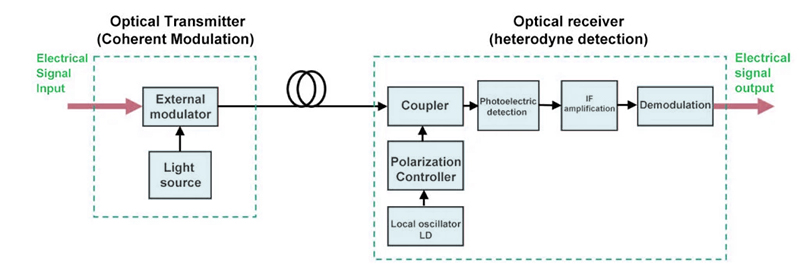
How Does Coherent Detection Work
We can understand the working principle of a coherent transceiver by starting with the processing flow at the receiving end.
First, the optical signal, after traveling through a long-distance optical fiber, arrives at the receiver. During transmission, the signal is usually affected by various factors that degrade signal quality, such as fiber dispersion, phase noise, and polarization changes, and the optical power is relatively low. At this point, a reference light with a stable frequency and narrow linewidth is generated by a local oscillator laser inside the receiver and superimposed with the optical signal.
After these two beams of light are superimposed in an optical mixer, interference effects occur due to the wave nature of light. After interference, the optical signal is then converted into an electrical signal by a balanced photodetector. Unlike traditional direct detection, this electrical signal not only contains intensity variations but also retains the phase and frequency information of the optical signal relative to the local oscillator light.
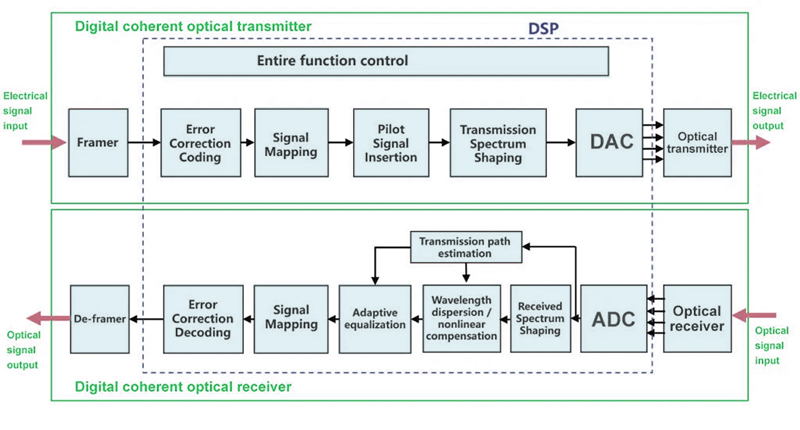
After being converted into an electrical signal, it enters a digital signal processor (DSP) for processing. The DSP uses complex and highly sophisticated algorithms to compensate for dispersion, polarization changes, and phase drift introduced during transmission, ultimately recovering the original data signal.
Key Conditions for Achieving Coherent Detection
To achieve stable coherent detection, several basic conditions must be met between the optical signal and the local oscillator light; otherwise, coherent detection cannot effectively interfere with the optical signal.
First, the frequencies of the optical signal and the local oscillator light need to be sufficiently close. If the frequency difference between them is too large, it will produce a frequency offset that is difficult to handle after mixing. The phase difference must also be within a trackable range to ensure that the DSP can perform phase recovery. Furthermore, the polarization state of the light directly affects the coherence efficiency; if the polarization is mismatched, it will lead to a significant reduction in signal quality.
In the early stages, coherent optical communication was difficult to implement due to these conditions. However, with the maturity of DSP technology, its dynamic compensation capabilities have made these conditions less critical, relying on DSP dynamic compensation rather than optical precision. This is a key technological foundation for the large-scale deployment of coherent optical communication.
Typical Architecture of a Coherent Optical Communication System
A coherent optical communication system consists of two parts: a transmitter and a receiver.
The transmitter uses a tunable, narrow-linewidth laser as the light source and, combined with coherent modulation structures such as an IQ modulator, maps the electrical signal onto the amplitude and phase of the optical carrier. This allows support for high-order modulation formats such as QPSK and 16QAM, enabling transmission of 100G, 400G, 800G, and even 1.6T modules, carrying more data within a limited bandwidth.
The receiver consists of a local oscillator laser, an optical mixer, a balanced detector, and a DSP chip. The DSP chip is the core of the entire system, and its performance directly determines the coherent system's performance in terms of transmission distance, speed, and stability. In short, the quality of the DSP chip directly determines the quality of the coherent optical communication system.
Why is Coherent Optical Communication Irreplaceable
Compared to traditional IM/DD systems, coherent optical communication systems offer improvements that go beyond just increased data rates. By using a local oscillator in the detection process, the system's receiver sensitivity is significantly enhanced. This means that under the same optical power conditions, coherent optical communication systems can support longer transmission distances. Furthermore, the application of higher-order modulation formats significantly improves the spectral efficiency of the optical signal.
Moreover, when combined with DSP chips, coherent systems possess strong capabilities for compensating for fiber dispersion and polarization-related impairments. This allows them to maintain stable and reliable transmission performance even in complex link environments, which is why coherent optical communication is gradually becoming the mainstream choice in backbone networks, metropolitan area networks, and data centers.
Conclusion
Coherent optical communication is not simply a new detection method different from traditional methods. By introducing phase and polarization dimensions and combining them with high-performance data signal processing, it achieves an overall improvement in the performance of optical communication systems. Furthermore, with continuous technological development and decreasing costs, coherent optical communication systems are extending from traditional long-distance transmission scenarios to more network layers and will play a crucial role in future high-speed optical communication networks.


share

