


25G Ethernet vs 40G Ethernet? What Is The Difference?

Cloud and data center networks are accelerating their upgrades to handle the pressure from AI workloads, virtualization, and the growth of 5G services. The ever-increasing demand for bandwidth makes the evolution from 10G to 100G and beyond almost inevitable. In this process, two primary upgrade paths—10G→25G→100G and 10G→40G→100G—jointly form the main trajectory of current Ethernet evolution.
While both 25GbE and 40GbE facilitate a smooth transition from traditional 10GbE, they differ in their technical implementation, scalability, and overall cost structure. This article compares 25G and 40G Ethernet across technical characteristics, cost and energy efficiency, scalability, typical application scenarios, and evolution strategies to provide guidance for network architecture planning and path selection for upgrades.
25G Ethernet vs. 40G Ethernet: Technical Overview
The fundamental distinction between 25GbE and 40GbE lies primarily in their channel architectures.
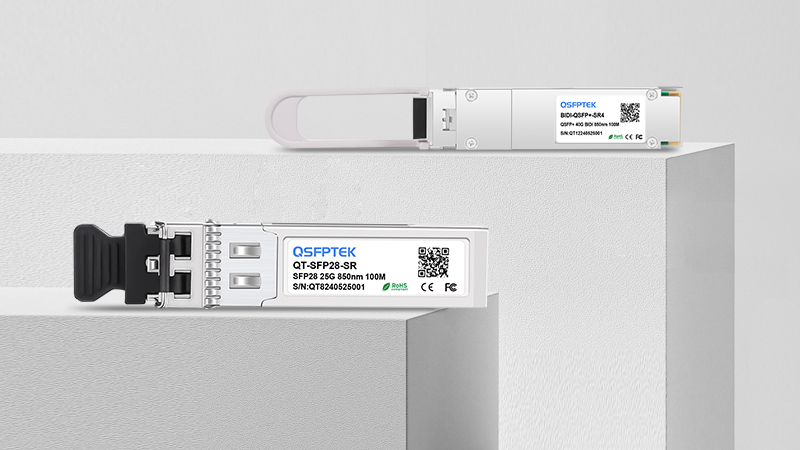
25G Ethernet (IEEE 802.3by) typically utilizes SFP28 modules, with each port employing a single 25Gbps channel corresponding to a SerDes rate of approximately 25.78GHz. This single-channel structure is relatively straightforward, featuring a more streamlined signal path and more efficient port-level processing.
40G Ethernet (IEEE 802.3ba), relying on QSFP+ transceivers, achieves 40Gbps total bandwidth through four parallel 10Gbps channels, requiring four SerDes operating at approximately 10.31GHz. While this solution is technically mature, its multi-channel parallel design results in a more complex overall architecture and relatively dispersed bandwidth utilization per channel.
Overall, 25G Ethernet's single-channel SerDes design facilitates higher port density and bandwidth utilization in switch equipment. The 40G solution builds on 10G technology for lower complexity, but it's not quite as efficient or scalable. These differences result in subsequent costs, expansion capabilities, and deployment choices.
25GbE vs. 40GbE: Cost and Scalability Comparison
As for power consumption and port density:
25GbE uses a single-channel SerDes design, which means it consumes less power and generates less heat per port. This lets switches fit more ports in the same space, making better use of the space and reducing the cost per Gb of bandwidth. On the other hand, 40GbE gets its bandwidth through 4x10G parallel channels, which means it needs more SerDes and circuit resources per port. This results in higher power consumption and thermal challenges, limiting available ports and naturally increasing the cost per Gb.
Regarding hardware costs, 25GbE leverages the mature SFP+/SFP28 packaging form factor, enabling full reuse of the 10Gb era's supply chain and design expertise. This makes per-port costs for modules and related hardware easier to control and eases network upgrades. On the other hand, 40GbE uses QSFP+ modules and new components. Its technology path is mature, but it costs more upfront and per port than 25GbE.
For cabling and connectivity, 25GbE typically uses LC duplex fiber or 25G DAC cables. In many situations, you can reuse existing 10G cabling systems without significant modifications, helping keep cabling costs down and simplifying deployment. 40GbE mainly uses MPO/MTP multi-fiber trunk cables (e.g., 12-fiber), which don't work with standard LC interfaces. This often necessitates new or reconfigured cabling infrastructure, resulting in higher project investment and implementation barriers.
Regarding scalability and performance: - 25GbE's single-channel architecture delivers higher per-port energy efficiency and bandwidth utilization, with link efficiency closer to that of an upper-layer bus. Combining four 25G channels makes it easy to upgrade to 100G. A 40GbE solution based on a 4x10G architecture has lower per-link bandwidth than 40GbE. Also, going faster usually requires changing the system setup or the cables, making it less flexible than the 25G-based approach.
25G Ethernet vs. 40G Ethernet: Application Scenario Comparison
40G Ethernet is still widely used for traditional aggregation and backbone applications. However, in new construction or large-scale upgrade projects, 25G is becoming the preferred solution. 25G Ethernet is better suited for high-density environments emphasizing energy efficiency and scalability, such as server uplinks in data center top-of-rack (ToR) deployments, AI cluster access layers, and cloud/edge node deployments. It enables a smooth upgrade path from 10G while leveraging existing cabling infrastructure, delivering higher port density, lower cost per Gbit, and superior energy efficiency. It also aligns well with scenarios demanding high bandwidth and low latency, such as 5G fronthaul.
40G Ethernet is more prevalent in established, long-running networks. It combines multiple 10G links in data center aggregation and core layers, campus networks, and metropolitan area networks, delivering stable, high-bandwidth backbone transmission. In these cases, the 40G switch and optical module infrastructure we already have is still a significant investment, and it'll serve as a transitional layer before we move on to 100G, 400G, or even higher speeds. Overall, 25G Ethernet is better suited for future-oriented, high-density deployments. In comparison, 40G Ethernet continues to play a foundational role in traditional systems and aggregation layers, providing a buffer and compatibility assurance for gradual upgrades.
How to Choose Between 25G Ethernet and 40G Ethernet?
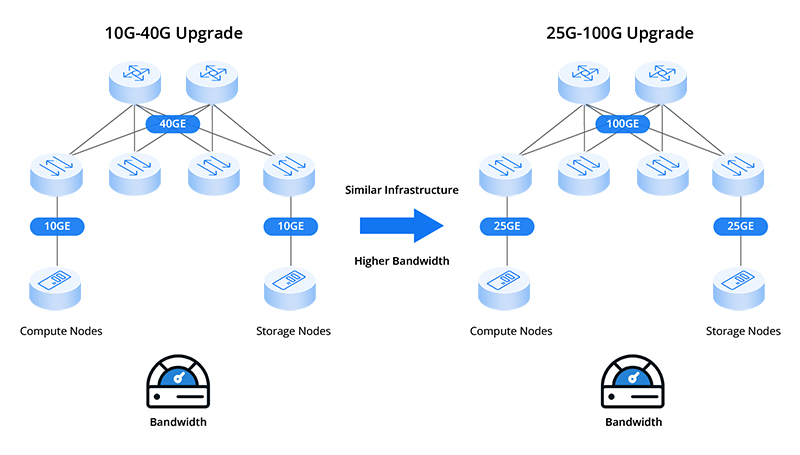
When choosing between 25G and 40G Ethernet, it depends on your specific network needs. 25G SFP28 is better suited for server connections. It works well with typical server network interface card speeds, offers more ports in the same space, and costs less per gigabit. If the primary focus is high-bandwidth uplinks between switches, or if the existing network has already deployed QSFP+ equipment on a large scale, continuing with a 40G solution will be smoother in the short term.
In terms of cabling and infrastructure, if the goal is to reuse existing 10G cables and wiring systems as much as possible, 25G offers a more significant advantage. In most cases, upgrading to 25G lets you reuse your current LC duplex fiber or copper DACs. This can save you money on rewiring and get you up and running faster. Typically, 40G uses MPO/MTP multi-fiber cables, which require new backbone cabling. This increases the complexity of planning and construction. When it comes to scalability, 25G naturally evolves to 100G via 4x25G, which lines up with the next 100G and 400G network roadmaps. Many 100G QSFP28 modules use a 4x25G design. While 40G can also migrate to 100G, it's not as efficient as the 25G-based evolution path in terms of power consumption and port density utilization. It is better suited as a transitional layer for existing networks rather than a core choice for new high-density architectures.
Regarding equipment availability and budget, 40G switches and QSFP+ modules are highly mature, making them suitable for leveraging existing ecosystems and enabling rapid short-term deployment. At the same time, 25G equipment is becoming more common in cloud data centers and 5G scenarios. SFP28 modules, NICs, and switches are getting cheaper, making them a better overall deal. In practice, many organizations use a mix of 25G for access and top-of-the-rack (ToR) layers, and 100G/400G for uplinks and backbones. This means they skip 40G as an intermediate step. If forced to choose one “intermediate speed solution,” a simple rule of thumb applies: 25G tends to offer better cost per Gbps and port density. At the same time, 40G leverages its maturity and existing network infrastructure to retain value in rapid deployment and compatibility.
Conclusion
In general, 25GbE and 40GbE both played a temporary role in the transition from 10G to 100G, but their roles in modern networks differ. The 25G SFP28 module is excellent because it offers high port density, allows you to control power consumption, and lets you reuse the cabling. It can use the 10G LC fiber and copper cables you already have, so it's a great choice for top-of-rack server access, 5G fronthaul links, and edge scenarios. 40G QSFP+ is still used in traditional aggregation and legacy networks, offering reliable, consistent performance support for established backbone and aggregation layers.
In most new or upgrade projects, 25G is a better deal and easier to expand, and it often completely replaces 40G. QSFPTEK offers a complete selection of QSFP+ and SFP28 optical modules and cables. All products undergo rigorous testing under near-real-world conditions, ensuring seamless compatibility with mainstream switches and servers. This makes it easy for users to upgrade, and it keeps everything running smoothly and working well together.


share

