


800G Transceivers and Cables Typical Applications in AI Data Center

With the continued growth of AI application workloads, data centers are gradually upgrading to 800G interconnect technology to support massive east-west traffic transmission between GPUs, switches, and storage systems. In large-scale AI clusters, thousands of acceleration chips need to achieve ultra-low latency and ultra-high bandwidth communication, making the selection of interconnect solutions particularly critical. This article will focus on the specific applications of QSFPTEK's 800G optical modules, DACs, and AOC products in AI data centers.
The Role of 800G in AI Infrastructure
Artificial intelligence training clusters require continuous data exchange between GPUs, often spanning multiple racks or even data centers. Traditional 100G and 400G links are insufficient for these environments, driving the adoption of 800G networks.
Compared to traditional enterprise-level business scenarios, AI cluster networks place greater emphasis on the following:
High bandwidth density: Individual server nodes typically require downlink bandwidth of at least 400Gbps, while in large AI clusters, backbone switches need switching capacities of tens or even hundreds of Tbps.
Low latency and high stability: Network latency directly impacts model training efficiency, especially in large-scale distributed training scenarios.
Scalable interconnect architecture: As the number of GPU nodes increases, the network needs to support smooth scaling, including both horizontally adding GPU servers and vertically upgrading speeds from 400G to 800G.
800G DAC: The Best Choice for Short-Range Links
For connections within the same rack, 800G DAC cables are the most efficient option. These cables use copper cabling and support ultra-low latency communication between GPUs, network interface cards (NICs), and top-of-rack switches.

Its key advantages include:
Due to the characteristics of DACs, their power consumption is close to zero, helping to reduce operating costs.
The cost of 800G DACs is extremely low; they are the lowest-cost of all 800G solutions, making them an excellent choice for enterprises with limited budgets.
Furthermore, 800G DACs transmit electrical signals directly, eliminating the need for photoelectric conversion, resulting in extremely low latency, which is particularly important for AI data centers.
With these characteristics, DACs are widely used in AI clusters for connections between GPUs and switches, as well as between servers and switches. However, their limitation lies in transmission distance. DACs typically only support transmission distances of a few meters, making them unsuitable for inter-rack or longer connections.
800G AOC: A Flexible, Interconnected Short-to-Medium Distance Solution
When transmission distances extend beyond rack-mounted areas, the 800G AOC becomes a more practical solution. The AOC integrates optical modules and fiber into a single component, enabling high-speed transmission over longer distances compared to a DAC.

Typical features of the 800G AOC include:
Longer transmission distances, typically reaching 30 meters or more.
AOCs are more lightweight and easier to manage than DACs, allowing deployment in confined spaces and facilitating network management.
Because AOCs use optical signals to transmit data, they are unaffected by electromagnetic interference, allowing deployment in environments with electromagnetic interference.
Their flexibility and higher signal integrity make them ideal for densely cabled environments where copper cabling management is challenging.
800G Optical Modules: The Backbone of AI Data Centers
800G optical modules are crucial for large-scale connectivity, especially in leaf-ridge architectures. They support both short and medium-distance links, offering high flexibility.
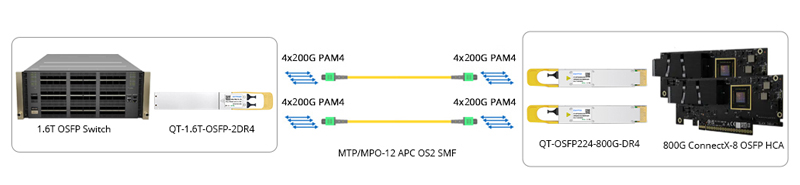
The 800G OSFP224 DR4 can connect to a 1.6T OSFP 2DR4 via two MTP/MPO-12 APC cables, enabling upgrades and data aggregation to the 1.6T core layer to meet the bandwidth requirements of AI data centers.
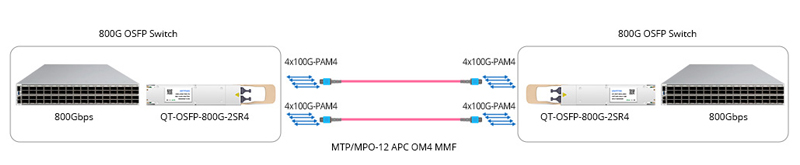
800G modules can also be directly interconnected via multimode fiber to achieve high-bandwidth switch interconnection. This solution offers higher port density and simpler cabling, facilitating future maintenance.
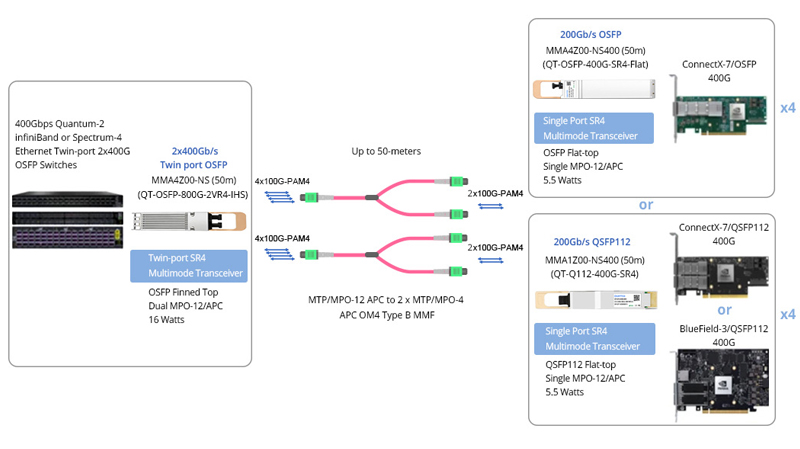
The 800G SR8 can also seamlessly connect to a 400G SR4 via MTP/MPO-12 APC OM4 patch cords to connect the switch to a high-performance network interface card (NIC). This connection method can quickly upgrade 400G networks to 800G, providing data centers with higher bandwidth and lower latency, as well as end-to-end non-blocking interconnection for AI training clusters.
Conclusion
The rapid development of AI services is driving data centers to upgrade to 800G interconnect technology to meet the demands for high bandwidth, low latency, and scalable networks. QSFPTEK's 800G DAC, AOC, and optical modules are adapted to different scenarios in short-haul, short-to-medium-haul, and backbone networks, forming a complete solution that effectively supports the efficient and stable operation of AI training clusters.


share

