


Copper Interconnects Cannot Scale for AI Data Centers

AI workloads are changing data center networks, making higher bandwidth and greater scalability more important. As speeds continue to increase, copper interconnects are reaching their limits in large-scale AI environments.
AI Data Centers Are Redefining Network Infrastructure
The Shift From Traditional Data Traffic to AI Workloads
Traditional data center traffic mainly supports applications such as cloud services, databases, and web platforms. These workloads usually involve predictable communication between servers and storage. AI workloads are different. Training large AI models requires thousands of GPUs to exchange huge amounts of data continuously, making high-speed, low-latency networking critical for performance. As AI models become larger, data centers are moving toward faster connections such as 800G and 1.6T to reduce communication bottlenecks and maximize GPU utilization.
Why Scale-out Architecture Changes Everything?
Modern AI data centers rely on scale-out architectures, connecting thousands of GPUs and servers into a single computing system. In this model, the network plays a critical role in enabling efficient communication between computing resources.
However, larger AI clusters require more connections, higher bandwidth. Traditional copper interconnect solutions that worked for smaller environments are becoming harder to scale. This shift is pushing data centers to adopt advanced connectivity technologies that can support higher density and larger AI workloads.
Why Copper Cabling is Under Re-evaluation?
AI model training is no longer driven by a single GPU. Instead, thousands of GPUs must work together as a distributed computing system, constantly exchanging massive amounts of data. When training, GPUs need to make sure their intermediate results are in sync. Even small delays in communication can reduce how much of the GPU is used and affect how well training is done overall. As AI models become more powerful, the amount of data they use is reaching the Tbps level, which is putting pressure on traditional copper cables. The challenge is no longer just computing power — it is how efficiently data can move between GPUs. As AI clusters expand from hundreds to thousands of accelerators, connectivity has become a critical factor limiting scalability.
Physical Limitations of Copper Wiring in High-Speed Networks
Signal Attenuation
Electrical signals gradually lose strength, the longer the transmission distance, the weaker the signal becomes, making it more difficult to maintain reliable data transmission.
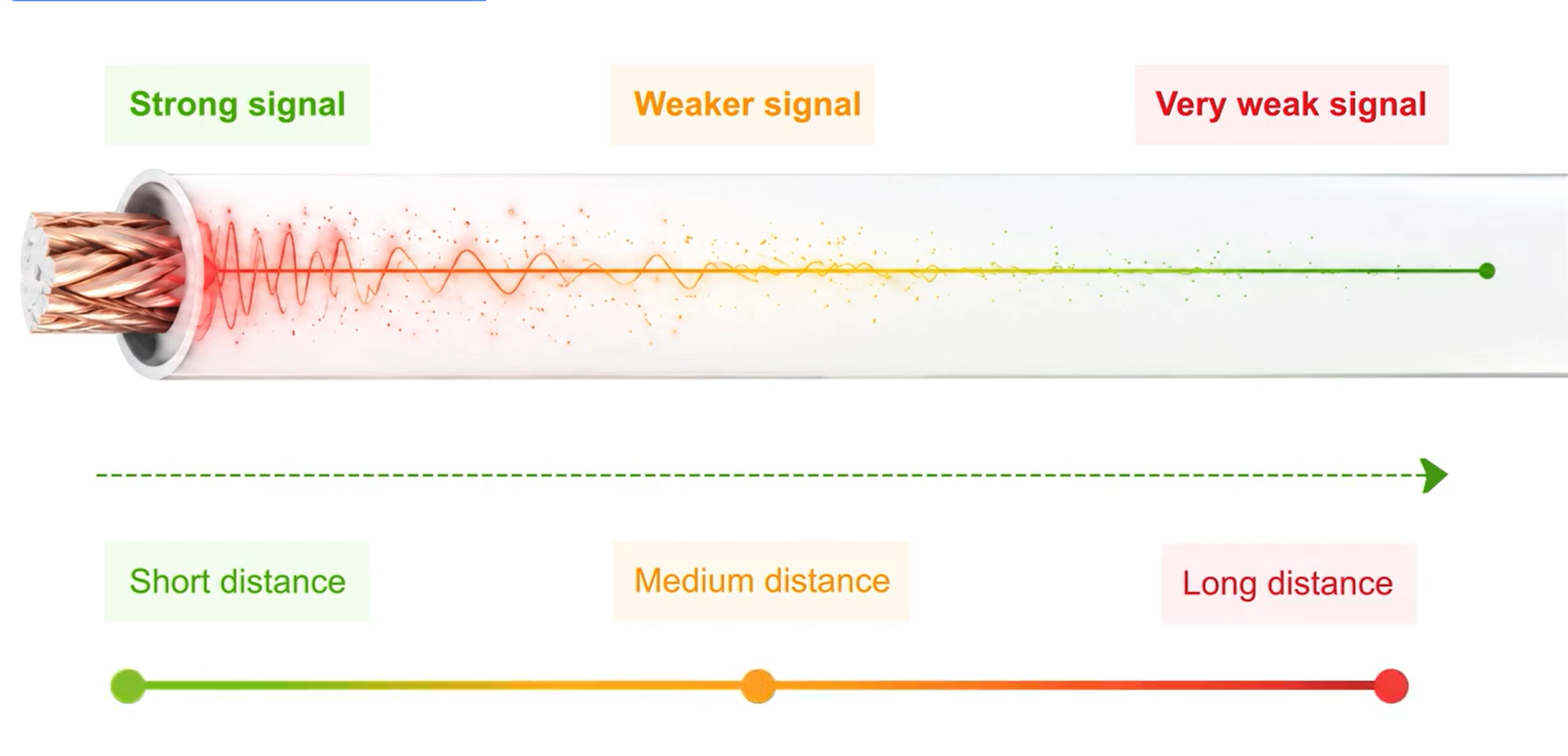
As network speeds continue to increase, signal strength becomes a greater challenge. Higher speeds mean higher frequencies, which lose more signal strength over distance. This makes it harder to use copper connections in large AI data centers.
Crosstalk
Crosstalk poses a hidden challenge for copper cabling. When large numbers of copper wires are densely packed, electrical signals interfere with one another. As AI data centers continue to scale up and require an increasing number of high-speed connections within racks, the issue of crosstalk becomes even more pronounced.
Electromagnetic Interference
Copper cables transmit data through electrical signals. This makes them vulnerable to electromagnetic interference (EMI) from nearby electronic devices, power cables, and other network connections. In data centers with a lot of AI data, thousands of high-speed connections work at the same time. This can increase the potential impact of EMI.
Power Consumption
In the era of AI infrastructure, where individual GPUs can already consume more than 1,000 watts, data center operators are under increasing pressure to optimize every part of the power budget. Allocating additional energy to high-speed copper transmission is becoming less attractive, especially as network scale continues to grow.
Cable Density and Thermal Challenges
High-speed copper cables are thicker and heavier than optical fiber cables. This makes them difficult to use in large-scale AI data centers where space and airflow are critical.
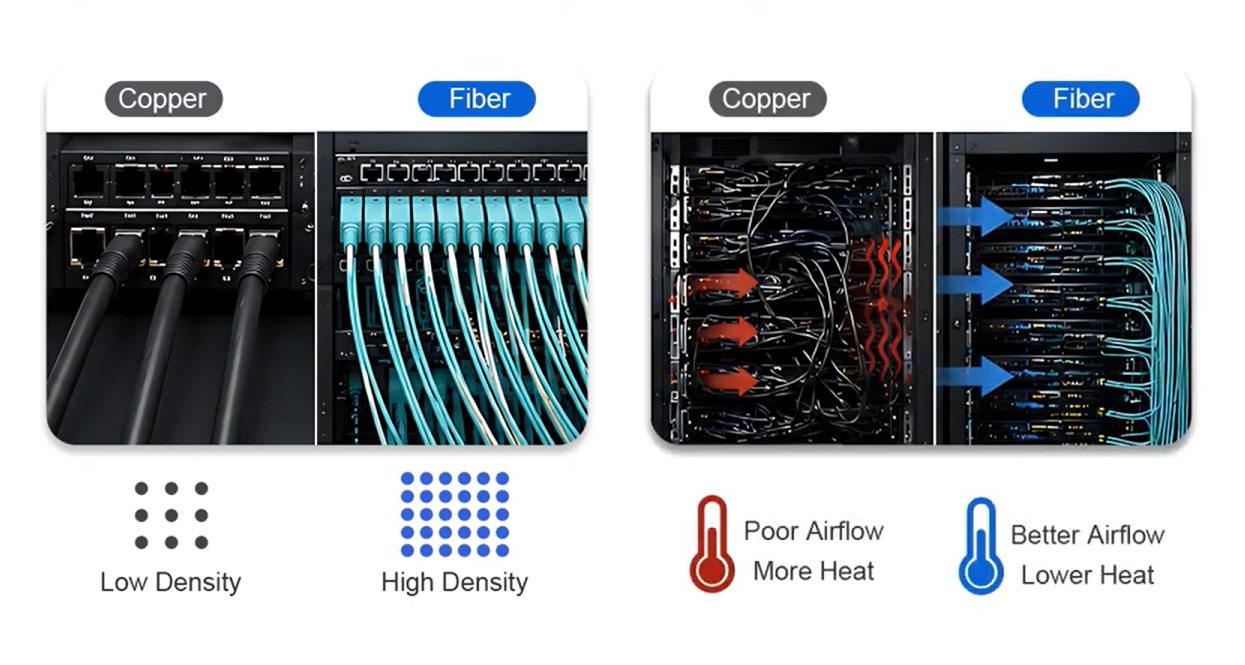
As AI clusters continue to grow, the number of network connections inside each rack increases a lot. Dense copper cabling can make managing cables harder, use up more space in the rack, and restrict airflow, which makes it harder to manage the heat.
The Continuing Role of Copper in AI Data Centers
Copper in Intra-rack Connectivity
Despite the growing adoption of optical solutions, copper still plays an important role in short-distance AI data center connections. Inside a rack, where distances are usually limited to a few meters, copper cables such as DACs can provide high-speed connectivity between servers, GPUs, and switches with lower cost and simpler deployment.
Cost-efficiency in Short-Distance Scenarios
Copper is still a most economical option for short-reach applications. Copper cables have a simple structure and do not require optical components, making them suitable for applications that do not require long-distance transmission compared with optical modules.
Copper as a Local Optimization Rather Than a Scalable Solution
But copper is not a permanent option for huge AI networks. With bandwidth requirements on the rise, signal loss, power consumption and limited reach represent funding issues. Thus copper will remain a short connection local optimization and fiber optics will be the scalable AI data center infrastructure.
How Optical Fiber Solves Copper's Scaling Limitations
Low Signal Loss Enables Long-distance Connectivity
One of the best things about optical fibre is that it can carry signals really well over long distances. Copper cables get weaker when the signal has to travel further and further, but fiber can send data over longer distances without losing much of the signal. This makes it perfect for use in large-scale AI data centre networks.
High Bandwidth Scalability for Future Data Rates
Optical fiber delivers the massive bandwidth scalability needed to meet the levels of data rates driven by AI workloads for next-gen. Fiber is a critical technology for scaling AI infrastructure in the future because it supports 400G, 800G and higher-speed connections.
Immunity to Electromagnetic Interference
Unlike electrical signals which use electricity, optical fiber transmits data through light. Thus, it is impervious to EMI. This makes sure that communication is more stable and reliable in places where there are a lot of AI data centres and thousands of high-performance components are running at the same time.
Superior System-level Scalability
Optical fibre is better for systems because it can be made bigger. Its smaller size, lower weight, and higher port density help data centres make better use of space, power consumption, and cooling efficiency. As AI clusters continue to grow, fibre is needed to build larger, faster, and more efficient networks.
Hybrid Network Architecture in Modern AI Data Centers
Separation of Intra-rack and Inter-rack Connectivity
As AI data centers continue to scale, a hybrid network architecture is emerging, combining the strengths of both copper and optical fiber. Instead of completely replacing copper, modern AI infrastructure is moving toward a "fiber-first, copper-assisted" approach.
Copper is still appropriate for intra-rack connectivity since short distances, lower cost, and ease of deployment are big drivers. On the other hand, with respect to inter-rack and long-distance connections, optical fibre is widely used when high bandwidth, low signal loss and better scalability are required.
Conclusion
Although AI data centers continue to scale, the scalability of copper interconnects has come to an end. Although copper still serves a purpose in short-run, intra-rack connections, the ever-increasing demands for higher bandwidth, longer reach, and improved efficiency for AI workloads cannot be met with current copper technology. The optical fiber is emerging as the backbone of the next generation AI infrastructure, powering hyperscale data centers more rapidly and stably to support more sophisticated AI systems.


share

