


DSP or LPO? Understanding the Two Paths Shaping Next-Gen High-Speed Optics

With the rapid growth of AI and high-performance computing (HPC), data centers face growing demands for bandwidth and energy efficiency. The move from 400G to 800G, along with the upcoming 1.6T era, makes choosing the right transceiver technology a big deal. With this trend, two different approaches have become the main topics of discussion: traditional DSP-based optical transceivers and the growing LPO (Linear-Driven Pluggable Optical Module) solution.
This article explores LPO's operating principles, outlines key differences from DSP architectures, and discusses how to select appropriate transceiver solutions for various deployment environments to achieve more efficient, stable network performance.
Understanding LPO Modules
When the transmission speed is low, each optical module typically consumes 1–3W (10G/25G) or 5–8W (100G), which is a small part of a switch's total power consumption. But as networks moved to 400G and 800G levels, the power consumption per module went way up. The traditional 800G modules using DSP architectures can reach a peak power consumption of 16–18W, while DSP-based modules typically consume more power at higher data rates. Advances in DSP design have also yielded lower-power 400G modules. In large-scale data centers, higher speeds mean greater energy use and more difficult thermal management, increasing operational costs and reducing overall equipment efficiency.
Therefore, reducing module power consumption remains a core objective in optical module design. Against this backdrop, LPO, a lightweight architecture eliminating complex DSP circuitry, offers a new approach to balancing high-speed bandwidth with energy efficiency and cost.
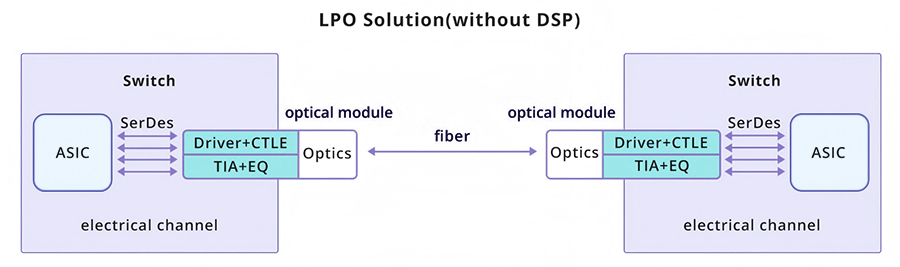
Linear-driven Pluggable Optical Modules (LPOs) represent a transceiver architecture for high-speed interconnects that reduces power consumption and latency by eliminating digital signal processors (DSPs). Unlike traditional approaches, LPOs do not perform complex digital signal processing within the module itself. Instead, they rely on highly linear laser drivers and transimpedance amplifiers (TIAs) for basic signal amplification, shifting critical processing tasks such as equalization and clock recovery to the switch-side ASIC. This design imposes higher demands on the linearity and noise immunity of switch SerDes. Recent advancements in CMOS process technology have accelerated the maturity of high-performance SerDes, making LPOs a viable solution for meeting the high-speed expansion requirements of data centers.
Comparison of DSP-Based Transceivers and LPO Transceivers
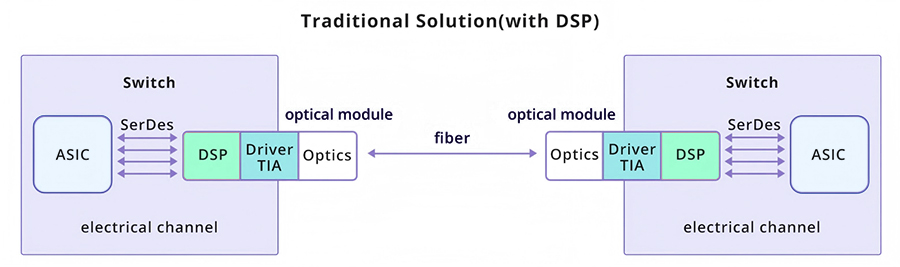
Digital Signal Processor (DSP) Transceivers
The DSP architecture has long formed the mainstream foundation of high-speed optical communications, enabling transceivers to maintain stable operation in complex, high-noise link environments. By adding DSP to the module, transceivers handle key digital tasks such as equalization, forward error correction (FEC), and clock recovery. These tasks help compensate for connection problems, such as signal loss, crosstalk (interference between signals), and dispersion (variations in signal strength and timing). DSP solutions are better able to withstand and maintain reliability in long-distance transmission and in the presence of multiple sources of interference.
These DSP-equipped optical modules are used a lot in metro, backbone, and data center interconnect networks, where distance and interoperability are really important. They also represent the main technology path for 400G deployments and early 800G modules. However, this comprehensive signal processing chain incurs a significant cost: DSP power consumption increases steadily as data rates rise. In designs targeting the 1.6T generation, this characteristic further intensifies energy consumption and thermal management pressures within data centers.
Linear Pluggable Optical (LPO) Transceivers
LPO transceivers differ from DSP-based optical modules because they perform less internal digital processing. They have a simpler design because they don't need a digital signal processor. This significant change delivers key energy-efficiency and lower-latency benefits for the module. LPO modules use highly linear analog components, so the critical task of complex signal conditioning is shifted to the serializer/deserializer (SerDes) within the host switch.
This design makes Linear Pluggable Optical (LPO) modules a great choice for short-reach, high-bandwidth applications in AI clusters and high-performance computing environments. In these environments, it's essential to keep latency and power consumption low. As for cost, LPO transceivers might cost more at first than DSP-based modules. However, they use less power and don't need as much thermal management, so they end up costing less over time. This means they'll cost less over time when used at scale. This makes them a great choice for balancing technical performance with sustainability goals.
But there are some limitations to the linear drive architecture. Without the full signal recovery and compensation chain provided by DSPs, typically, LPO transceivers have an effective transmission distance of under 500 meters on standard multimode fibers, although this may vary with host SerDes performance and fiber quality. Also, these modules require host-side SerDes with sufficient linearity and noise immunity to operate correctly. LPO modules are more sensitive to compatibility than standard DSP-based transceivers. They often need to be paired with specific switch models to work well. So, it's still important to make sure your host device is compatible before you roll it out.
When Should DSP-Based Transceivers Be Selected?
When you're looking for top performance, solid links, and something that'll work with a wide range of gear, DSP-equipped transceivers are the go-to option.
Here are the universal link requirements: DSP transceivers perform well across a variety of conditions, whether for short-haul connections within data centers or long-distance links in metropolitan areas. These models are perfect for situations that require top-notch signal processing and dependability.
Multi-vendor environments: The DSP architecture is standard across the industry. When you're working with different vendor switches or routers, strong interoperability can significantly reduce deployment risks and costs.
Complex or Degraded Link Conditions: In environments with high noise or complex connections, DSP can maintain a strong signal by using equalization, correction, and clock recovery technologies. This makes them great for multi-hop transmission or aging fiber systems.
When reliability is the primary objective: For networks where stable operation is a core metric, such as carrier networks or mission-critical systems, a mature and robust DSP architecture delivers enhanced security and predictability.
When Should LPO-based Transceivers Be Selected?
Linear-driven Pluggable Optical (LPO) modules are better suited for scenarios where power is a concern and efficient connections are needed within limited resources:
For links to high-efficiency data centers, LPO modules use little energy and have low latency, making them useful in high-density designs as bandwidth requirements continue to grow. They're the perfect solution for data centers that want to save energy.
In deployment environments with power and thermal constraints, such as space-constrained edge data centers and colocation scenarios with limited power redundancy, LPO modules significantly reduce equipment thermal and power distribution burdens, enabling higher-density cabling.
Green and energy-efficient construction requirements: In large-scale deployments, LPOs effectively lower overall energy consumption and thermal output, helping optimize Power Usage Effectiveness (PUE) and reduce operational costs. Their energy-saving attributes also align closely with current data center demands for sustainability and green operations.
Future-proof links with low energy consumption: As networks evolve toward 800G and 1.6T, LPO's low power consumption, high linearity, and compact design make it well-suited for next-generation high-speed interconnect technologies. It's a key choice for future high-speed, low-power designs because it balances signal quality and energy efficiency.
Conclusion
As data centers advance toward 400G, 800G, and the future 1.6T era, both DSP-based optical transceivers and LPO transceivers will continue to play critical roles in their respective domains. DSP solutions are still the best for long-distance, complex links, and environments with different vendor products, while LPO shows clear advantages in short-distance AI and HPC applications because it uses low power and has low latency. The selection should be based on a balanced assessment of the specific network architecture, deployment scenarios, and overall cost.
QSFPTEK now offers a complete line of DSP-based optical transceivers that can handle up to 200G, 400G, 800G, and 1.6T speeds. These transceivers are compatible with both Ethernet and InfiniBand networks. Additionally, QSFPTEK's 800G LPO modules have been tested by professionals and have shown that they can operate reliably on their own LPO switch platform, which demonstrates their excellent reliability and energy efficiency. Choosing QSFPTEK provides high-quality, sustainable interconnect solutions that balance current upgrade needs with future scalability requirements.


share

