


How Is LPO Transforming 800G Transceivers?

Facing the growing power challenges in 800G transceiver connectivity, is there a solution that reduces power consumption and cost without compromising flexibility? Linear Pluggable Optics (LPO) offers exactly that. This article explores how LPO is transforming 800G optical modules and examines the evolving roles of CPO and LPO in shaping the future of data center networks.
What Challenges Do Traditional 800G Modules Face?
The upgrade of optical communication technology is not a simple increase in speed, but a trade-off between energy consumption and performance. When the network speed increases from 1G to 800G, the complexity of signal processing increases exponentially, resulting in higher power consumption, higher costs, and more stringent heat dissipation requirements.
Optical modules, this core component almost entirely determines the power consumption and performance of the entire data center link. Early 10G optical modules consumed only about 1W, while today's 800G modules consume nearly 30W. A switch often requires dozens of optical modules to work together, and the overall power consumption can easily exceed kilowatts, with optical modules typically constituting over 40% of total energy consumption. This means that every increase in data rate pushes data centers to a higher energy consumption threshold.
Therefore, in the trend of seeking higher energy efficiency, lower cost and simpler system design, the industry has explored a lighter solution: LPO technology.
LPO Transceivers Overview
What is LPO Packaging Technology?
An LPO module, or Linear Pluggable Optics module, is a type of optical module for data centers that reduces power consumption and latency by removing the DSP or CDR. Instead of the complex DSP, LPO modules use high-linearity Trans-Impedance Amplifiers (TIAs) and Drivers within the module itself and rely on equalization capabilities built into the host network equipment's ASIC. This makes LPO modules a cost-effective and energy-efficient solution, particularly for shorter-distance connections within a data center.
What is DSP?
A DSP (Digital Signal Processor) is a chip specialized for high-speed digital signal computation, responsible for tasks such as signal equalization, amplification, and error correction. In high-speed traditional optical modules, the DSP effectively compensates for signal attenuation over long-distance transmission, but at the cost of higher power consumption and overall expense.
Note: Not all traditional optical modules use a DSP. However, in high-speed modules, DSPs are usually needed to ensure high signal requirements.
What is CDR?
CDR (Clock and Data Recovery) is a circuit technology used to restore and retime signals. In some low-speed optical modules, CDR is commonly employed to stabilize signal transmission, but in high-speed modules, it is typically integrated within the DSP. In the LPO architecture, this function is also removed, resulting in a simpler and more streamlined optical module design.
LPO vs. Traditional DSP-Based Transceiver Modules, What's the Difference?
Unlike traditional DSP-based transceiver modules, LPO technology streamlines optical module design by removing traditional DSP (digital signal processing) and CDR (clock and data recovery) chips, these LPO modules integrate DSP functions into the switching chip on the device side. Instead, LPO modules retain high-linearity drivers (Driver) and trans-impedance amplifiers (TIA) that incorporate continuous-time linear equalization (CTLE) and equalization (EQ) functions. This simplified design greatly reduces power consumption and latency, although it may slightly increase error rates and limit transmission distances.
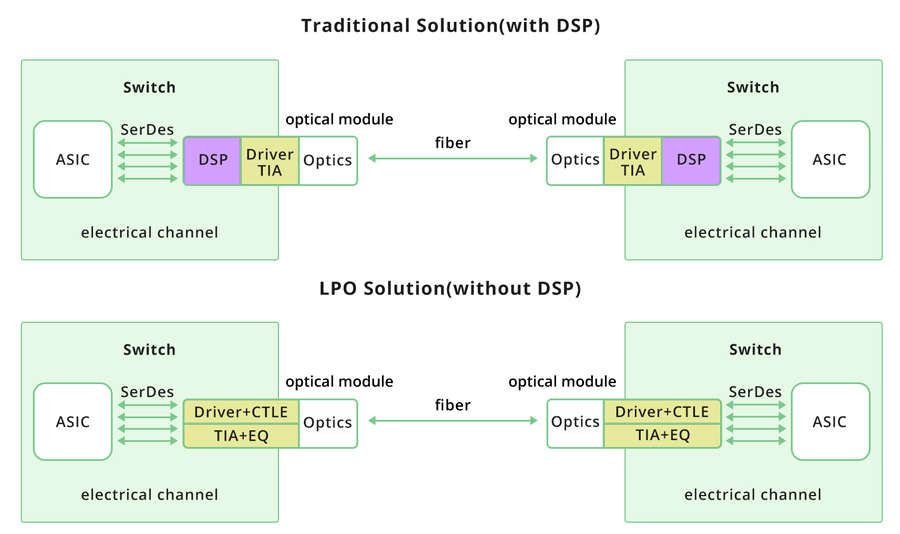
How LPO Transforms 800G Fiber Optic Transceiver?
Reduced Power Consumption
Compared with DSP-based 800G optical modules, 800G LPO modules can cut power consumption by as much as 50%, offering a significant advantage for data centers aiming to reduce energy use and operational costs. Lower power usage also means less heat generation in switches and servers, further contributing to overall energy efficiency.
Cut Transmission Latency
By removing the DSP, LPO transceivers eliminate an additional processing step, which helps reduce data transmission latency. According to research from Dell Technologies, linear pluggable optics can lower latency by as much as 90%.
Enhanced Cost Effectiveness
The DSP is the most expensive component in a traditional pluggable module, so removing it can lead to substantial cost savings.
Enabled Hot-Swappable and Easy Maintenance
Compared with the CPO solution, LPO offers greater flexibility and ease of maintenance. In a CPO system, if any device fails, the entire board must be powered down and replaced, which is highly inconvenient. LPO, on the other hand, retains a traditional hot-pluggable design that supports hot swapping, simplifies fiber cabling and equipment maintenance, and provides a more user-friendly solution.
Where Is LPO Applied in Real-World Scenarios?
High-Density Data Center Interconnects
Hyperscale data centers require massive amounts of data exchange between server clusters. The DSP chips used for signal compensation in traditional pluggable optical modules are a major source of power consumption. By removing the DSP, LPO significantly reduces the power consumption of individual optical modules and latency. This reduces the power consumption of racks in high-density deployments, making it a vital technology for enabling high-speed data center interconnects.
AI and Machine Learning Workloads
AI and machine learning tasks require high-speed, low-latency data exchange. The LPO module provides extremely low latency, streamlining data transmission between GPU clusters or AI server nodes and boosting overall computing efficiency. This makes it particularly suitable for high-frequency communication scenarios.
What Challenges Should Be Considered with LPO?
Limited Transmission Distances
Removing the DSP has a drawback. While TIA and driver chips cannot fully replace the functions of a DSP, leading to a higher bit error rate. Consequently, transmission distances are naturally limited. The industry generally considers LPO suitable only for specific short-reach applications, such as server-to-switch connections within a data center rack or interconnections between adjacent racks. Early LPO implementations support distances ranging from a few meters up to tens of meters, with potential future extensions reaching up to 500 meters.
Host Dependency
LPO offloads some signal processing functions from optical modules to ASIC chips in switches or servers. This means that LPO module performance is no longer completely independent but highly dependent on host capabilities. Therefore, the implementation of LPO requires closer collaborative design and verification between optical module and system equipment vendors, increasing system complexity and coupling.
Interoperability Challenges
Currently, LPO standardization is still in its early stages, which can lead to interoperability challenges. Enterprises adopting LPO need sufficient technical expertise to develop specifications and solutions, test device and module limits, and carry out extensive integration and compatibility testing.
In other words, in environments with multiple vendors, without strong control and coordination, issues such as unclear responsibilities and blame-shifting may arise, making deployment more complicated than with traditional DSP-based solutions.
CPO vs LPO: Which Technology Will Lead Data Center Optical Connectivity?
First, we need to briefly understand what CPO is.
Co-Packaged Optics is an advanced optical technology that integrates optical and electronic components within the same package. This solution shorten the electrical link lengths. Reducing power consumption and latency. It also allows for higher bandwidth density compared to traditional architectures with separate pluggable optical modules. CPO is particularly suited for high-performance computing (HPC), AI-driven data centers, and hyperscale cloud environments, where ultra-high bandwidth, low latency, and energy-efficient networking are critical.
The following table will illustrate the differences between LPO and CPO.
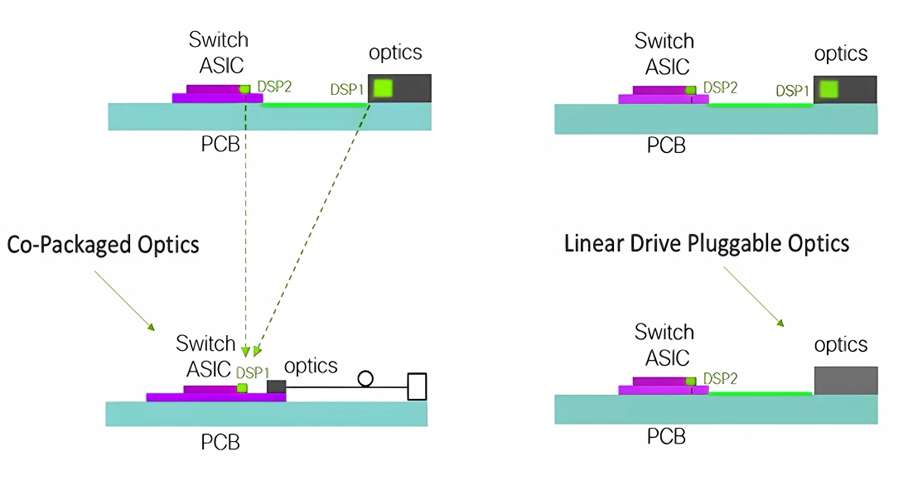
LPO (Linear Pluggable Optics) is designed for short-reach applications, such as intra-rack or adjacent-rack connections. By removing DSP or CDR, it may have slightly higher bit error rates and shorter transmission distances, but offers lower power consumption, reduced latency, and cost efficiency. In contrast, CPO (Co-Packaged Optics) excels in high-speed, high-density, and long-reach deployments but involves higher system complexity and maintenance. Short-reach interconnects are used a lot in modern data centers. This means that LPO is expected to be adopted more quickly in these situations. However, CPO will still be essential for high-end, large-scale and long-distance applications.
Conclusion
In short, LPO is changing 800G transceivers by making them simpler to design, using less power, and reducing delay, which makes them a better and cheaper option for connecting data centers that are not very far apart. While challenges such as limited distance, reliance on a host and standardisation remain, LPO provides a practical step towards greener, faster and more flexible network architectures alongside CPO in the evolution of next-generation data centers.


share

