


OSFP vs OSFP224: Inside the 1.6T Upgrade

In terms of physical appearance, the OSFP224 retains the basic dimensions and front-panel configuration of the OSFP form factor. This is precisely why, when planning network upgrades for AI clusters, many mistakenly view the transition to 1.6T as merely a routine doubling of bandwidth.
However, for hardware architects, the absence of revolutionary changes in physical dimensions does not imply stagnation in underlying technologies. On the contrary, the core technical challenges within the module have shifted. To meet the demands for superior high-speed signal integrity and system thermal management, the OSFP224 ecosystem imposes stringent requirements—far exceeding those of previous generations—regarding connectors, channel design, and thermal architecture.
Electrical Interface: The 224G SI Challenge
The core difference between OSFP and OSFP224 lies in the transmission rate of the single-lane electrical interface. According to the OSFP MSA specifications:
800G OSFP: Utilizes the 8 × 112G-PAM4 specification, with a baud rate of 53.125 Gbaud and a single-lane rate of 100 Gb/s; eight lanes achieve a total throughput of 800G.
1.6T OSFP224: Utilizes the 8 × 224G-PAM4 specification, with the baud rate increased to 106.25 Gbaud and a single-lane rate reaching 200 Gb/s; eight lanes achieve a total throughput of 1.6T.
Doubling the baud rate presents practical challenges for hardware engineering. At a rate of 106.25 Gbaud, the corresponding Nyquist frequency reaches 53.125 GHz. In this high-frequency range exceeding 50 GHz, managing insertion loss, reflections, and crosstalk—introduced by connectors, package transitions, and PCB channels—becomes significantly more difficult.
Consequently, OSFP224 systems cannot simply adopt previous high-speed channel designs. To meet the signal integrity (SI) requirements of the 224G electrical interface, the OSFP224 ecosystem demands more rigorous SI design for module connectors, host connectors/cages, and high-speed PCB channels. This is essential to ensure impedance continuity across the entire link and to keep channel losses within acceptable limits.

Thermal Evolution: Introducing RHS
As the integration of DSPs and optical engines within 1.6T modules increases, the power consumption of some modules has risen, making thermal management space under traditional air-cooling conditions increasingly constrained. To address this trend, the OSFP224 ecosystem has evolved beyond relying solely on the module itself, introducing changes to the system-level thermal architecture.
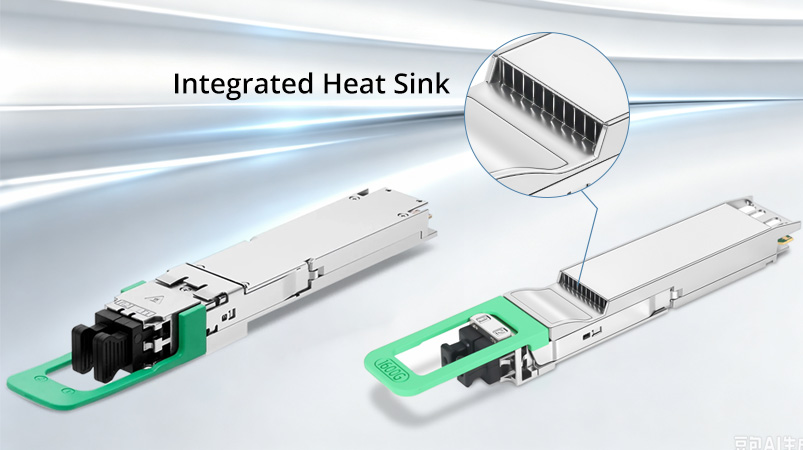
With the development of high-density thermal solutions, new thermal management configurations—such as the Riding Heat Sink, have emerged within the OSFP ecosystem. Unlike traditional modules featuring integrated heat sinks, the RHS design reconfigures the thermal interface at the top of the module, enabling more direct thermal coupling with the system-level cooling structure.
This design is particularly well-suited for high-density switching platforms that require system-level thermal management, including systems utilizing liquid cooling or centralized thermal baseplates. It allows heat generated by the module to be coupled more directly into the switch's overall cooling structure, thereby reducing localized thermal resistance and alleviating thermal stress on the switch's front panel.
Backward Compatibility & Host Platforms
In practical applications, backward compatibility is a primary concern for engineers. The OSFP ecosystem defines various host port modes within its specifications, supporting a range of data rates—including 1.6T, 800G, and 400G—and lane configurations.
However, it is crucial to note that physical compatibility (the ability to plug the module in) does not guarantee automatic operation at a lower speed. When a legacy 800G or 400G module is inserted into a 1.6T switch port equipped with an OSFP224 interface, successful interoperability and automatic speed downshifting depend on a combination of factors: the switch's ASIC, host electrical interface, underlying software, CMIS configuration, and the vendor's specific implementation. This is a system-level capability rather than a simple "plug-and-play" feature determined solely by the module interface specifications.
Conclusion
For the 1.6T network upgrade in AI data centers, the evolution to OSFP224 represents more than just a doubling of bandwidth; it entails the simultaneous advancement of high-speed electrical lanes and system-level thermal designs. As AI data centers transition to 1.6T, rigorous connector signal integrity (SI) design, high-speed lane control, and system-level thermal management solutions—such as RHS—are becoming essential engineering foundations for high-bandwidth pluggable interconnects. As a professional provider of optical interconnect solutions, QSFPTEK has aligned its 1.6T OSFP224 product portfolio with the requirements of 224G electrical interfaces and high-speed optical interconnects, offering connectivity options tailored for next-generation computing networks.


share

