


How Does Silicon Photonics Technology Impact AI Network Architecture

Due to the continuous expansion of AI training scale and the significant changes in the network architecture within data centers, silicon photonics modules are gradually becoming a mainstream choice. Previously, CPU-centric computing clusters prioritized network stability and compatibility. However, GPU-centric AI clusters push networks to the limits of high bandwidth, low latency, and continuous full-load operation. In this context, silicon photonics modules, due to their unique advantages, can deliver superior performance compared to conventional modules in AI applications.
How AI Workloads are Changing Networks
The biggest difference between AI model training and traditional business traffic lies in the change in communication patterns. In large-scale distributed training, GPUs need to frequently synchronize parameters and gradients, and the communication traffic is primarily east-west traffic, with the following typical characteristics:
Links are under high load for extended periods, rather than experiencing sudden traffic spikes.
Communication latency directly impacts training efficiency.
Network performance imbalances are amplified, with the slowest link determining the overall pace.
When the speed of a single port increases to 400G, 800G, or even 1.6T, traditional optical module architectures begin to exhibit performance-limiting issues. For example, power consumption increases significantly, electrical signal paths become too long, and module consistency becomes difficult to control. This is a key reason why silicon photonics modules are being introduced into AI networks.
What is a Silicon Photonics Module
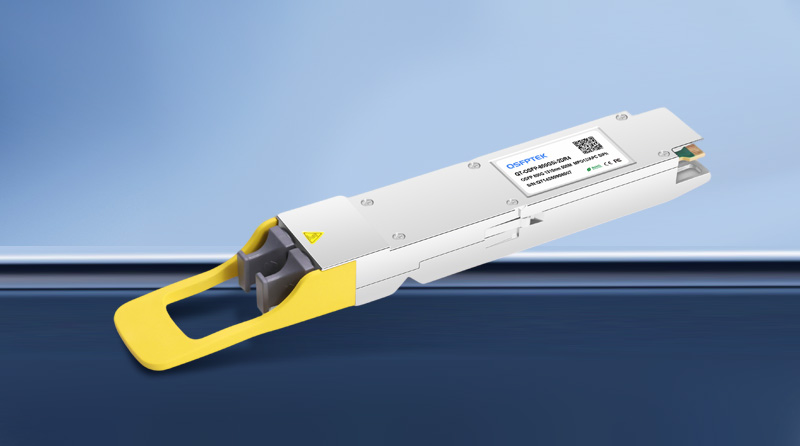
A silicon photonics module is an optical communication module based on silicon photonics technology, which differs from traditional optical modules. Traditional modules rely on discrete optical components, while silicon photonics modules integrate modulators, waveguides, and other optical structures directly onto a silicon-based chip, making them highly compatible with CMOS processes. This architecture aims to achieve higher bandwidth, lower power consumption, and better scalability at a more advanced level, thus meeting the demands of AI networks.
However, silicon photonics modules do not mean the complete absence of lasers. In most products, lasers still exist as external or hybrid integrated components. But by integrating modulation and optical path control onto a silicon platform, the system achieves significant improvements in integration, consistency, and manufacturability.
How Silicon Photonics Modules Work
In practical deployments, silicon photonics transceivers are still standard pluggable modules such as QSFP-DD and OSFP, with interfaces and cabling methods essentially the same as traditional modules. The main difference from traditional modules lies within the optical module itself:
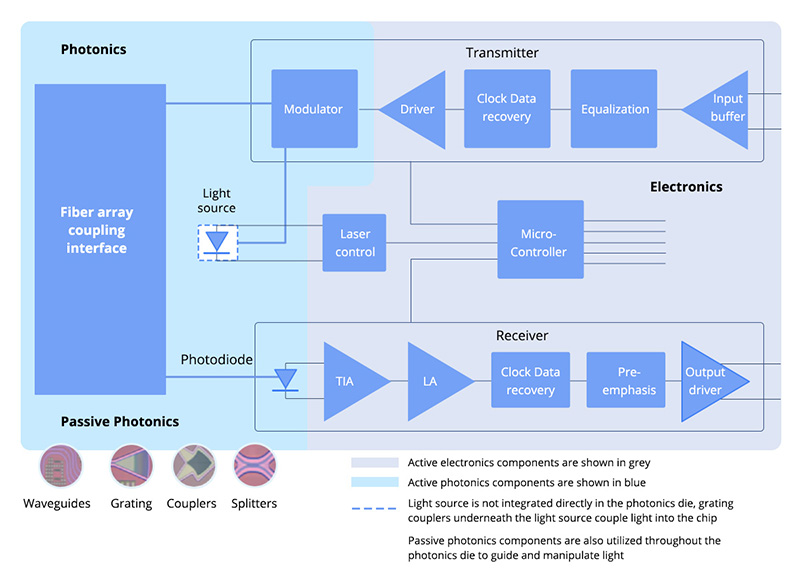
High-speed electrical signals from the switch chip enter the silicon-based modulator over the shortest possible distance. By changing the phase or amplitude of the optical signal in the silicon waveguide, the electrical signal is efficiently mapped onto the optical carrier. Due to the precise etching of the optical routing using photolithography, the signals between modules are highly consistent.
After processing within the module, the modulated optical signal is output to the optical fiber through a standard optical interface. At the receiving end, the silicon photonics device performs the reverse process, stably converting the optical signal back into an electrical signal for processing by the host device.
This method of shortening the electrical path and entering optical pre-processing as early as possible allows silicon photonics modules to significantly reduce loss, crosstalk, and power consumption under high bandwidth conditions.
Why are Silicon Photonics Modules Suitable for AI Scenarios
First, bandwidth density directly determines the upper limit of the network scale in AI data centers, a reality that AI networks cannot ignore.
When the data rate per port increases, if the module's size, power consumption, and heat dissipation requirements increase proportionally, it will ultimately prevent the equipment from expanding physically, thus limiting the network scale. Silicon photonics modules can support higher effective bandwidth within the same volume because they support higher electrical interface speeds, such as 100G or 200G per lane. This means that with the same number of switching devices, more GPUs can be connected, and in a spine-leaf architecture, it can reduce the number of layers or the complexity caused by over-aggregation, and also offers more flexible scalability.
Secondly, power consumption and heat dissipation are also important factors affecting network scale and operating costs in AI clusters.
Because AI clusters require large-scale deployment of optical modules, when the number of ports reaches tens of thousands or more, the overall power consumption and heat dissipation pressure of the optical modules will directly affect the operation and cost of the data center.
Silicon photonics modules effectively reduce the energy consumption per bit by shortening the electrical signal path and increasing integration. Although a single module still has relatively high power consumption, under the same bandwidth conditions, it has lower power consumption and heat dissipation than traditional modules, which is also beneficial for long-term operation. For users who want to control overall costs, operating costs are often more important than procurement costs.
Finally, silicon photonics modules are also more suitable for mass production and long-term evolution. Unlike traditional modules, silicon photonics modules integrate functions onto a silicon-based chip, directly fabricated using photolithography, resulting in higher production capacity than traditional modules. Leveraging a mature semiconductor manufacturing system, silicon photonics modules have significant advantages in product consistency, scalability, and supply chain stability, which is especially important for long-term evolving AI networks.
Applications of Silicon Photonics Modules in AI Networks
Silicon photonics modules are not the only correct answer for AI networks. In low-to-medium speed, short-distance, or extremely cost-sensitive applications, traditional modules still have some advantages. However, in the following scenarios, silicon photonics modules are a more ideal choice:
Large-scale GPU clusters: In large-scale GPU clusters, silicon photonics modules not only ensure consistent product performance but also reduce the overall network performance degradation caused by the performance of individual edge modules.
Power-sensitive networks: In power-sensitive networks, silicon photonics modules can effectively reduce overall power consumption and heat dissipation, lowering overall operating costs and investment in cooling.
Network planning for 1.6T evolution: Silicon photonics modules can achieve higher speeds per channel. If your network has plans to upgrade to a 1.6T network in the future, then silicon photonics modules are undoubtedly your ideal choice. Silicon photonics is also a crucial technological foundation for next-generation interconnect architectures such as CPO.
Conclusion
The development of silicon photonics modules aims to address the challenges faced by AI networks under high-speed and large-scale conditions, rather than replacing all existing modules on the market. With superior performance in bandwidth density, power consumption control, and consistency, silicon photonics modules are becoming a critical component in AI data center networks. If you are planning or deploying AI infrastructure, understanding the practical value of silicon photonics modules is more important than simply focusing on speed.


share

