


Technical Overview of Active Electrical Cables (AEC) for Data Center Connectivity

The Emergence of AEC Technology in High-Speed Data Centers
The AI and high-performance computing continue to push data centers to operate at higher speeds, and bandwidth and stability are under increasing pressure. The more workloads scale up, the clearer it becomes that traditional passive direct-attach copper cables (DACs) can't keep pace. They still make sense for short runs thanks to their low cost, but once the data rate climbs past 100 Gbps or the distance stretches out, problems like signal loss, crosstalk, and rising error rates start showing up fast—issues that AI clusters, in particular, can't afford to ignore.
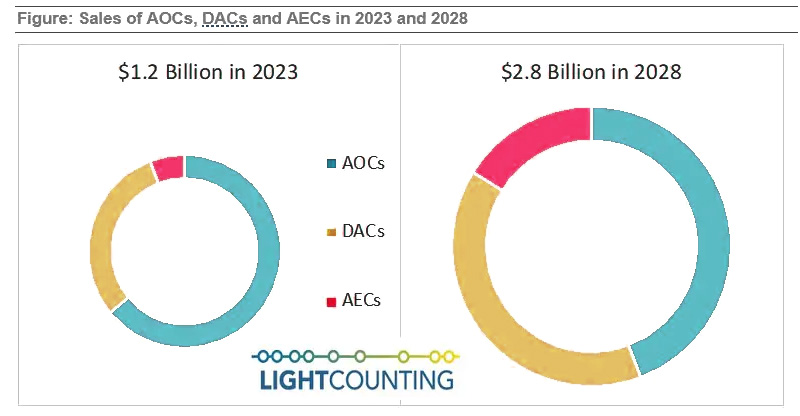
That's where active electrical cables (AECs) step in. Each cable has built-in electronics in its connectors that tune, clean, and amplify the signal as it travels. This setup helps data travel farther with fewer errors and keeps connections steady, giving data centers more room to arrange high-speed links between racks or servers without worrying about signal loss. According to LightCounting forecasts, driven by the ongoing expansion of AI and cloud data centers, the global AEC market is expected to grow about 45% on average each year from 2024 to 2028.
What is an Active Electrical Cable (AEC)?
Active Electrical Cables (AEC) are a high-speed copper interconnect standard introduced by the HiWire Alliance. The HiWire AEC spec has consistent electrical and mechanical design rules, making these cables good for data transmission rates of 100G, 200G, 400G, and up to 800G. They come in familiar forms like QSFP56, OSFP, and QSFP-DD, so they're easy to use with existing high-speed network equipment.
Unlike traditional passive copper cables (DAC), AEC incorporates active signal conditioning circuits into its structure. AEC's integrated equalizer and retimer chips fix signal loss and distortion during data transmission, making sure the signal stays steady even over long distances. Positioned between DACs and AOCs, they inherit the cost-effectiveness of copper cables while meeting the performance demands of high-speed interconnects. This makes them an efficient, energy-saving choice for short-distance connections in modern data centers.
How AEC Cables Work
What keeps Active Electrical Cables (AECs) stable in high-speed setups is their built-in ability to refresh and fine-tune electrical signals, preserving transmission quality continuously. At 56G or 112G per channel using PAM4 signaling, the current running through copper tends to weaken or distort due to attenuation and jitter, which can easily cause data errors. To counter this, AECs include components like retimers, equalizers, and forward error correction (FEC) circuits that clean up and restore the signal as it travels. These parts make sure that the signal is clear and not damaged during transmission.
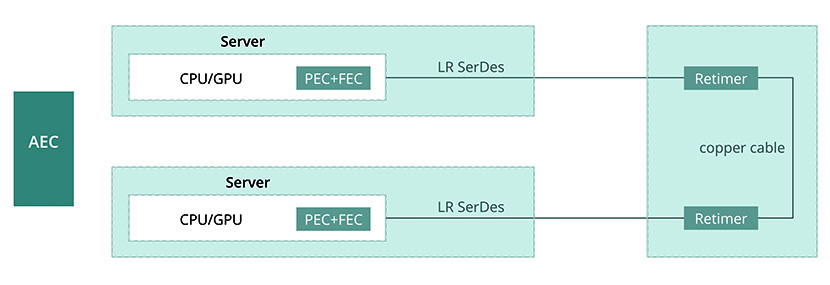
From the signal flow perspective, when data is transmitted from the electrical interface of a switch or server, it first enters the copper wiring structure of the AEC for transmission. As signals move through the cable, they inevitably run into interference like crosstalk or high-frequency loss. The active chips inside the AEC react in real time, correcting distorted waveforms and cutting down on bit errors. A built-in retimer chip with clock data recovery (CDR) realigns the signal's timing to smooth out jitter, while the equalizer offsets high-frequency roll-off. An onboard amplifier then boosts the signal's strength, allowing copper cables to keep a clean, reliable transmission even across longer distances.
Key Advantages of AEC Cables
Enhanced Signal Integrity
AEC cables incorporate active circuitry—including retimers, equalizers, and amplifiers—that dynamically correct and optimize electrical signals during transmission. Together, these components help reduce jitter, crosstalk, and signal distortion, keeping bit-error rates low and performance steady even at 400G or 800G speeds. With this kind of real-time signal correction, AEC cables can handle heavy data loads while maintaining clean, consistent transmission throughout the link.
Extended Transmission Distance
Unlike passive DACs, which typically transmit only 1 to 3 meters at high speeds, AEC cables maintain high-quality signals over 5 to 7 meters. This extended reach makes them ideal for inter-rack or mid-distance connections, preserving flexible cabling space in high-density data center layouts without requiring costly optical module solutions.
Energy Efficiency and Cost Advantages
AEC employs pure electrical signal transmission without electro-optical conversion, resulting in lower power consumption—typically under 10–12W per port. Compared to active optical cables (AOCs) with equivalent bandwidth, AEC offers lower overall costs and higher operational efficiency. It's an affordable option for businesses that value both high performance and low power consumption.
Enhanced Cable Management Flexibility
As data rates increase, traditional passive DAC cables tend to get bulkier and more complex to bend, making them inconvenient to route through crowded racks. AEC cables are lighter and more flexible, and they can be installed much more easily due to their smaller bend radius. Their slim design also keeps airflow unobstructed inside the cabinet, helping data centers stay organized while improving cooling efficiency and simplifying maintenance.
High Reliability and Scalability
Leveraging the durability of copper media, AEC outperforms fiber optic cables in lifespan and stability, requiring less maintenance. It operates reliably from 100G to 800G. It possesses scalability potential up to 1.6T, fully meeting the growing bandwidth and reliability demands of AI clusters and high-performance computing systems for years to come.
AEC vs. DAC/ACC: Technical Differences and Performance Comparison
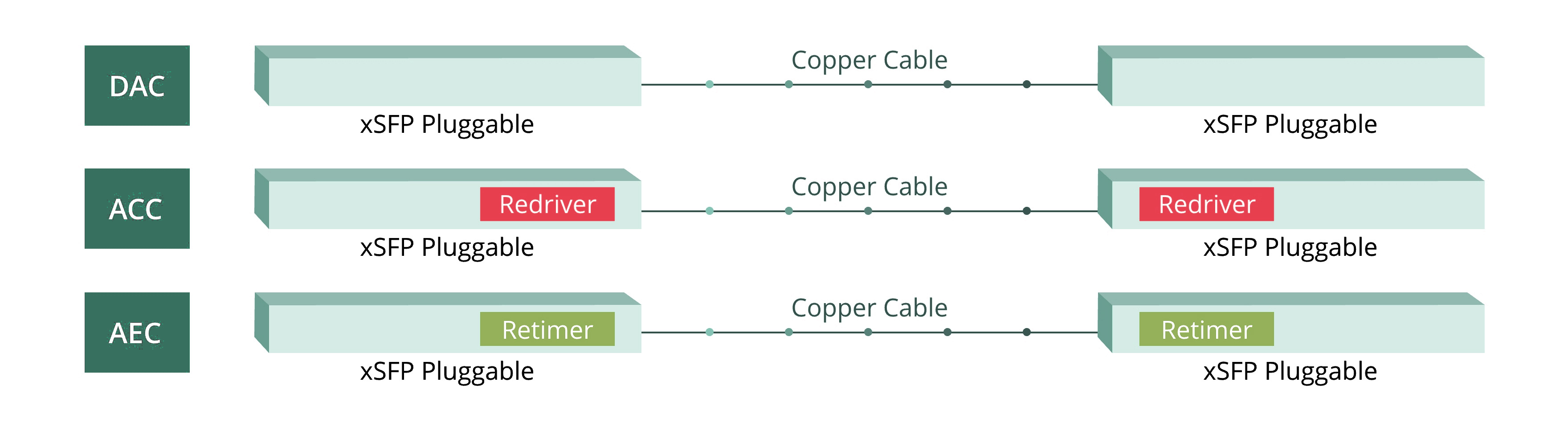
High-speed copper interconnects generally fall into three main types: Direct Attach Copper (DAC), Active Copper Cable (ACC), and Active Electrical Cable (AEC). While all use copper as the transmission medium, their internal architectures and signal processing methods vary greatly, leading to apparent differences in transmission performance and application scope.
AEC vs. DAC Comparison
Passive DACs feature a simple structure in which signals travel directly through copper cables from device ports, without amplification or correction circuits. This design remains stable at low speeds or short distances, but signal attenuation and crosstalk issues rapidly worsen at 400G or 800G rates. Typically, the effective distance for a DAC is only 2 to 3 meters. AEC continuously incorporates retimers and equalizers to restore signal quality and correct distortion during transmission. Thanks to these active circuits, AEC maintains low bit error rates (BER) and stable high-speed communication performance over distances of 5 to 7 meters, providing a more reliable interconnect solution for high-density data centers.
Comparison of AEC and ACC
Active Copper Cables (ACC), which are also considered active cables, use a basic signal enhancement process that mostly relies on linear amplification chips to strengthen the signal. However, this approach has trouble dealing with noise, often amplifying interference and increasing jitter. On the other hand, Active Electrical Cables (AEC) use advanced circuitry with clock data recovery (CDR) and equalization technologies. These smart parts help strengthen and adjust the signal and filter out noise. Reduce errors and improve the signal.
Overall, AEC achieves an excellent balance among performance, reach, power efficiency, and cost. It supports high-speed, low-error transmission over distances beyond 5 meters while keeping power consumption and deployment costs low. These advantages make AEC an ideal solution for mid-range, high-speed interconnects in next-generation data centers.
Application Scenarios for High-Speed AEC
As the construction of AI clusters and hyperscale data centers accelerates, Active Electrical Cables (AECs) have emerged as the core solution for mid- to short-range high-speed interconnects. With the ability to maintain ultra-low Bit Error Rates (BER) and stable performance at data rates up to 800G, AEC cables are ideal for high-density interconnects such as Top-of-Rack (ToR), Mid-of-Rack (MoR), and server-to-switch connections. In harsh environments like high-performance computing (HPC) and AI training clusters, AEC delivers a strong signal while balancing power efficiency and cost.
Conclusion
AEC solves the signal loss problems that plague traditional DAC cables at higher speeds, delivering stable performance without the high cost or power draw of optical solutions. QSFPTEK is a top network solutions provider, offering a full lineup of AEC products supporting 400G and 800G speeds, to meet a wide range of deployment needs. This enables enterprises to build next-generation interconnect networks characterized by higher speeds, lower latency, and enhanced reliability.


share

