


What is InfiniBand XDR and Why It IS Important in AI Network

InfiniBand XDR is a crucial solution introduced due to the ever-expanding scale of AI training clusters and the rapid increase in data exchange between GPUs. For large training platforms with tens of thousands of GPUs, the network is no longer just an auxiliary system, but a critical infrastructure affecting training efficiency. Against this backdrop, the continuous evolution of InfiniBand technology towards higher bandwidth has become a trend, and InfiniBand XDR is precisely the technology addressing the next stage of AI network requirements.
What is InfiniBand XDR
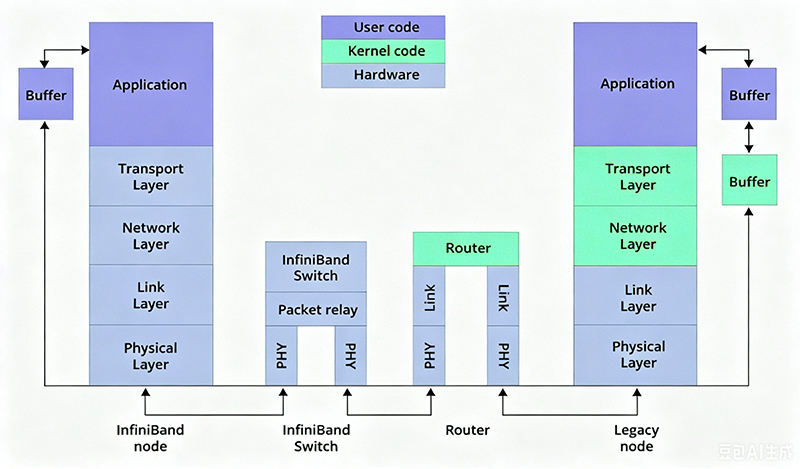
InfiniBand XDR is the latest speed class in the InfiniBand technology roadmap, driven by NVIDIA, primarily targeting next-generation AI computing platforms and high-performance computing environments. Compared to the previous generation NDR's 400Gbps port speed, XDR increases single-port bandwidth to 800Gbps, achieving a significant increase in network capacity.
From a technical perspective, XDR continues InfiniBand's core advantages of low latency, high throughput, and RDMA, while combining next-generation high-speed SerDes, switching chips, and optical interconnect technology to provide stronger network support capabilities for ultra-large-scale GPU clusters.
Simply put, XDR is not just about doubling the speed; it's a next-generation interconnect platform designed to meet the future scaling needs of AI clusters.
Why Does AI Training Require 800G or 1.6T Networks
In traditional enterprise networks, most traffic is north-south traffic generated by users accessing servers. AI training environments are entirely different; their core traffic primarily occurs between servers, i.e., east-west traffic.
During large model training, numerous GPUs need to frequently exchange gradients, model parameters, and intermediate computation results. For example, the All-Reduce operation, common in distributed training, generates significant inter-node communication requirements.
As model size grows from billions of parameters to hundreds of billions or even trillions of parameters, network communication volume also increases. If the network cannot synchronize data in a timely manner, GPUs can only wait for data transmission to complete, thus reducing overall utilization.
Therefore, in modern AI clusters, network performance is as important as GPU performance.
How InfiniBand XDR Boosts AI Cluster Efficiency
First, there's the increased bandwidth. A 1.6T XDR link can transmit more training data in the same amount of time, reducing synchronization latency in distributed training and improving GPU utilization.
Second, there's better scalability. As AI clusters grow, the number of switch ports and network layers also increases. Higher port rates mean fewer links can be used to achieve the same bandwidth, simplifying network architecture design.
Furthermore, greater bandwidth alleviates hotspot traffic and congestion issues. When thousands of GPU nodes are exchanging data simultaneously, the network can provide more ample transmission resources, reducing performance fluctuations.
For training large language models, multimodal models, and scientific computing tasks, these advantages directly translate into higher training efficiency.
InfiniBand XDR and Ethernet AI Networks
In recent years, RoCEv2-based Ethernet solutions have developed rapidly, with 400G and 800G Ethernet widely adopted in the AI data center market. However, InfiniBand still holds a significant advantage in ultra-large-scale training scenarios.
First, InfiniBand was designed from the outset for high-performance computing environments, and its RDMA mechanism, congestion control, and aggregated communication capabilities have been validated over a long period.
Second, NVIDIA has built a complete InfiniBand ecosystem, including Quantum switches, ConnectX network cards, and the CUDA software stack. These components work together to optimize AI training performance.
For AI platforms seeking ultimate performance and minimal communication latency, InfiniBand remains the preferred solution for many supercomputing centers and large AI training clusters.
InfiniBand XDR Drives Upgrades in High-Speed Optical Interconnects
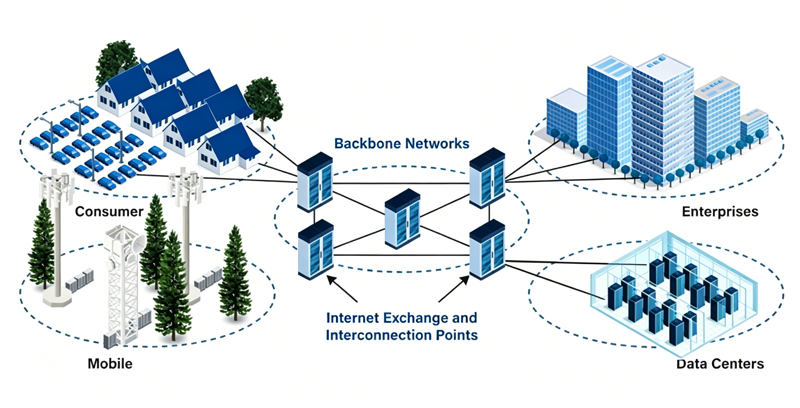
As XDR networks are gradually deployed, data center optical interconnect architectures will also be upgraded accordingly. 800Gbps links require higher-performance switches and optical modules. Currently available high-speed optical modules, such as 800G OSFP, 800G OSFP SR8, 800G DR8, and 800G 2x FR4, are gradually becoming important components in building XDR networks.
At the same time, fiber optic cabling, rack design, and cooling systems also need to adapt to the deployment requirements of higher density and higher bandwidth. It is foreseeable that network upgrades in AI data centers in the coming years will largely revolve around the 800G interconnect ecosystem.
Conclusion
As AI model sizes continue to grow, networks have become a crucial factor determining training efficiency. As the latest generation of InfiniBand technology, XDR provides a more efficient interconnect platform for future hyperscale GPU clusters through its 800G and 1.6T bandwidth, low-latency architecture, and excellent scalability. In the ongoing evolution of AI infrastructure, XDR is expected to become one of the key technologies driving the development of next-generation intelligent computing centers.


share

