


XPO Transceiver Overview: What is the Difference Between CPO?

As optical modules have evolved from 100G to 400G, 800G, and even towards 1.6T, the bandwidth capacity of data centers has been continuously increased. For a long time, the idea that "speeding up solves the problem" worked. However, as AI training workloads expand rapidly, simply relying on speed increases alone is insufficient.
The current bottleneck is no longer just whether the bandwidth of a single port is sufficient; it has expanded to the entire system level—port density, power consumption control, heat dissipation space, and subsequent maintenance issues are emerging simultaneously and are mutually restrictive.
Against this backdrop, the industry is exploring new optical interconnect paths. On one hand, there are highly integrated solutions like CPO; on the other hand, there are new adjustments to pluggable architectures. XPO (eXtra-dense Pluggable Optics) is a direction that has gradually emerged under this approach.
AI Infrastructure is Entering a New Phase of Constraints
As data centers slowly move away from traditional cloud setups and adopt massive, AI-focused computing systems, the role of the network is also changing. It's more than just a way to move data around — it's a vital part of the infrastructure that directly affects how well people can train and how efficiently they use resources.
Usually, increasing port speeds from 400G to 800G, then to 1.6T, is not enough to meet the needs of real-world systems. The main problem is moving from "single-port bandwidth" to more complex system-level issues.
Bandwidth Pressure is Shifting from a Single Point to a Global One
During large model training, numerous GPUs or accelerator cards need to continuously synchronize parameters and gradients, resulting in extremely high data exchange frequencies between nodes. As model size increases, network traffic grows significantly faster than the increase in single-port speed.
Even though interface speeds keep increasing, network bandwidth density can still easily limit training efficiency, especially in multi-node parallel training scenarios.
Reliability Issues Are Amplified in Large-scale Deployments
In AI clusters, the number of optical module links can easily reach tens of thousands, or even more. If the scale gets bigger, even if each link doesn't fail very often, there will probably be some problems. It will be hard to avoid these problems completely.
In this kind of environment, if one link fails, it affects more than just a local area. You can pause, reschedule, or cancel training tasks using all the computing resources. Network reliability is more than just a visual feature. The business needs to run smoothly.
Cooling Systems are Shifting Towards Liquid Cooling Architectures.
As the power consumption of AI computing chips continues to rise, traditional air-cooling solutions are approaching their limits, and liquid cooling is becoming the mainstream approach for high-density data centers.
This also places new constraints on optical interconnect devices: not only must signal performance be guaranteed, but structural design, material selection, and thermal design must also be adapted to liquid cooling environments to support higher-density rack-level deployments.
Energy Efficiency Has Become One of the Core Indicators of Network Design
In high-density AI clusters, power resources need to be redistributed between computing and networking. As system scale increases, the network-side power consumption cannot be ignored.
As a result, "power per bit" has emerged as a pivotal metric for assessing optical interconnect solutions, directly impacting overall operating costs and the upper limit of system energy efficiency.
Physical Port Density Approaching Engineering Limits
Current mainstream pluggable optical module form factors (such as OSFP) are approaching physical density limits as bandwidth increases. When chip bandwidth continues to grow while port density cannot increase simultaneously, the network architecture must add layers, resulting in higher latency and more complex designs.
What is XPO (eXtra-dense Pluggable Optics)?
With OFC 2026 approaching, Arista Networks, in collaboration with several optical module manufacturers, proposed the concept of XPO (eXtra-dense Pluggable Optics). XPO can be understood as a high-density pluggable optical interconnect solution for next-generation AI data centers. Its core objective is to further improve bandwidth density and heat dissipation capabilities without sacrificing the operational advantages of pluggable modules, to adapt to high-power computing environments.
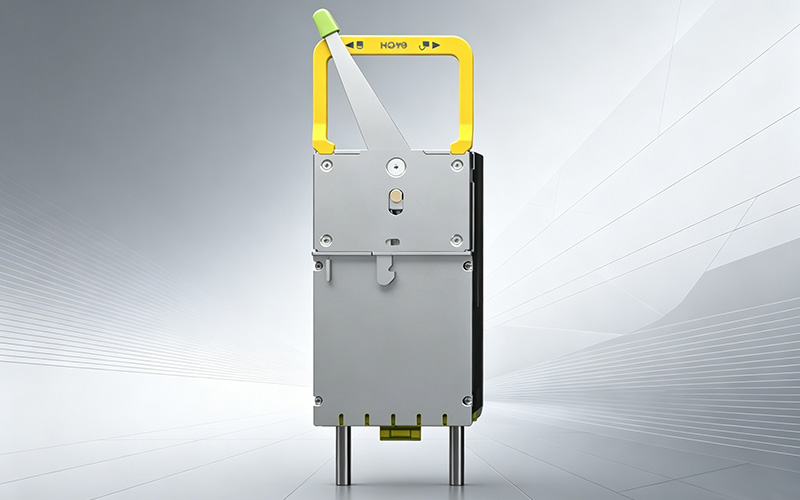
XPO is more than just a "speed upgrade." It's a complete rebuild of the structure, power supply, and heat-dissipation methods, all focused on meeting the needs of AI rack-level deployment.
Key Specifications and Capabilities of XPO
From a design perspective, XPO has clearly departed from the traditional OSFP evolution path, leaning more towards a "system-level optical interconnect unit":
All of these factors point to the same reality: XPO is more than just an optical module; it's a high-density computing interconnect component.
The Change Compared to OSFP is More Than Just "Doubling"
If we use traditional OSFP solutions as a reference, XPO represents a significant leap forward in multiple dimensions: single module bandwidth is increased by approximately 8 times, panel density is increased by approximately 4 times, and it is the first time a complete liquid cooling solution has been introduced in a standard pluggable form factor.
The more crucial change lies not in the numbers themselves, but in the shift in design logic—from "increasing single-port speed" to "redefining the form factor of optical interconnects around rack-level power consumption and density." Under this approach, XPO is more like a fundamental interconnect unit, redesigned for the ultra-high-power consumption scenarios of AI.
XPO's Core Innovative Design:
"Belly-to-Belly" Dual PCB Stacking Architecture
The most significant change in XPO's hardware structure is the replacement of the traditional single-PCB design with a "dual-PCB stacking." Two 32-channel PCBs are arranged tightly back-to-back, redefining hot and functional areas at the system level.
This structure puts high-heat-generating components (like transmitter circuits and laser driver modules) in the inner "hot zone," and puts lower-power components (like receivers and control logic) in the outer "cold zone." The main idea of this method is to reduce the path for heat to travel, which allows heat to enter the cooling system more quickly and improves how efficiently heat is removed.
As more channels are put into a single module, the mechanical side becomes more demanding. There are a lot of places to put your fingers, so it takes more effort to plug and unplug. Over time, this can make routine maintenance feel a bit more tedious, especially in complex setups.
Module-Level Liquid Cooling: Built Directly into the Optical Module
XPO now includes liquid cooling as part of the module. The cold plate is sandwiched between two PCBs. This allows heat from both layers to be removed together via a shorter, more direct path. This means you don't need to use outside air or ducts to move air around, so you can get rid of heat right where it's coming from.
In practice, this design can handle TDPs of 400W or higher. When the coolant temperature is around 40–45°C, the overall temperature is usually 20 to 25°C lower than traditional air-cooling solutions.
The connectors are blind-plug quick-connects with a leak-proof design, capable of withstanding approximately 500 repeated insertions and removals. The cold plate's interior isn't just a simple piece of metal; it incorporates flow channels that run along areas of concentrated heat. The structure is simple, with a single inlet and a single outlet. The overall approach is more like a GPU cold plate solution than a traditional "external" module cooling system, and it resembles a system-level design.
Electrical Architecture and 50V Power Supply
At the signal and power supply levels, XPO has also been redesigned. Its electrical architecture supports 64 high-speed electrical channels, each at 200Gbps PAM4, achieving a total bandwidth of 12.8Tbps, and is planned to evolve towards 400Gbps channels to achieve a 25.6Tbps capability.
Several key features of the electrical design are:
Firstly, optimized channel layout: Tx and Rx signals are positioned on opposite sides of the paddle card to reduce crosstalk and improve signal integrity, making it better suited to linear drive architecture (LPO) scenarios.
Secondly, the power supply and control sections are designed separately. The Low-speed control signals (like I2C/I3C, reset, and alarm signals) is used a separate central connector. This connector is physically separated from the high-speed data channel. This reduces electrical interference, improves the stability of the control signals, and prevents high-speed links from affecting them.
More importantly, the power supply architecture has been upgraded. XPO uses 46–53V DC input (typically around 48V/50V), directly from the rack-level bus power supply. Compared to traditional 3.3V modules, this significantly reduces current requirements, thereby reducing line losses and connector size and improving overall power supply efficiency. This design also aligns better with the future trend of high-voltage DC power supply in data centers.
The Actual Impact of XPO on Data Center Architecture
The importance of XPO goes beyond making individual optical modules or switching devices better. It directly affects the design of the entire data center. When a single module makes big improvements in bandwidth, power usage, and heat dissipation, this change builds up layer by layer along the network hierarchy. In the end, this affects the overall system capacity, how it's used, and the overall cost structure.
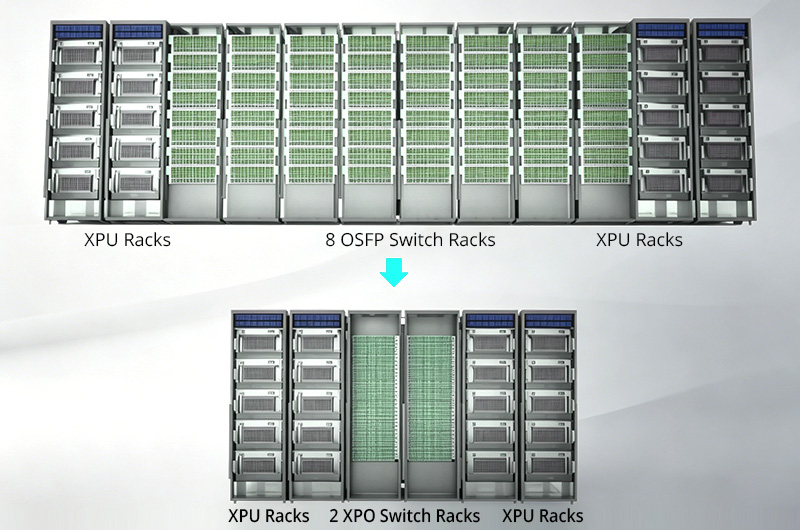
From a system design perspective, for example, to build a network with a total switching capacity of 204.8 Tbps, the rack space required by the XPO solution is only about one-quarter that of the traditional OSFP solution, corresponding to an approximately four-fold increase in bandwidth density. This means that within the same physical space, network devices can support higher throughput, thus providing more compact infrastructure support for AI training and high-performance computing.
In a typical ORv3 (HPR) liquid-cooled rack environment, the difference between the two solutions is also very significant. The power consumption of a single rack in a traditional OSFP architecture is approximately 32 kW. In comparison, the XPO solution can increase this to approximately 128 kW, closer to the power density range of 120 kW and above typically planned for liquid-cooled systems. In practical deployments, the OSFP solution often fails to leverage the capabilities of the liquid-cooled infrastructure fully. In contrast, XPO achieves a better match between power consumption and heat dissipation capacity, enabling fuller use of energy and cooling resources and thereby improving overall TCO performance.
In short, XPO can deliver about four times more network capacity in the same amount of space. This improvement is more than just saving space; it also affects the cost to set up a data center, the time to deploy it, and the complexity of operating it.
In hyperscale AI scenarios, this advantage is even stronger. For example, a 400MW-level AI data center with around 128,000 XPUs using a three-layer Clos topology requires about 12.8Tbps of scale-up bandwidth and 1.6Tbps of scale-out bandwidth. In a traditional OSFP architecture, the switching capacity per rack is about 1.64 Pbps. However, the XPO architecture can achieve around 6.55 Pbps, reducing the number of racks by about 75%.
This reduction in racks reduces demand for infrastructure such as power supply, cooling, and cabling. Overall construction costs are significantly lowered as a result. XPO can also be used in existing data center environments to increase accelerator deployment density without requiring additional physical space, thereby improving the use of existing resources.
The Core Difference Between XPO and CPO
Today, there are two main ways to connect optical devices: XPO and CPO. XPO focuses on "deep integration," meaning that the devices are fully connected. On the other hand, CPO focuses on making the most of the available space, which is important for devices that can be plugged in.
CPO: Extreme Integration for Maximum Performance
The Co-packaged Optics integrates the optical engine and switching chip directly. Results in a shorter signal path, lower losses, and higher energy efficiency. In theory, this design can deliver higher bandwidth density and lower power consumption, showing a longer-term evolution path.
But there are also some issues to think about. The optical components and switching chip are closely connected. If the optical module or its parts don't work right, the job can get pretty complicated. A lot of the time, this means making changes to the whole device or even the whole system. This can lead to higher costs and more complicated maintenance and replacement.
CPO also demands extremely high levels of manufacturing process and supply chain maturity. Right now, it's unclear if it's ready for large-scale commercial use, so it's hard to say how fast it will be adopted.
XPO: Engineering Optimization within a Pluggable Architecture
XPO is different from CPO because it doesn't stop using the pluggable architecture. Instead, it makes improvements to the current system. XPO gets close to the performance of CPO by increasing channel density, adding liquid cooling, and improving power supply. It also keeps the same modular replaceability.
This design achieves a more realistic balance between maintainability, upgrade flexibility, and deployment costs, making it more suitable for the engineering implementation needs of current large-scale data centers.
Differences in Choice from an Engineering Perspective
CPO focuses more on long-term technical goals, such as extreme performance and future changes. But it still struggles to be used in the short term. XPO, on the other hand, is a more practical choice. It strikes a balance between making improvements and keeping things simple, making it easier for cloud vendors to use at scale.
For this reason, in cloud data center environments that emphasize stability and maintainability, pluggable solutions remain highly attractive.
Summary
Overall, XPO and CPO are not simple substitutes; rather, they are more likely to coexist in different application scenarios over the long term. CPO represents the long-term upper limit of the architecture, while XPO represents a faster evolutionary path within the existing industry ecosystem. The future form of data center networks will largely depend on the ongoing trade-off between "performance limits" and "engineering feasibility".


share

