


Unlocking 1.6T XDR: The New Cornerstone of Next-Gen AI Supercomputing

As large-scale AI training and models with trillions of parameters become the norm, performance bottlenecks in AI infrastructure are shifting—from pure computing power to network interconnectivity. While GPUs are evolving at a rapid pace, the massive east-west traffic generated by distributed training is expanding even faster. As a result, network bandwidth, latency, and scalability have become the key factors determining the overall compute utilization of the entire cluster.
Network technology has evolved from HDR 200G to NDR 400G and 800G, and today, the contours of the next-generation evolution are already quite clear: a 1.6T interconnect architecture built on single-channel 200G signal technology is taking center stage. Combining silicon photonics, advanced DSPs, and high-density optical interconnect technology, 1.6T InfiniBand XDR is poised to play a central role in supporting future AI supercomputing clusters.
AI Clusters Are Driving the Evolution of Networks from 800G NDR to 1.6T XDR
Network Challenges Faced by Hyperscale AI Clusters
Today’s distributed AI training often requires thousands or even tens of thousands of GPUs to work in tandem. The massive-scale synchronization of parameters, gradient aggregation, and frequent inter-cluster communication generate an enormous amount of east-west network traffic within data centers.
As cluster sizes continue to expand, existing HDR and NDR networks are beginning to show bottlenecks, primarily in the following areas:
Bandwidth Constraints: Faced with the high-speed communication demands of massive GPU arrays, 400G links are already struggling to keep up, which can lead to idle computing resources and lower overall utilization.
Transmission Distance Limitations: Traditional multimode SR optical solutions have relatively short coverage distances, which directly limits the flexibility of hyperscale data centers in rack layout and spatial planning.
The Dual Challenges of Power Consumption and Signal Integrity: Increasing the electrical signal rate to boost throughput leads to a sharp rise in power consumption and places significant strain on thermal management, as well as posing severe challenges for bit error rate (BER) control.
InfiniBand networks have been getting better and faster over the last 20 years to deal with these kinds of problems. With each generational transition, they've achieved major leaps in throughput while continuously introducing faster SerDes technologies and higher-performance underlying interconnect architectures.
1.6T XDR Industry-Standard Core Technology Baseline Parameters
The core of this generational leap lies in the comprehensive upgrade of electrical signals from 100G SerDes to 200G. By doubling the per-channel bandwidth—combined with advanced DSP technology and an improved packaging architecture—the new-generation XDR platform can significantly raise the overall network throughput ceiling without significantly increasing system complexity.
Key Underlying Technologies Supporting the 1.6T XDR
Just increasing bandwidth isn't enough. For 1.6T interconnects to really work, they need to evolve together in a bunch of areas, like optical packaging, DSP signal processing, thermal management design, and low-level switch chips, to name a few.
An In-Depth Analysis of Full-Stack Hardware Architecture: 1.6T XDR vs. 800G NDR
To build a high-performance AI network, simply upgrading switch chips is far from enough. The entire interconnect infrastructure must rely on the coordinated work of optical modules, DAC direct-attach copper cables, AOC active optical cables, and branch interconnect components to meet the stringent requirements across different transmission distances.
From GPUs inside the rack to switch interconnects, and on to long-span backbone links connecting different data centers, each component plays an indispensable role in supporting a highly scalable network.
Optical Module Product Matrix: From 800G NDR to 1.6T Silicon Photonics
For medium- and long-distance connections in AI data centers, optical modules are still the go-to solution. Depending on how far the signal has to travel and the type of fiber, the industry usually puts them into three categories: SR (short-reach) multimode solutions, DR (data center-class) single-mode solutions, and FR (long-reach) single-mode solutions.
As data rates approach 1.6T, silicon photonics (SiPh) technology is becoming more and more important. Putting optical functions right onto a silicon-based platform is a total game-changer for silicon photonics. It's got a lot of advantages.
Higher integration density
Lower power consumption
Better scalability for mass production
More flexibility for thermal management
Thanks to these characteristics, silicon photonics technology has become one of the primary pathways for the future large-scale deployment of 1.6T networks.
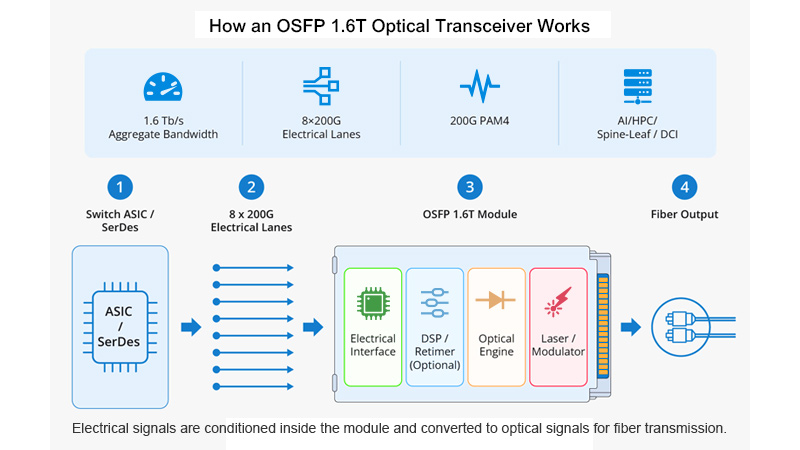
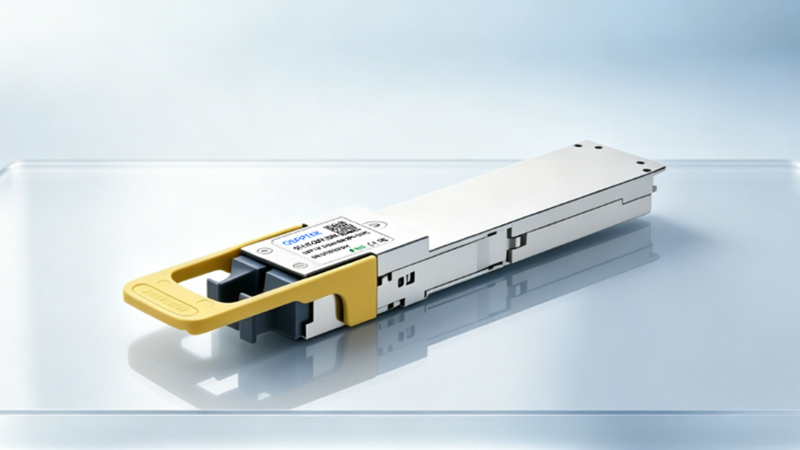
1.6T XDR OSFP DR8 (1310 nm single-mode silicon photonics solution)
The operating wavelength is 1310 nm, and it uses single-mode fiber transmission.
The typical transmission distance is up to 500 meters.
Features a dual MPO interface design
8-channel parallel architecture, with a data rate of approximately 200G per channel
Typical applications: backbone interconnections between next-generation AI switches and the deployment of fabric networks for hyperscale AI clusters.
800G NDR OSFP Series
SR8 (850 nm multimode): It uses OM3 and OM4 fiber to make short-distance, high-speed connections inside data centers.
FR8 (1310 nm single-mode): It can transmit over long distances, even several kilometers, so you can make long-distance connections across buildings and campuses.
400G NDR OSFP / QSFP56 Series
Offers proven architectures such as SR4, DR4, and FR4
Enables a smooth evolution and transition from HDR networks
Widely deployed on the server access side and in access-layer networks.
High-Speed Cable Matrices: DAC and AOC Interconnect Solutions
These cables are mostly used to connect GPU servers and switches in the same rack. Some of the more common types include passive copper cables (DAC), active optical cables (AOC), and splitter cables (1-to-2 or 1-to-4). These cables are popular for short-distance connections in AI clusters because they're affordable and have high-density cabling.
Passive DAC Direct-Attach Copper Cables (OSFP / QSFP56 Interfaces): These cables do not contain signal processing chips at either end and rely entirely on copper media for pure electrical signal transmission, offering the advantages of ultra-low power consumption and low cost. Common lengths are primarily 1 meter and 3 meters, and they are specifically designed for internal cabinet interconnects ranging from 1 to 3 meters. Product forms include standard straight-through cables, Y-type 1-to-2 splitters, and 1-to-4 splitters, which enable cost-effective, flexible expansion of multi-GPU nodes by splitting the bandwidth of a single port.
Active AOC Cables: These cables integrate optoelectronic conversion chips at both ends and use optical fiber for transmission in the middle, completely overcoming the physical transmission distance limitations of copper cables. Among them, the HDR 200G AOC supports transmission distances of up to 100 meters, while the NDR 400G AOC can cover distances of several tens of meters; they are primarily used for high-speed cross-rack interconnects between adjacent cabinets.
Breakout Cables: These support conversion specifications, such as OSFP to 2×QSFP56 or OSFP to 4×OSFP, allowing a single 800G port to be split into multiple 200G/400G downlinks. They're perfect for flexible networking in diverse AI clusters and can really cut down on idle and wasted switch ports.
Across Three Generations: The Evolution of Network Hardware
From HDR to NDR, and now to XDR, the technological leap involved goes far beyond simply doubling bandwidth figures. With each generation of evolution, underlying signal modulation, DSP architecture, optical packaging designs, and overall power consumption have all undergone a comprehensive overhaul.
The key differences among these three generations of hardware architectures are primarily reflected in these core metrics.
The Practical Value of 1.6T XDR Networks in AI Supercomputing Clusters
Significantly Boosts GPU Computing Power Utilization
Thanks to the ultra-low-latency architecture combining 1.6T RDMA and InfiniBand, communication latency between GPUs has been reduced to the microsecond range. In distributed large-model training, the effective computing power utilization of GPU clusters can jump directly from approximately 40% to 75%–80%, substantially shortening the training cycle for models with trillions of parameters. If existing 800G NDR clusters are upgraded and replaced with an XDR backbone network, the overall training efficiency of the entire cluster is expected to increase by more than 40%.
Optimizing Cabling and Data Center Infrastructure Costs
Reducing the Total Number of Switch Ports: With double the bandwidth per port, the number of ports required by a switch is reduced by 50% while supporting the same computing capacity, thereby significantly reducing rack space, power distribution loads, and cooling costs.
Extended Transmission Distance: The 1310nm single-mode DR/FR series modules support transmission distances ranging from 500 meters to 2 kilometers. This is better than the distance constraints imposed by 850nm multimode fiber in data center physical layouts. This makes it easier to divide up racks and add more capacity in intelligent computing centers.
Superior Full-Link Energy Efficiency: Integrating silicon photonics with a next-gen 3nm DSP solution cuts energy use per Gbps of bandwidth by about 25% compared to regular discrete parts. This makes electricity costs way lower for supercomputing clusters that use 10,000 cards and have a high load all year.
Compatible with Existing Network Assets
The XDR 1.6T protocol works with the NDR 800G and HDR 200G. You don't have to completely rebuild your 200G/400G clusters. Just replace the core switches and backbone optical modules to gradually transition to 1.6T. This'll really cut down on the costs of upgrades at the start.
Selection Recommendations for Common Scenarios
Different business scenarios have different interconnection requirements. When picking hardware, you usually think about things like how far the signal needs to go, how much cabling you need, how much you want to spend, and if you'll need to add more in the future.
Based on the actual needs of mainstream business environments, the recommended network hardware solutions for different scenarios are summarized as follows:
In Closing
Looking at the overall technological trends in the industry, the adoption of silicon photonics is continuing to accelerate. As network speeds surpass the 800G threshold, the value of silicon photonics in reducing power consumption and increasing integration becomes irreplaceable; at the same time, 1.6T networks are moving from forward-looking planning toward substantive commercial deployment and will become the mainstay for high-bandwidth AI training in the coming years. As for longer-term solutions such as Co-Packaged Optics (CPO), R&D enthusiasm remains high. Both now and in the foreseeable future, mature pluggable optical modules will be the absolute mainstream in the deployment sector.
This also means that 1.6T represents the clearest and most pragmatic key step in the current upgrade of AI infrastructure. However, to truly make the 1.6T architecture work, simply upgrading switch hardware is far from sufficient; it requires the coordinated efforts of an entire interconnect ecosystem encompassing optical modules, high-speed cables, and network architecture.
Leveraging a complete product portfolio covering 400G, 800G, and the emerging 1.6T—including silicon photonics-based transceiver modules, high-density DAC/AOC cable assemblies, and AI-focused network solutions— QSFPTEK is committed to helping users build a highly scalable and high-performance computing infrastructure, ensuring a more stable and seamless transition from the existing NDR architecture to the next-generation 1.6T AI Fabric.


share

